
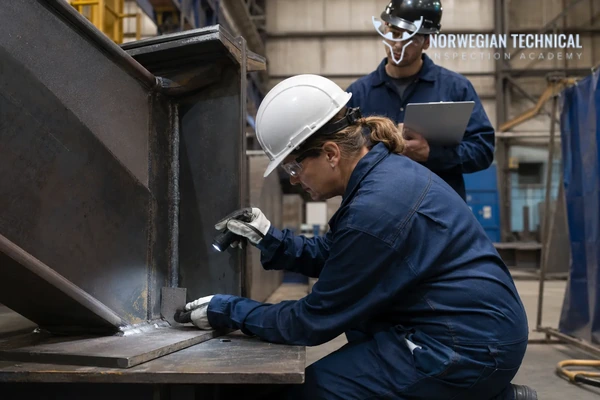
Visual welding inspection is one of the most important parts of weld quality control. It is often the first inspection activity performed on a weld, but it should not be treated as a simple final look at the finished bead.
A good visual welding inspection starts before welding begins, continues during welding and finishes after the weld is complete. Many weld defects, repair delays and NDT failures can be prevented when inspectors check fit-up, joint preparation, WPS availability, welder qualification, preheat, interpass cleaning, weld profile and surface condition at the right time.
For welding inspectors, QA/QC inspectors, vendor inspectors, NDT technicians and fabrication quality teams, visual inspection is not just about appearance. It is about confirming that the weld was prepared, performed and accepted according to approved drawings, WPS, ITP, project specification and acceptance criteria.
This checklist explains what inspectors should check before, during and after welding.
For the complete inspection workflow, including welding defects, NDT methods, WPS/PQR/WQT, report review and inspector duties, see the full welding and NDT inspection guide.
NTIA’s Welding and Non-Destructive Testing Training Course also covers visual inspection, welding defects, NDT methods, quality control and inspection documentation.
Visual welding inspection is the examination of welded joints using direct visual observation, measuring tools and inspection aids to verify weld preparation, welding quality and final weld condition.
It may include checking:
Visual inspection is often called VT, or Visual Testing, when used as an NDT method. In welding QA/QC work, visual inspection is also part of the wider inspection process before and during fabrication.
For a comparison between VT and other NDT methods, see VT, PT, MT, UT and RT in weld inspection.
One of the biggest mistakes in welding inspection is waiting until the weld is finished before checking quality.
By the time the weld is complete, some problems may already be hidden or difficult to verify. Poor fit-up, wrong root gap, missing preheat, incorrect consumables or poor interpass cleaning can all lead to defects that are more expensive to repair later.
Visual inspection should help inspectors answer three questions:
| Stage | Main Question |
| Before welding | Is the joint ready to be welded? |
| During welding | Is the welding being controlled correctly? |
| After welding | Is the finished weld visually acceptable? |
A strong inspection process prevents problems instead of only detecting them after they happen.
Before welding starts, the inspector should confirm that the work is technically ready.
Check:
This stage is critical because many welding defects begin before the arc is started.
For example, poor fit-up may contribute to lack of penetration, lack of fusion, distortion or excessive weld volume. Missing WPS or invalid welder qualification can create acceptance problems even if the final weld looks visually acceptable.
For documentation control before welding, see WPS, PQR and WQT explained.
During welding, the inspector verifies that the welding activity follows the approved WPS and project requirements.
Check:
During-welding inspection is especially important for critical welds, pressure-retaining welds, structural welds, repair welds and activities under hold or witness points.
The inspector should not interfere unnecessarily with production, but should confirm that essential welding variables and quality controls are respected.
After welding, the inspector checks the completed weld surface, geometry and identification.
Check:
A weld should normally be visually acceptable before PT, MT, UT or RT is performed. NDT should not be used to compensate for poor workmanship that is already visible.
For common surface and internal defect types, see welding defects explained for inspectors.
Visual inspection can help identify many surface and profile-related defects.
Common visual welding defects include:
| Defect | What the Inspector May See |
| Undercut | Groove beside the weld toe or root |
| Overlap | Weld metal rolled over base metal without proper fusion |
| Surface crack | Linear opening on the weld or heat-affected zone |
| Crater defect | Unfilled or cracked area at weld stop point |
| Arc strike | Accidental arc mark outside the weld area |
| Spatter | Metal particles attached near the weld |
| Excess reinforcement | Weld bead higher than allowed |
| Incomplete filling | Groove not filled to the required level |
| Misalignment | Joint parts not aligned correctly |
| Distortion | Deformation caused by welding heat |
Visual inspection cannot detect every internal defect. Internal porosity, slag inclusion, lack of fusion or lack of penetration may require additional NDT depending on the project requirement.
The tools required for visual inspection depend on the project specification and inspection scope.
Common tools include:
The tool is only useful if the inspector knows what requirement is being checked. Measurements should always be compared with the approved drawing, WPS, project specification or acceptance standard.
Visual inspection and NDT are closely connected, but they are not the same.
Visual inspection checks surface condition, profile, fit-up and visible workmanship. NDT methods provide additional evidence about surface-breaking, near-surface or internal discontinuities.
For example:
If additional testing is required, inspectors should verify that the NDT report is complete, traceable and aligned with the ITP. For report control, use the NDT report review checklist.
Inspectors should avoid these common mistakes:
Good visual inspection is disciplined, staged and traceable. It is not a quick look at the end of welding.
Use this checklist as a quick field reference.
A visual inspection record should be clear, complete and traceable.
It may include:
Incomplete records can create problems during final dossier review, even when the weld itself is acceptable.
For wider inspection planning and training resources, see NTIA’s technical inspection training courses.
Visual welding inspection is the examination of welded joints before, during and after welding to verify fit-up, procedure compliance, weld profile, surface defects, weld size and final acceptance.
Yes. Visual Testing, or VT, is one of the main NDT methods. However, visual welding inspection is also used more broadly as part of welding quality control before and during fabrication.
Before welding, inspectors should check material identification, joint preparation, fit-up, root gap, bevel angle, cleanliness, WPS availability, welder qualification, consumables, preheat requirements and inspection hold points.
After welding, inspectors should check weld size, profile, reinforcement, undercut, overlap, surface cracks, crater defects, arc strikes, spatter, distortion, weld ID and final visual inspection records.
No. Visual inspection can detect visible surface and profile defects, but it cannot detect hidden internal defects. UT, RT or other NDT methods may be required depending on the project specification.
Usually yes. A weld should normally be visually acceptable before additional NDT such as PT, MT, UT or RT is performed. NDT should not be used to compensate for visible poor workmanship.
Visual welding inspection is one of the most practical and important controls in welding QA/QC. It helps inspectors prevent problems before welding, monitor essential variables during welding and verify final weld condition after welding.
A strong visual inspection process checks fit-up, WPS, welder qualification, preheat, interpass cleaning, weld size, weld profile, surface defects, repair areas and final records. It also supports better NDT results because visually unacceptable welds can be corrected before further testing.
For inspectors, the goal is not only to look at the weld. The goal is to confirm that the weld was prepared, performed, inspected and documented according to approved project requirements.
For structured learning, NTIA’s Welding and Non-Destructive Testing Training Course covers visual inspection, weld defects, NDT methods, inspection documentation and QA/QC control. You can also check upcoming dates in the NTIA training calendar.

At NTIA (Norwegian Technical Inspection Academy), we specialize in delivering world-class training programs in vendor inspection, quality surveillance, and technical compliance – specifically tailored for professionals in the oil, gas, and energy industries.
Copyright © 2025 by NTIA. All Rights Reserved.



One Response
It’s extremely wonderful to go through the above pages.
Thank you