
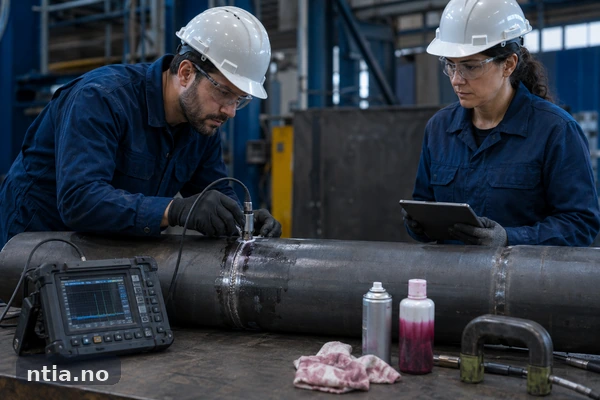
Welding and NDT inspection is the quality control process used to verify weld quality, welding documentation, visual condition, nondestructive testing results, repair status and final acceptance before welded components are released for use, delivery or operation.
In industrial projects, welds are critical to the integrity of pressure vessels, piping systems, structural steel, tanks, skids, valves, rotating equipment packages and many other fabricated items. A weld may look acceptable from a distance, but hidden defects, poor procedure control, incomplete documentation or incorrect NDT coverage can create serious safety and compliance risks.
For QA/QC inspectors, welding inspectors, NDT technicians, vendor inspectors and project quality teams, welding and NDT inspection is not only about finding defects. It is about confirming that welding has been performed by qualified personnel, according to approved procedures, inspected at the right stages, tested with suitable NDT methods and documented against the correct acceptance criteria.
If you want structured training on this subject, NTIA provides a Welding and NDT Inspection Training Course covering welding processes, inspection principles, NDT methods, quality control, codes, documentation and safety requirements.
Welding inspection is the verification of welded joints before, during and after welding to confirm that the welds meet approved procedures, drawings, specifications and acceptance criteria.
Welding inspection may include checking:
A welding inspector does not only inspect the finished weld. Many important inspection points happen before and during welding. If these stages are missed, some quality problems may become difficult or impossible to verify later.
NDT stands for Nondestructive Testing. NDT inspection uses testing methods that evaluate welds, materials or components without damaging the item being inspected.
Common NDT methods used in weld inspection include:
NDT helps detect surface and internal discontinuities such as cracks, porosity, lack of fusion, lack of penetration, inclusions and other weld imperfections.
The purpose of NDT is not simply to “test the weld.” The purpose is to provide objective evidence that the weld meets the required acceptance criteria.
Welding inspection and NDT inspection are closely related, but they are not the same.
| Area | Welding Inspection | NDT Inspection |
| Main focus | Welding process, fit-up, visual quality, procedure compliance | Detection of surface or internal discontinuities |
| Typical timing | Before, during and after welding | Usually after welding, sometimes during fabrication stages |
| Main documents | WPS, PQR, WQT, weld map, visual report | NDT procedure, NDT report, technician qualification, calibration records |
| Common checks | Joint preparation, welder ID, consumables, weld profile | VT, PT, MT, UT, RT results and acceptance status |
| Main question | Was the weld produced correctly? | Does the weld contain unacceptable discontinuities? |
A strong inspection process uses both. Welding inspection controls how the weld is made. NDT provides additional evidence about the weld condition.
Welded joints often carry pressure, load, temperature, vibration or structural stress. A defective weld can become a failure point.
Poor welding or incomplete inspection can lead to:
Many welding problems are easier to prevent than repair. A wrong joint fit-up, missing WPS, unqualified welder or uncontrolled preheat may create defects that are expensive to fix later.
Good welding and NDT inspection helps confirm that welds are made correctly, tested properly and accepted with complete documentation.
In live industrial projects, companies may also use independent third-party welding inspection services to verify weld compliance, procedure control, NDT coordination and documentation before final acceptance.
Welding and NDT inspection is especially important for equipment such as pressure vessels, piping systems, fabricated skids and rotating equipment packages. For related inspection workflows, see also: pressure vessel inspection and rotating equipment inspection.
Welding inspection is usually divided into three stages:
Each stage has different inspection priorities.
Before welding starts, the inspector should confirm that the work is technically ready.
Typical checks include:
This stage is critical because many weld defects begin before the arc is started.
For example, poor fit-up can contribute to lack of penetration, distortion or excessive weld volume. Wrong consumables can cause metallurgical or mechanical property issues. Missing welder qualification can make the weld unacceptable from a documentation point of view, even if it looks visually acceptable.
During welding, the inspector verifies that welding is performed according to the approved WPS and project requirements.
Typical checks include:
During welding inspection is especially important for critical welds, pressure-retaining welds and work under hold or witness points.
The inspector should not interfere unnecessarily with production, but must verify that essential welding variables and quality controls are respected.
After welding, the inspector checks the completed weld and confirms whether further testing is required.
Typical checks include:
Visual inspection after welding is usually the first acceptance step before additional NDT methods are performed.
A weld should normally be visually acceptable before PT, MT, UT or RT is carried out. NDT should not be used to compensate for poor workmanship that is already visible.
Welding inspectors and NDT personnel should be able to recognize common weld defects and understand their likely causes.
| Defect | Description | Possible Cause |
| Crack | A linear fracture in or near the weld | High stress, poor procedure, hydrogen, rapid cooling |
| Porosity | Gas pockets or voids in the weld metal | Contamination, moisture, poor shielding gas |
| Lack of fusion | Weld metal does not fuse properly with base metal or previous pass | Low heat input, poor technique, poor cleaning |
| Lack of penetration | Weld does not fully penetrate the joint root | Poor fit-up, low heat input, incorrect joint design |
| Undercut | Groove melted into base metal beside weld toe | Excessive current, poor technique, travel speed |
| Slag inclusion | Non-metallic material trapped in the weld | Poor cleaning between passes, improper technique |
| Overlap | Weld metal flows over base metal without fusion | Low travel speed, poor electrode angle |
| Excess reinforcement | Weld metal higher than specified | Over-welding, poor control of deposit |
| Burn-through | Excessive penetration causing hole or collapse | Excessive heat input, thin material |
| Distortion | Deformation after welding | Heat input, restraint, welding sequence |
Not every discontinuity is automatically rejectable. Acceptance depends on the applicable code, standard, project specification and acceptance criteria.
Different NDT methods detect different types of discontinuities. Selecting the right method depends on material type, weld geometry, defect type, thickness, access and project requirements.
| Method | Full Name | Common Use in Weld Inspection | Key Limitation |
| VT | Visual Testing | Surface condition, weld profile, visible defects | Only detects visible surface issues |
| PT | Penetrant Testing | Surface-breaking defects on non-porous materials | Surface must be clean and accessible |
| MT | Magnetic Particle Testing | Surface and near-surface defects in ferromagnetic materials | Only works on ferromagnetic materials |
| UT | Ultrasonic Testing | Internal defects, thickness, planar discontinuities | Requires skilled operator and suitable geometry |
| RT | Radiographic Testing | Volumetric defects inside welds | Safety controls, access and interpretation required |
No single NDT method is best for every situation. The selected method should match the material, weld type, expected defect, acceptance criteria and inspection plan.
Visual Testing is the most basic and widely used inspection method, but it should not be treated as unimportant.
VT can detect visible issues such as poor weld profile, undercut, overlap, surface cracks, spatter, arc strikes, crater defects, incomplete filling and surface porosity.
VT is often performed before other NDT methods. If a weld fails visual inspection, it may require repair before further testing.
Good VT requires adequate lighting, access, surface condition, measuring tools and knowledge of acceptance criteria.
Penetrant Testing is used to detect surface-breaking defects on non-porous materials.
It is commonly used for stainless steel welds, non-ferromagnetic materials, machined surfaces, weld toes, repair areas and surface crack detection.
PT can detect very fine surface-breaking defects, but it cannot detect internal defects below the surface.
Surface cleanliness is critical. Oil, paint, scale or contamination can prevent penetrant from entering defects and may lead to unreliable results.
Magnetic Particle Testing is used to detect surface and near-surface discontinuities in ferromagnetic materials.
It is commonly used for carbon steel welds, pressure-containing welds, structural welds, repair welds, critical weld toes and areas prone to cracking.
MT is useful for detecting cracks and linear indications, but it is limited to ferromagnetic materials.
The inspector should verify that the test method, magnetization technique, surface condition, equipment and acceptance criteria are suitable for the work.
Ultrasonic Testing uses sound waves to detect internal discontinuities and measure material thickness.
UT is commonly used for internal weld defects, lack of fusion, lack of penetration, laminations, thickness measurement, critical butt welds and thicker materials.
UT can be very powerful, but it depends heavily on technician skill, calibration, scanning technique, equipment setup and weld geometry.
For inspectors reviewing UT reports, it is important to check the procedure, calibration block, scanning coverage, acceptance criteria, indication evaluation and result summary.
Radiographic Testing uses X-rays or gamma rays to create an image of the internal condition of a weld.
RT is commonly used for volumetric weld inspection, porosity detection, slag inclusions, internal cavities and certain fabrication acceptance requirements.
RT provides a permanent image record, but it requires strict radiation safety controls and suitable access.
RT may be less effective for some planar defects depending on orientation. This is why method selection should always follow the applicable code, specification and inspection plan.
Welding inspection is closely connected to welding qualification documents.
| Document | Meaning | Why It Matters |
| WPS | Welding Procedure Specification | Defines how the weld must be made |
| PQR | Procedure Qualification Record | Provides evidence that the welding procedure was qualified |
| WQT / WPQ | Welder Qualification Test / Welder Performance Qualification | Confirms the welder is qualified for the required work |
The inspector should verify that the correct WPS is available, the PQR supports the WPS and the welder is qualified for the welding process, material group, thickness range, position and joint type.
A weld can look good but still be unacceptable if it was made without the required procedure or welder qualification.
This is one of the most important documentation principles in welding QA/QC.
An Inspection and Test Plan, or ITP, defines what must be inspected, when inspection is required, who must be involved and what records must be produced.
For welding and NDT work, an ITP may include:
Common inspection points include:
| Inspection Point | Meaning |
| Hold Point | Work cannot proceed until inspection or approval is completed |
| Witness Point | Client or inspector may attend the activity |
| Review Point | Documents or reports must be reviewed |
| Surveillance | General monitoring of work quality and process compliance |
For welding activities, hold points are often used before welding, before closing access, before pressure testing or before final release.
Reviewing NDT reports is a major part of welding and NDT inspection.
A proper NDT report should include:
The inspector should check that the report is complete, traceable and aligned with the ITP and project requirements.
A common mistake is checking only whether the report says “accepted.” A professional review also confirms that the correct weld was tested, the correct method was used, the required coverage was achieved and the report is technically traceable.
For project owners and quality teams, independent NDT audit and supervision services can help verify that NDT procedures, personnel qualifications, reporting and acceptance decisions are properly controlled.
A practical welding and NDT inspection checklist should cover the full inspection cycle.
| Stage | Typical Checks |
| Before welding | Material, fit-up, WPS, PQR, welder qualification, consumables, preheat |
| During welding | Welding parameters, interpass temperature, cleaning, pass sequence, surveillance |
| After welding | Visual inspection, weld profile, surface defects, weld ID, repair areas |
| NDT | Method, coverage, procedure, technician qualification, calibration, reports |
| Documentation | Weld map, NDT reports, repair records, retest reports, final dossier |
The checklist should always be used with the approved drawings, ITP, project specification and applicable acceptance standard.
Welding and NDT documentation problems are common during fabrication and vendor inspection.
Typical issues include:
These problems can delay release, shipment, pressure testing or final handover.
For inspectors, documentation review is not an administrative task. It is part of technical acceptance.
A welding and NDT final dossier may include:
Every record should be traceable to the correct item, weld number, material, welder and inspection activity.
Incomplete records can create acceptance issues even if the welds are physically acceptable.
A welding and NDT inspector needs both technical understanding and disciplined documentation control.
Important skills include:
The inspector does not need to perform every NDT method personally, unless qualified for that role. However, the inspector must understand enough to review NDT requirements, reports and acceptance status correctly.
Welding and NDT inspection training is useful for professionals who inspect, test, verify or manage welding quality in industrial projects.
This includes:
The training is especially relevant for teams working with welded components, pressure equipment, piping systems, structural fabrication, vendor-supplied equipment and industrial QA/QC documentation.
Professionals who move into welding and NDT inspection often come from welding, fabrication, mechanical inspection, QA/QC, NDT, piping, pressure vessel, structural steel or vendor inspection backgrounds.
A practical training path should cover:
NTIA’s Welding and NDT Inspection Training Course is designed for professionals who need structured knowledge of welding inspection, NDT methods, codes, quality control, documentation and safety requirements.
You can also check the upcoming Welding and NDT training dates in the NTIA training calendar.
Welding and NDT inspection is the quality control process used to verify weld quality, welding procedures, welder qualification, visual condition, nondestructive testing results, repair records and final acceptance documentation.
A welding inspector checks material identification, joint fit-up, WPS, PQR, welder qualification, consumables, preheat, weld profile, surface defects, NDT status, repair records and final welding documentation.
The main NDT methods used for weld inspection are Visual Testing, Penetrant Testing, Magnetic Particle Testing, Ultrasonic Testing and Radiographic Testing. Each method has different strengths and limitations.
VT checks visible surface condition. PT detects surface-breaking defects on non-porous materials. MT detects surface and near-surface defects in ferromagnetic materials. UT detects internal discontinuities using sound waves. RT detects internal volumetric defects using radiography.
Common welding defects include cracks, porosity, lack of fusion, lack of penetration, undercut, slag inclusion, overlap, excessive reinforcement, burn-through and distortion.
WPS defines how the weld must be made. PQR provides evidence that the procedure was qualified. WQT or WPQ confirms that the welder is qualified for the required welding work. These documents are essential for welding quality control.
An NDT report should include item identification, weld number, method, procedure reference, test coverage, equipment, calibration where applicable, technician qualification, acceptance criteria, indications, result status, repair requirements and signatures.
Pressure vessel inspection often depends on welding and NDT control because pressure-retaining welds must be properly qualified, inspected, tested and documented before the vessel can be accepted.
Welding and NDT inspection training is useful for QA/QC inspectors, welding inspectors, NDT technicians, mechanical inspectors, vendor inspectors, fabrication personnel and project quality teams working with welded components.
Welding and NDT inspection is a critical part of industrial QA/QC. Welded joints must be controlled before, during and after welding, and NDT must be selected, performed and reviewed according to approved requirements.
For inspectors, the key is to understand the welding process, verify qualifications, recognize common defects, review NDT reports properly and confirm that all records are complete before acceptance.
A strong welding and NDT inspection process helps reduce repair costs, prevent failures, support compliance and improve project handover.
For professionals who want to build practical competence in this field, NTIA’s Welding and NDT Inspection Training Course provides structured training in welding inspection, NDT methods, codes, quality control and documentation. Upcoming course dates are available in the NTIA Training Calendar.

At NTIA (Norwegian Technical Inspection Academy), we specialize in delivering world-class training programs in vendor inspection, quality surveillance, and technical compliance – specifically tailored for professionals in the oil, gas, and energy industries.
Copyright © 2025 by NTIA. All Rights Reserved.