
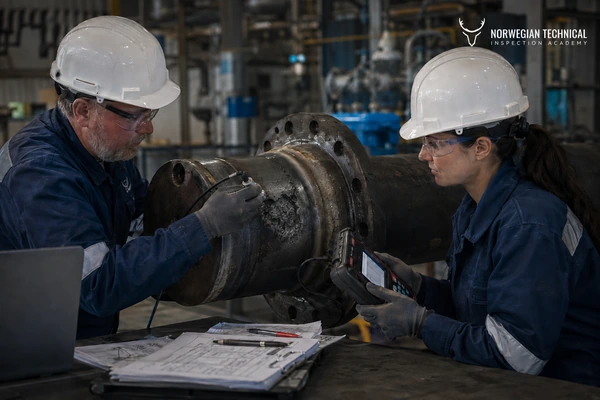
Inspection findings do not always lead to simple repair or replacement decisions. In many industrial facilities, the first question after finding corrosion, cracking, deformation or wall loss is more difficult:
Can this equipment continue operating safely, and under what conditions?
Fitness-for-Service, commonly called FFS, is an engineering assessment approach used to evaluate whether equipment with flaws, damage or degradation is still fit for continued operation. API 579-1 / ASME FFS-1 is one of the most widely used references for Fitness-for-Service assessment of in-service pressure equipment, piping, tanks and related industrial assets.
For asset owners, inspection teams, reliability engineers and maintenance managers, FFS is not only a technical calculation. It is a structured way to support defensible decisions: continue operation, repair, re-rate, replace or inspect further.
NTIA provides a Fitness-for-Service Training Course for technical teams that need to understand FFS principles, damage assessment, remaining life, inspection inputs and continued operation decisions.
Fitness-for-Service is a structured engineering assessment used to determine whether equipment with damage or degradation can continue operating safely for a defined period, under defined conditions.
It is commonly applied to in-service equipment such as:
The purpose of FFS is not simply to decide whether equipment is “good” or “bad.” The purpose is to evaluate the condition of the asset against its operating requirements and determine what action is technically justified.
In practice, an FFS assessment may help a team decide whether the asset can continue in service, whether it needs repair, whether operating limits should be reduced, or whether replacement is required.
This is why FFS is an important part of Asset Integrity Management. It connects inspection findings with continued operation decisions.
Industrial equipment is often designed and fabricated according to construction codes. But after years of operation, the asset may no longer match the original assumptions perfectly.
It may have:
Without FFS, teams may fall into one of two extremes.
They may replace or repair equipment too early, creating unnecessary cost and downtime. Or they may continue operating damaged equipment without enough technical basis, creating safety and reliability risk.
FFS helps avoid both problems. It provides a structured way to evaluate damage, define safe limits and document the basis for continued operation or corrective action.
For companies, this matters because asset integrity decisions need to be technically defensible, not based on habit, pressure or guesswork.
An FFS assessment is typically considered when inspection, testing or operating history shows that equipment has damage, degradation or conditions outside normal assumptions.
Common triggers include:
The practical point is simple: once damage is found, the team needs to know whether the asset is still acceptable for continued service. FFS provides the assessment structure for that decision.
API 579-1 / ASME FFS-1 is the main reference associated with Fitness-for-Service assessment. It is used to evaluate in-service equipment that contains flaws or damage, has aged, or cannot be evaluated only by the original construction code assumptions.
For inspection and integrity teams, the value of API 579 / ASME FFS-1 is that it provides a structured assessment basis.
It helps define how teams should evaluate different types of damage, what data is needed and how continued operation decisions should be supported.
However, a company should not treat FFS as a checklist that can be completed without engineering judgment. A reliable FFS assessment depends on:
In other words, API 579 / ASME FFS-1 gives the framework, but the quality of the decision depends on the quality of the data and the competence of the team using it.
Fitness-for-Service is closely related to inspection and Risk-Based Inspection, but it has a different purpose.
| Method | Main Question | Typical Output |
| Inspection | What is the current condition of the asset? | Inspection report, thickness readings, NDT findings |
| RBI | Where and when should we inspect based on risk? | Risk-ranked inspection plan and intervals |
| FFS | Can damaged equipment continue operating safely? | Run, repair, re-rate or replace decision |
Inspection identifies the condition.
Risk-Based Inspection helps prioritize inspection based on probability and consequence of failure.
FFS helps decide what to do after damage has been identified.
In a mature integrity program, these activities work together. RBI may define inspection priorities. Inspection may identify wall loss or cracking. FFS may then evaluate whether continued operation is acceptable. If repair is required, the result may feed into repair planning and future inspection intervals.
This is why FFS should not be treated as an isolated calculation. It is part of a larger asset integrity decision process.
Different types of damage require different assessment approaches. A simplified overview is shown below.
| Damage Type | Typical Concern | Why FFS May Be Needed |
| General metal loss | Overall wall thinning | To determine remaining strength and acceptable operating conditions |
| Local metal loss | Localized thinning or corrosion | To evaluate whether the local damaged area is acceptable |
| Pitting corrosion | Small localized pits | To determine whether pitting affects pressure integrity |
| Crack-like flaws | Cracks or sharp defects | To evaluate fracture risk and continued operation limits |
| Dents and gouges | Mechanical deformation or damage | To assess local stress concentration and severity |
| Weld misalignment | Fabrication or in-service alignment issue | To evaluate structural significance |
| Shell distortion | Deformation of vessel or shell | To assess whether geometry remains acceptable |
| Fire damage | Material exposure to high temperature | To evaluate metallurgical and strength concerns |
| Creep damage | High-temperature long-term degradation | To assess remaining life |
| Fatigue damage | Cyclic loading or vibration-related degradation | To evaluate crack initiation or growth risk |
This table is intentionally simplified. The actual assessment depends on equipment type, geometry, material, flaw size, operating conditions and the applicable assessment procedure.
Fitness-for-Service assessments are often discussed in levels. In general, lower-level assessments are more screening-oriented and conservative, while higher-level assessments require more detailed data, engineering review and sometimes advanced analysis.
| Level | General Character | Typical Use |
| Level 1 | Screening-oriented and conservative | Initial assessment with simpler inputs |
| Level 2 | More detailed engineering assessment | When Level 1 is not suitable or more precision is needed |
| Level 3 | Advanced assessment | Complex cases requiring detailed engineering review or advanced analysis |
For practical asset integrity teams, the key point is not to memorize level names. The important point is to understand that not every finding requires the same depth of analysis, and not every case can be handled with a simple screening method.
Teams need to know when a finding can be screened, when more detailed assessment is needed and when specialist engineering input is required.
An FFS assessment is only as reliable as the data behind it.
A practical FFS input package may include:
The assessment team also needs to understand the credibility of the data. A thickness reading from an uncertain location, an incomplete NDT report or unclear operating conditions can change the confidence level of the FFS result.
This is where welding and NDT inspection becomes important. FFS depends heavily on reliable inspection records, correct flaw sizing and traceable reports.
A useful FFS assessment should lead to a clear technical decision.
| Decision | Meaning |
| Run | The asset can continue operating under defined conditions |
| Repair | Corrective action is required before continued operation or before a defined limit |
| Re-rate | The asset may continue operating at modified pressure, temperature or service limits |
| Replace | The asset is not acceptable for continued service and should be replaced |
| Monitor | Continued operation may be allowed with additional inspection, monitoring or restrictions |
In real projects, the output should not be limited to “accepted” or “rejected.” A good FFS report should explain the basis for the decision, input data, assumptions, limitations, remaining life considerations and any required follow-up actions.
NWE describes Fitness-for-Service in a decision-oriented way, including run as-is, repair, re-rate or replace decisions, remaining life, safe operating limits and traceability back to inspection, design and operating data.
For companies, this is the real value of FFS: it turns inspection findings into a documented decision that inspection, maintenance, engineering and operations can act on.
FFS often becomes important before a repair decision is made.
If an inspection finds damage, the team may need to know:
For pressure equipment and piping, repair decisions may connect to ASME PCC-2 repair of pressure equipment, especially when teams need to understand welded repairs, mechanical repairs, composite repairs, bonded repairs and examination after repair.
FFS and repair planning should not be separated. If FFS shows that continued operation is acceptable only under certain limits, those limits must be communicated clearly. If repair is required, the repair method, inspection after repair and future monitoring requirements should be aligned with the integrity strategy.
Fitness-for-Service is commonly associated with pressure equipment, but its logic is broader than one equipment type.
In pressure vessels, FFS may be used after thickness loss, local corrosion, pitting, cracking, distortion or fire exposure. This makes it closely connected to pressure vessel inspection, where material traceability, welding records, NDT and hydrotest documentation may all affect the assessment basis.
In piping systems, FFS may help evaluate local wall loss, corrosion, dents, mechanical damage, vibration-related fatigue or operating changes.
In pipelines, FFS can support decisions about anomalies such as corrosion, dents, cracks or deformation, especially when inspection data needs to be converted into run, repair or replace decisions.
For project execution support beyond training, independent Fitness-for-Service assessments can help asset owners evaluate flaws and damage and make documented decisions about continued operation, repair, re-rating or replacement.
Many organizations understand the value of FFS but still struggle to use it effectively.
Common challenges include:
These challenges are often organizational as much as technical.
An FFS assessment may be technically strong, but if the result is not understood by inspection, maintenance, operations and management, the decision can still fail in practice.
This is why FFS training should not be limited to only one specialist engineer. The broader technical team should understand when FFS is needed, what data it requires, what the outputs mean and how FFS connects to inspection planning and repair strategy.
A practical FFS workflow should normally consider the following areas.
| Area | Typical Question |
| Damage identification | What type of damage or flaw has been found? |
| Damage sizing | Are the size, location and orientation of the damage clearly defined? |
| Equipment data | Are drawings, material data and design conditions available? |
| Operating conditions | What pressure, temperature and process conditions apply? |
| Inspection data | Are NDT reports and thickness readings reliable and traceable? |
| Damage mechanism | What caused the damage and is it still active? |
| Assessment level | Is a screening assessment enough, or is detailed analysis required? |
| Remaining life | Can continued operation be justified for a defined period? |
| Decision | Should the asset run, be repaired, be re-rated, be monitored or be replaced? |
| Follow-up | Are operating limits, repair actions and future inspections clearly defined? |
| Documentation | Are assumptions, inputs, limitations and conclusions recorded? |
| Team alignment | Do inspection, maintenance, engineering and operations understand the decision? |
This checklist is not a replacement for API 579 / ASME FFS-1 or company procedures. It is a practical way to understand whether the FFS decision process is complete enough to support a defensible integrity decision.
Fitness-for-Service decisions often involve several functions. Inspection identifies the finding. NDT may size the flaw. Engineering evaluates acceptability. Maintenance may plan repair. Operations needs to know whether the asset can continue running. Management may need to approve downtime, repair cost or operating restrictions.
If these teams do not understand the FFS process, decisions can become slow, inconsistent or poorly documented.
FFS training is useful for:
For companies, the goal of FFS training is not to turn every participant into a specialist FFS analyst. The goal is to help technical teams understand when FFS is needed, what information is required, what the output means and how the decision affects operation, repair and future inspection planning.
Fitness-for-Service is an engineering assessment approach used to determine whether equipment with flaws, damage or degradation can continue operating safely under defined conditions.
API 579-1 / ASME FFS-1 is a widely used reference for evaluating in-service equipment with flaws, damage or aging-related issues and determining whether it is fit for continued operation.
An FFS assessment may be required when inspection identifies corrosion, local metal loss, pitting, cracking, dents, gouges, deformation, fire damage, creep damage, fatigue or other conditions that may affect continued operation.
RBI helps prioritize where and when to inspect based on risk. FFS helps determine whether damaged equipment can continue operating safely after a flaw or degradation has been found.
An FFS assessment may support a decision to continue operation, repair, re-rate, monitor or replace the asset. The decision should include assumptions, limitations and follow-up actions.
FFS may require drawings, design data, material specifications, NDT reports, flaw dimensions, thickness readings, operating pressure, operating temperature, process conditions, corrosion rates, inspection history and repair history.
No. FFS is commonly used for pressure vessels, piping, tanks, pipelines and other industrial equipment where damage or degradation may affect continued operation.
FFS training is useful for asset integrity engineers, inspection engineers, mechanical engineers, pressure equipment engineers, reliability teams, maintenance managers, NDT coordinators, pipeline integrity teams and technical training managers.
Yes. FFS is often best delivered as in-house training when a company needs inspection, maintenance, reliability, engineering and operations teams to understand the same decision process for damaged equipment.
Fitness-for-Service is a critical part of Asset Integrity Management because it helps teams make structured decisions after damage has been found.
Inspection may identify wall loss, corrosion, cracking, deformation or another flaw, but the inspection report alone may not answer whether the asset can continue operating safely. FFS helps close that gap by connecting inspection data, damage assessment, operating conditions and engineering judgment.
For industrial companies, the value of FFS is not only in the calculation. The real value is a defensible decision: run, repair, re-rate, monitor or replace.
NTIA provides a Fitness-for-Service Training Course for companies and technical teams that need practical knowledge of API 579 / ASME FFS-1, damage assessment, remaining life and continued operation decisions. For tailored or in-house training, you can request a quotation or contact NTIA to discuss your training needs.

At NTIA (Norwegian Technical Inspection Academy), we specialize in delivering world-class training programs in vendor inspection, quality surveillance, and technical compliance – specifically tailored for professionals in the oil, gas, and energy industries.
Copyright © 2025 by NTIA. All Rights Reserved.