When pressure equipment or piping is damaged, the question is rarely just “Can we repair it?”
The better question is:
Can the repair be selected, inspected, tested and documented in a way that supports safe continued operation?
That is where ASME PCC-2 becomes important.
ASME PCC-2, formally known as Repair of Pressure Equipment and Piping, provides recognized methods for repairing pressure equipment, piping, pipelines and related equipment after they have been placed in service. ASME describes the standard as covering repair methods associated with design, fabrication, examination and testing practices.
For inspection teams, maintenance teams, reliability engineers and asset integrity teams, ASME PCC-2 is not just a standard name. It is a practical reference for making better repair decisions.
ASME PCC-2 helps technical teams understand how to approach repairs on pressure equipment and piping after damage, degradation or defects are found.
It is especially relevant for:
For teams that need structured learning around repair decisions, NTIA’s Repair Pressurized Equipment Training helps connect repair standards with practical inspection, maintenance and asset integrity work.
ASME PCC-2 is a post-construction repair standard. That means it is used after equipment has already been built, installed and placed in service.
It helps teams answer questions such as:
This matters because repairs on pressure-retaining equipment can affect safety, reliability and future integrity.
A repair is not only a maintenance activity. It can change the condition of the equipment, the inspection strategy and the risk profile.
Industrial equipment may need repair because of:
When this happens, teams are often under pressure to return equipment to operation quickly.
But a fast repair is not always a good repair.
A technically controlled repair should consider:
This is why ASME PCC-2 training is useful for teams that must understand the logic behind repair decisions, not just the repair method itself.
ASME PCC-2 is commonly associated with several broad repair categories, including welded repairs, mechanical repairs, and non-metallic or bonded repairs. ASME’s own training description also highlights these repair categories as key areas of PCC-2 learning.
Welded repairs may be used when damaged metal needs to be restored, reinforced or replaced.
Examples can include:
Welded repair requires careful control because it may involve heat input, residual stress, weld quality, material compatibility and post-repair examination.
Teams should understand:
A welded repair on pressure equipment should never be treated as ordinary fabrication work.
Mechanical repairs may include clamps, bolted enclosures, leak sealing devices or other non-welded repair solutions.
They can be useful when welding is not practical, when shutdown time is limited or when operational constraints make other repair methods difficult.
However, mechanical repairs still need technical review.
Teams should check:
A mechanical repair may be quick to install, but it still needs a clear technical basis.
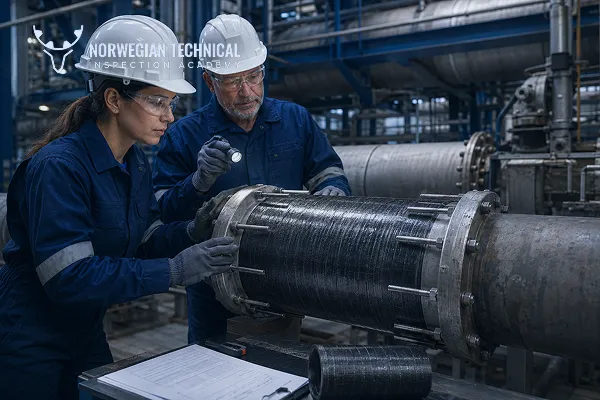
Composite repairs and other non-metallic repair systems may be used in certain pressure equipment or piping repair situations.
These repairs depend heavily on:
Composite repair is not simply “wrapping the pipe.” It is a controlled repair method with limits and conditions.
This is an area where training is especially important, because poor installation or weak understanding of limitations can reduce the reliability of the repair.
One of the most important repair decisions is whether the repair is temporary or permanent.
A temporary repair may be acceptable as a risk-control measure until a shutdown, replacement or permanent repair can be completed.
But temporary repairs must be controlled.
They should have:
Many integrity problems happen when temporary repairs become permanent by neglect.
A permanent repair needs a stronger technical basis, complete documentation and suitability for long-term operation.
ASME PCC-2 often works together with other asset integrity methods.
Risk-Based Inspection / RBI helps teams prioritize inspection based on risk. If you need a deeper foundation, the Risk-Based Inspection / RBI Guide explains how risk-based thinking supports inspection planning.
Fitness-for-Service / FFS helps teams assess whether damaged equipment can continue operating safely under defined conditions. The Fitness-for-Service / FFS Guide gives more context on that decision process.
ASME PCC-2 then supports the repair side of the decision: how the repair should be selected, controlled, inspected and documented.
For a wider view of how these methods connect, the article RBI vs FFS vs PIMS explains how different integrity methods support different decisions.
Before selecting a repair method, technical teams should ask:
The repair method is only one part of the decision. The technical basis behind the repair is just as important.
Repairing pressure equipment or piping is not the same as replacing a non-critical part.
The repair may affect pressure containment, future inspection and long-term reliability.
A repair may fail again if the original damage mechanism is not understood.
For example, repairing corrosion damage without addressing corrosion control may only delay the next problem.
Temporary repairs can be useful, but they must be tracked. If there is no review date, monitoring plan or permanent repair strategy, they become unmanaged risk.
Repair records should show what was repaired, why it was repaired, what method was used, what inspections were performed and who approved the decision.
Without documentation, future integrity decisions become harder to defend.
Inspection, maintenance, reliability and operations may all be involved in repair decisions. If they do not understand the same repair logic, decisions can become inconsistent.
Reading a standard is not the same as knowing how to apply it.
ASME PCC-2 training helps teams understand:
For organizations that want to strengthen repair decision-making, NTIA’s Repair Pressurized Equipment Training supports technical teams involved in inspection, maintenance and asset integrity.
ASME PCC-2 is useful for:
Not every role needs the same level of calculation or engineering responsibility. But each role should understand how repair decisions are selected, reviewed, inspected and documented.
ASME PCC-2 helps teams move from quick fixes to controlled repair decisions.
For asset integrity teams, its value is not only in listing repair methods. The real value is in helping inspection, maintenance, reliability and engineering teams work from the same technical basis.
When teams understand ASME PCC-2, they can make better decisions about repair selection, inspection requirements, testing, documentation and long-term equipment integrity.
If your team needs stronger capability in pressure equipment and piping repair, explore NTIA’s Repair Pressurized Equipment Training or contact NTIA to discuss a dedicated training option.
ASME PCC-2 is a repair standard for pressure equipment and piping after they have been placed in service. It provides methods and guidance for repair selection, examination, testing and documentation.
No. ASME PCC-2 applies to pressure equipment, piping, pipelines and related equipment within its defined scope.
It is commonly associated with welded repairs, mechanical repairs, non-metallic repairs and bonded repair methods, depending on the equipment condition and repair need.
Fitness-for-Service helps evaluate whether damaged equipment can continue operating safely. ASME PCC-2 helps guide repair method selection and repair control when repair is required.
ASME PCC-2 training is useful for inspection, maintenance, reliability, piping, pressure equipment and asset integrity teams involved in repair decisions, repair review or repair documentation.

At NTIA (Norwegian Technical Inspection Academy), we specialize in delivering world-class training programs in vendor inspection, quality surveillance, and technical compliance – specifically tailored for professionals in the oil, gas, and energy industries.
Copyright © 2025 by NTIA. All Rights Reserved.