
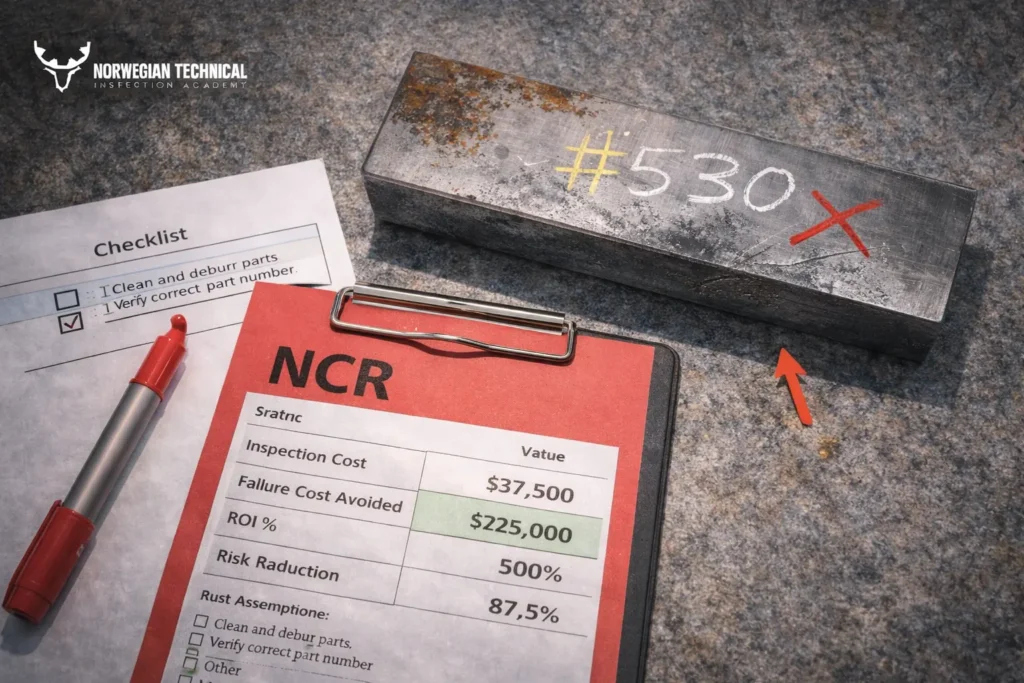
Top 20 Receiving NCRs (and Quick Fixes) for Raw Materials
If your receiving inspection is weak, your whole project inherits its problems.
Wrong plate grade, rusty forgings, mismatched heat numbers, missing MTCs – all of them usually show up at receiving, or not at all. Incoming inspection is the first line of defence against shipping damage, wrong material and documentation gaps before items enter production or the site.
This guide is a practical list of the 20 most common receiving NCRs for raw materials – plus quick fixes you can apply at the gate:
- What typically goes wrong at incoming inspection
- Ready-made NCR titles you can reuse
- Likely root causes
- Simple, realistic corrective & preventive actions
You can treat it as a field companion to NTIA content like “Templates for QA/QC & Inspection Teams”, “Heat Numbers, Traceability & Certificate Matching”, and “Receiving Photo & Documentation SOP for Incoming Goods”.
1. What Is a Receiving NCR (and Why It Matters)?
A receiving NCR is a nonconformance raised during incoming inspection when delivered material does not meet purchase order, drawing, standard or certificate requirements. It formally records the issue so that the batch is:
- Identified and segregated
- Investigated for root cause
- Dispositioned (use-as-is, rework, return, scrap, replace)
Done well, receiving NCRs:
- Stop wrong or damaged material before it contaminates stock or reaches fabrication
- Provide data for supplier scorecards and improvement
- Protect projects from late surprises and claims
NTIA’s “Vendor Inspection Reporting: IR/NCR/Final Dossier” shows how these NCRs feed into the final quality story of your project.
2. How This List Is Structured
We grouped the top 20 receiving NCRs into five themes:
- Material ID, certificates and traceability
- Dimensional and fit-up issues
- Visual condition, damage and corrosion
- Documentation, marking and packaging
- Test results and measuring equipment
For each NCR you get:
- Typical NCR title (how to name it)
- Symptom at receiving (what you see)
- Quick fix (what to do now + how to reduce recurrence)
Use this list together with “Visual & Dimensional Inspection: Step-by-Step” to build your own incoming inspection checklists.
3. Material ID, Certificates and Traceability NCRs
Wrong or unclear material at receiving is one of the most serious triggers for NCRs in fabrication and supply chains.
NCR 1 – Wrong Material Grade vs PO
Symptom: Grade/standard on MTC or marking does not match PO, datasheet or drawing.
Quick fix:
- Quarantine the batch; do not book into stock.
- Confirm with supplier whether it is a picking error or manufacturing error.
- Use PMI or hardness checks if needed to verify actual grade.
- Request replacement or formal deviation; update supplier performance data.
NCR 2 – Missing or Incorrect MTC / EN 10204 Type
Symptom:
- No MTC delivered, or
- Certification does not meet required EN 10204 type (e.g. 3.1 instead of 3.2) or lacks required signatures/identification.
Quick fix:
- Hold material in quarantine; request correct MTC.
- Ensure PO clearly states required certificate type.
- Link this NCR to “EN 10204 3.1 vs 3.2: Differences Explained” for training your own team and suppliers.
NCR 3 – Heat Numbers Do Not Match MTC
Symptom: Heat numbers on plates/bars/forgings do not correspond to the heat numbers listed on the MTC, or some items are unmarked.
Quick fix:
- Treat as a traceability break; segregate items with mismatched or missing heat numbers.
- Request corrected markings or replacement and updated MTC.
- Use “Heat Numbers, Traceability & Certificate Matching” to define standard responses.
NCR 4 – PMI Mismatch
Symptom: Positive Material Identification results do not match the specified grade or MTC description.
Quick fix:
- Stop further receipt from that heat/lot.
- Perform additional PMI sampling to confirm scope of the issue.
- Raise NCR with clear mapping of affected items; agree with supplier on rework/replace/return.
- Feed data into supplier qualification and audit process.
This NCR links directly with “PMI Testing: What, When & How to Document”.
NCR 5 – Mixed Batches in One Delivery
Symptom: Same bundle or pallet contains items from multiple heats or even different grades, without clear segregation.
Quick fix:
- Stop put-away until batches are separated and re-identified.
- Require supplier to clearly segregate and label heats in future shipments.
- Update purchasing terms to forbid mixed heats unless pre-approved.
4. Dimensional and Fit-Up NCRs
Dimensional issues are another classic source of receiving nonconformances, as described in many incoming inspection checklists.
NCR 6 – Out-of-Tolerance Dimensions
Symptom: Thickness, width, OD, length or straightness outside specified tolerances.
Quick fix:
- Record actual measurements and compare with specification.
- Assess whether rework (machining, trimming) is economical; otherwise reject and replace.
- Use “Receiving Inspection Sampling Plans (AQL)” logic to decide if the entire batch is suspect.
NCR 7 – Wrong End Preparation / Bevel / Thread
Symptom: Ends prepared with wrong bevel angle, root face, thread type or end connection.
Quick fix:
- Quarantine affected items; do not allow them to join production.
- Check manufacturing drawing and PO to confirm specification.
- Decide with engineering if local rework is permissible; otherwise return to the supplier.
NCR 8 – Flange Facing or Gasket Surface Out of Spec
Symptom: Flange serration, flatness or surface finish does not meet drawing or standard; raised-face height wrong.
Quick fix:
- Measure surface finish and flatness vs specification.
- If minor, consider controlled re-machining with documented repair.
- Otherwise reject; make this a learning case for more explicit drawings and ITPs.
5. Visual Condition, Damage and Corrosion NCRs
Many receiving NCRs come from simple visual checks: damaged packaging, rust, dents, contamination.
NCR 9 – Rust and Corrosion Beyond Acceptable Level
Symptom: General rust, pitting or staining beyond what the specification allows; may affect machined surfaces or bevels.
Quick fix:
- Define acceptance criteria for corrosion in your incoming inspection procedure.
- For light, removable rust, allow controlled cleaning with an agreed method.
- For heavy or pitting corrosion, reject and request replacement; update storage and packaging requirements.
NCR 10 – Mechanical Damage from Transport
Symptom: Dents, bent corners, gouges, deformation on plates, bars, flanges or fittings; often linked to poor packaging.
Quick fix:
- Photograph damage before moving the load; note it on delivery documents.
- Quarantine affected items and assess structural impact with engineering.
- Work with logistics and suppliers to upgrade packaging and handling instructions.
NCR 11 – Coating / Painting Defects
Symptom: Peeling, blistering, low dry-film thickness (DFT), runs, overspray or wrong colour code on coated items.
Quick fix:
- Measure DFT where applicable; compare to spec.
- Decide on re-coating in-house vs supplier repair vs rejection.
- Clarify coating specifications in PO and ITP to avoid ambiguity.
NCR 12 – Contamination or Protection Failure
Symptom: End caps missing, internal bores dirty or full of moisture, surfaces covered in oil, grease or debris.
Quick fix:
- Require basic protective measures (caps, plugs, desiccant bags) in purchase documents.
- Quarantine and clean items where possible; reject where contamination risks service performance.
- Capture photos for supplier feedback.
6. Documentation, Marking and Packaging NCRs
Even when material is physically acceptable, documentation and identification problems can trigger receiving NCRs and downstream risk.
NCR 13 – Incomplete or Incorrect Certificate of Conformance (CoC)
Symptom: CoC missing mandatory data (PO, part number, spec, quantity), or refers to wrong order or revision.
Quick fix:
- Request corrected CoC and do not accept material into stock until received.
- Standardise CoC requirements in your supplier quality manual.
NCR 14 – Missing or Incorrect Marking on Material
Symptom: Lack of marking for grade, size, schedule, pressure class, heat number, or wrong markings.
Quick fix:
- Require permanent, legible marking as part of PO.
- If physically possible and traceability is intact, mark items at your facility with documented procedure.
- For critical items, treat missing marking as a rejectable condition.
For a practical marking system, see “Color Coding and Marking for Metals: Quick Reference for Receiving and Inspection”.
NCR 15 – Mislabelled or Mixed Pallets
Symptom: Labels show wrong part numbers, quantities or PO references; boxes or pallets contain mixed items not reflected in documents.
Quick fix:
- Stop the receiving process until items are correctly sorted and labelled.
- Engage suppliers to improve their internal picking/packing verification.
- Use barcoded/QR-coded labelling where possible to reduce human error.
NCR 16 – Quantity Mismatch vs Packing List
Symptom: Counted quantity does not match packing list or PO (shortage or over-supply).
Quick fix:
- Document discrepancy on delivery note; adjust GRN (goods receipt note) accordingly.
- Clarify responsibility: transport vs supplier.
- For chronic issues, escalate through supplier scorecards and performance meetings.
NCR 17 – Inadequate Packaging for Transport and Storage
Symptom: Broken pallets, torn shrink-wrap, missing supports, unprotected edges or bores.
Quick fix:
- Define minimum packaging standards in PO and supplier handbook.
- Reject or repackage material if packaging damage compromises quality or safety.
- Share photos and lessons learned with suppliers and logistics partners.
7. Test Results and Measuring Equipment NCRs
Some receiving NCRs arise when incoming checks or documentation reveal problems with test results or measurement systems.
NCR 18 – Hardness Out of Specification
Symptom: Receiving hardness tests show values outside specified range, inconsistent with MTC or heat treatment condition.
Quick fix:
- Re-test using a verified method (Brinell/Rockwell/Vickers).
- If confirmed, treat as significant nonconformance: quarantine batch, inform engineering and supplier.
- Investigate heat treatment process and update supplier qualification status if needed.
This NCR ties directly to “Hardness Testing Basics: Brinell, Rockwell & Vickers”.
NCR 19 – Non-Compliant Test Reports
Symptom: Test reports (e.g. impact, tensile, NDE) are incomplete, missing key data or not performed according to the specified standard.
Quick fix:
- Request corrected or additional test reports following the correct standard and location.
- Clarify in PO which tests are mandatory and how they should be documented.
- Consider this as a systemic issue in supplier QA if repeated.
NCR 20 – Unverified Calibration of Measuring Equipment (Supplier Side)
Symptom: Calibration certificates for critical measuring equipment (e.g. micrometers, hardness testers, gauges) are missing, expired or unclear.
Quick fix:
- Treat supplier measurement data as suspect until calibration status is confirmed.
- Request up-to-date calibration certificates and check how often they are maintained.
- Include calibration control in supplier audits and qualification criteria.
NTIA’s Raw Material Inspection Training explains how to integrate such checks into your supplier approval process.
8. Turning Receiving NCRs into Better Systems (Not Just More Paper)
If receiving NCRs only live in a folder, they will not change anything.
To make them useful:
- Standardise how you log receiving NCRs
Use consistent titles and categories (material ID, documentation, dimensions, surface, packaging, tests). - Connect each NCR to a root cause and a “quick fix plus prevention”
Not just “return to vendor”, but: what will stop this happening again? - Feed NCR data into vendor scorecards and audits
So suppliers see a clear link between their performance and future business. (See “SQS KPIs That Matter (Vendor Scorecards)”.) - Tie NCRs to your ITP and incoming inspection plans
If a certain defect is repeating, upgrade checks or sampling plans in that area.
NTIA’s “Inspection Evidence and Recordkeeping: What Auditors Expect” shows how well-structured NCRs and receiving records become assets in audits, not liabilities.
9. FAQ – Receiving NCRs for Raw Materials
Q1. When should I raise an NCR at receiving?
Whenever delivered material does not meet specified requirements in the PO, drawing, standard or certificate – including wrong grade, missing or incorrect documentation, significant dimensional issues, corrosion or damage, and serious packaging or labelling errors.
Q2. What is the difference between a minor issue and an NCR?
Minor issues that can be fixed without risk (for example, replacing a missing label with full traceability intact) may be logged as observations, depending on your system. Issues that affect fit, function, safety, traceability or compliance, or that repeat frequently, should be captured as NCRs.
Q3. How many receiving NCRs are “acceptable”?
There is no universal number. A high NCR rate can indicate weak suppliers – but zero NCRs may also indicate that issues are not being detected or recorded. The key is to track trends by supplier and category and use them for improvement.
Q4. Should we always return nonconforming material to the supplier?
Not necessarily. Depending on the issue, you may decide to rework, downgrade, use under concession or scrap. The decision should balance safety, compliance, cost and schedule. However, the supplier should always be informed and involved in corrective action when the issue is under their control.
Q5. How do AQL sampling plans relate to receiving NCRs?
AQL (Acceptable Quality Level) sampling plans define how many items you inspect from a lot and when to accept or reject the lot based on the number of nonconformities found. They directly influence how likely you are to detect issues at receiving and how often lots are accepted or rejected.
10. If You Control Receiving NCRs, You Control What Enters Your Project
Think of receiving NCRs as the front gate logic of your entire project:
- Everything that passes through them can touch fabrication, welding, assembly and, eventually, operation.
- Everything they block or detect early saves time, money and risk downstream.
If you:
- Are responsible for incoming inspection of plates, pipes, forgings and fittings
- Spend time chasing missing MTCs, mismatched heat numbers and damaged deliveries
- Are tired of seeing the same receiving issues repeat from the same suppliers
…then you are already living inside this list of 20 NCRs.
NTIA’s Raw Material Inspection training is built around exactly this reality. It connects:
- Practical incoming inspection (checklists, forms, sampling)
- Material verification and PMI
- Traceability, MTC interpretation and NCR handling
- Supplier qualification and improvement
So the next time a truck arrives at your gate, you are not just “counting and stamping”. You know precisely which NCRs to watch for, how to fix them fast – and how to turn each one into a step towards a cleaner, safer and more reliable supply chain.