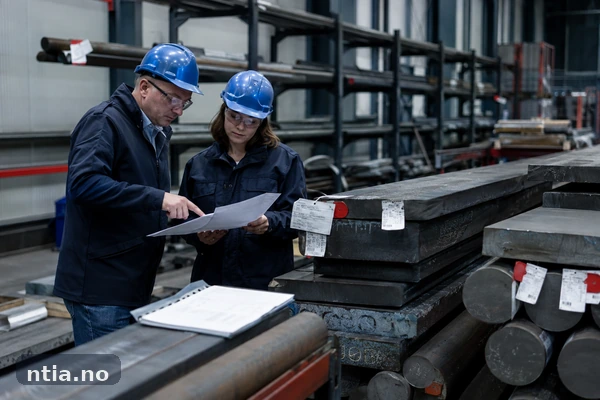
When raw materials go wrong, everything downstream pays the price: fabrication, testing, installation, even safety and reputation.
Choosing suppliers “because they are cheap” or “because we used them before” is not enough.
You need a structured qualification process that proves your raw material suppliers can deliver consistent quality, compliance and reliability.
This article gives you a practical, inspector-friendly view of:
- What supplier qualification for raw materials really is
- Which criteria matter (beyond price)
- How to plan and execute supplier qualification audits
- How to connect it all to incoming inspection and traceability
It is written for:
- QA/QC engineers and supplier quality (SQS / SQM) roles
- Raw material and welding engineers
- Vendor inspectors who participate in supplier audits
- Anyone who has to sign off: “This supplier is approved”
NTIA is used here as the reference frame: the examples align with how NTIA structures raw material inspection and supplier qualification in its training.
1. What Does “Supplier Qualification for Raw Materials” Actually Mean?
Supplier qualification is more than “adding a supplier to the ERP”.
For raw materials, supplier qualification means:
- Evaluating a potential (or existing) supplier’s ability to deliver materials that consistently meet your technical, quality, regulatory and delivery requirements
- Using a risk-based process: higher-risk materials and suppliers → deeper qualification
- Documenting the result in a way that is defensible to customers, auditors and regulators
It is not the same as:
- Routine supplier evaluation (scorecards, monthly OTD, etc.)
- A one-off audit done because “we had to fill a checklist”
Instead, qualification is the front door:
- “Who is allowed to supply our plates, forgings, castings, pipes, coatings, seals, chemicals…?”
- “Under what conditions?”
- “With which controls and requalification intervals?”
For raw materials used in pressure equipment, rotating equipment, safety-critical parts, coatings and welds, getting this front door wrong can damage safety, reliability and project profitability.
2. Start With Risk: Classify Your Raw Materials and Suppliers
Before you design the qualification process, you need to know which suppliers deserve the most attention.
2.1 Classify Raw Materials by Criticality
A simple three-level model works well:
- Category A – Critical materials
- Pressure-boundary materials (plates, pipes, forgings, castings)
- Welding consumables for critical joints
- Elastomers and seals in safety-related systems
- Coatings with strict environmental or safety requirements
- Category B – Important materials
- Structural steel, standard fasteners in non-critical locations
- General-purpose gaskets and seals
- Non-critical paints and consumables
- Category C – Low-risk materials
- Packaging materials, basic shop supplies, low-impact items
Higher criticality → deeper qualification:
- More thorough document review
- On-site audit required
- More intensive incoming inspection and monitoring
2.2 Classify Suppliers by Role and Risk
Combine material criticality with supplier characteristics:
- Are they a mill / primary producer, a stockist, a service centre, a broker?
- Are they a single-source for something critical?
- Do they have strong quality and traceability systems, or minimal controls?
A raw material mill producing plates for pressure boundaries should obviously go through a much stronger qualification than a local supplier of cardboard boxes.
3. Key Qualification Criteria for Raw Material Suppliers
Once you know which suppliers are critical, you can define what to check.
Think in criteria categories. You do not need a 200-point list for everyone, but you do need clear, repeatable criteria.
3.1 Quality Management System and Certifications
Core questions:
- Does the supplier operate an effective, certified quality management system (e.g. ISO 9001)?
- Are there relevant industry certifications (e.g. sector-specific schemes, GMP where applicable)?
- How mature and embedded is the system (real practice vs paperwork)?
Look for:
- Clear process descriptions from order entry to dispatch
- Documented control of nonconforming product
- Internal audits and management review culture
- Change control for materials, processes, sub-suppliers
Certification is not a guarantee of perfection, but a meaningful baseline.
3.2 Material and Product Quality Capability
Raw material suppliers must demonstrate that they can:
- Produce or source materials that meet your standards (EN, ASTM, ISO, API, etc.) and project specifications
- Provide complete and accurate test certificates / MTRs with heat numbers, test results and references
- Perform or coordinate chemical and mechanical testing according to relevant test standards
- Manage special processes (e.g. heat treatment, coating, galvanizing) with proper procedures and qualifications
This is where NTIA’s article EN vs ASTM: Common Material Specs Mapped becomes very useful: it helps your engineers and inspectors verify that material grades and test requirements from different systems actually match what the project expects.
🔗 https://ntia.no/en-vs-astm-common-material-specs-mapped/
3.3 Traceability and Document Control
For raw materials, traceability is non-negotiable.
Your qualification criteria should cover:
- How heat numbers are assigned, transferred and preserved
- How MTRs are linked to physical material (markings, tags, barcodes)
- How the supplier controls stock mixing, splitting and cutting
- How they handle document revisions and corrections
You want confidence that the heat number on your plate, forging or pipe is real and traceable, not just ink on steel.
This ties directly into NTIA’s “Heat Numbers, Traceability & Certificate Matching”, which explains how inspectors can cross-check markings and certificates at incoming inspection.
3.4 Regulatory, Safety and Environmental Compliance
Depending on your sector and geography, raw material suppliers may need to show:
- Compliance with relevant chemical and product regulations
- Proper handling, storage and labelling of hazardous materials
- Environmental management practices (waste, emissions, effluent)
- Worker safety programs and training
Many organisations now treat sustainability and ESG as explicit supplier selection criteria, especially for mining, chemicals and materials with environmental impact.
3.5 Supply Chain, Capacity and Logistics
A technically excellent supplier that cannot deliver on time is still a risk.
Qualification criteria should address:
- Production capacity and flexibility
- Lead times and minimum order quantities
- Contingency plans (second mills, alternative sources, dual plants)
- Performance history: on-time delivery, shortages, quality incidents
This information helps you avoid creating a single point of failure in your supply chain.
3.6 Financial Stability and Business Risk
Raw material projects often span many years. You do not want your critical material supplier to disappear halfway.
Include in your criteria:
- Basic financial stability indicators
- Ownership and organisational structure
- Exposure to sanctions, political or trade risks
- History of major litigations or compliance issues (where relevant)
4. The Supplier Qualification Process for Raw Materials
With criteria defined, you need a repeatable process. A typical model looks like this.
4.1 Step 1 – Pre-Screening and Self-Assessment
Start with a desktop evaluation:
- Supplier questionnaire focused on raw materials
- Collection of certificates (ISO 9001, product approvals, etc.)
- Basic technical and capacity data
- Initial risk rating based on material type and supplier role
For many non-critical suppliers, this step already gives enough information to approve or reject them with minimal effort.
4.2 Step 2 – Technical and Quality Review
For medium- and high-risk suppliers, technical and QA/QC staff should:
- Review sample MTRs, CoAs and test reports
- Check that test methods and acceptance criteria match your standards
- Review key procedures: nonconformance handling, calibration, document control, change management
- Evaluate how the supplier will handle project-specific requirements (e.g. additional tests, special markings, specific test standards)
Document this review in a structured way. It becomes evidence that supplier qualification was not just a box-ticking exercise.
4.3 Step 3 – On-Site Qualification Audit (for Critical Suppliers)
For Category A raw materials and high-risk suppliers, an on-site audit is usually essential.
A good raw material supplier audit should cover at least:
- Incoming inspection and identification of raw inputs
- Production processes (melting, rolling, forging, casting, heat treatment, coating…)
- In-process controls and inspection points
- Laboratory capabilities and quality control of tests
- Handling, storage and labelling practices
- Control of nonconforming material and rework
- Traceability from finished material back to heats and batches
- Safety, environmental and housekeeping standards
Use a structured checklist to support consistency, but don’t let the checklist replace professional judgement.
Tools like vendor audit checklists, raw material supplier audit templates and internal ISO 9001 audit forms can be adapted to your context.
4.4 Step 4 – Trial Orders and First-Article Qualification
Even a strong audit does not replace real deliveries.
For new raw material suppliers, it is good practice to:
- Place a trial order (or a limited number of initial orders)
- Increase incoming inspection sampling and test frequency
- Compare delivered properties and documentation against expectations
- Track issues in a structured way (NCRs, deviations, logistic problems)
For some industries, this phase may resemble a “first-article inspection” or “PPAP-style” approval: once the supplier proves they can deliver repeatedly, you may reduce the extra controls.
NTIA’s article “Incoming Inspection Form Template (XLSX/PDF)” can be used here to make sure your incoming inspection team captures all relevant data from those first deliveries.
4.5 Step 5 – Approval Decision and Quality Agreement
After pre-screening, review, audit and trial deliveries, you should have enough data to decide:
- Approved as a preferred supplier
- Approved with restrictions (for specific grades, sizes or projects)
- Provisional / conditional approval (with follow-up actions)
- Rejected
Document the rationale and risk level.
For critical raw materials, it is often worth having a quality agreement or technical annex that clearly defines:
- Which standards and test requirements apply
- Change-control expectations (e.g. no change of mill, process or raw material source without approval)
- Communication and escalation paths for issues
- Documentation and traceability expectations
4.6 Step 6 – Ongoing Monitoring and Requalification
Supplier qualification is not “once and done”.
You should:
- Track vendor performance: NCRs, late deliveries, certificate issues, test failures
- Periodically review whether the supplier still fits your risk appetite
- Re-qualify according to risk: for high-risk / critical suppliers, this may mean re-audits every 1–3 years; for low-risk, a lighter review may be enough
This monitoring feeds into your vendor scorecards and SQS KPIs – another place where NTIA’s SQS KPIs That Matter (Vendor Scorecards) gives you a structured view.
🔗 https://ntia.no/sqs-kpis/
5. Practical Tips for Raw Material Supplier Audits
Qualification audits for raw materials can easily drift into either:
- A superficial tour of the plant
- Or a very long, unfocused checklist session
You want something in between: thorough, but targeted.
5.1 Prepare With Your Material and QA/QC Teams
Before the audit:
- Identify the key material grades and products you care about
- List typical nonconformities you’ve seen in the past (e.g. plate lamination, wrong impact test temperature, incomplete MTRs)
- Decide which processes and labs you must see, not just offices
- Align audit scope with incoming inspection controls and project specs
NTIA’s Common Vendor Nonconformities & Fixes can help you build that list of typical pain points.
🔗 https://ntia.no/common-vendor-nonconformities/
5.2 Focus on Evidence, Not Speeches
During the audit, ask for concrete evidence:
- Show me a recent batch of this material and its MTR
- Show how you assigned and transferred this heat number
- Show how you handled this nonconforming lot
- Show your calibration records for this impact-testing machine
Avoid getting lost in long presentations. Real documents and the shop floor tell the true story.
5.3 Verify Traceability End-to-End
For critical materials, try to walk the chain:
- From finished plate / pipe / forging in the warehouse
- Back through production records
- To melting, test records and raw inputs
If the supplier cannot demonstrate this traceability during an audit, you should treat it as a serious risk.
6. How This Links to Incoming Inspection and Day-to-Day Work
Supplier qualification does not replace incoming inspection. It makes it:
- More focused (you know where the risks are)
- More efficient (fewer surprises, better documentation)
- More defensible (you can show you did your homework on supplier selection)
In practical terms:
- Incoming inspection levels can be risk-based, not “same for everyone”
- NCRs from incoming inspection feed back into supplier performance reviews
- Repeated issues from a qualified supplier may trigger:
a special audit
-
- tighter incoming controls
- or ultimately, de-qualification
7. FAQ – Supplier Qualification for Raw Materials
Q1. Is supplier qualification the same as a supplier audit?
Not exactly. A supplier audit is one tool inside supplier qualification. Qualification also includes risk classification, document review, trial orders, performance monitoring and the approval decision.
Q2. How often should raw material suppliers be re-qualified?
It depends on risk. Critical suppliers for high-risk materials are often re-audited every 1–3 years. Lower-risk suppliers may only need a periodic desktop review, plus ongoing monitoring of NCRs and delivery performance.
Q3. Can a certification (like ISO 9001) replace qualification?
No. Certification is a helpful input, but it does not guarantee that the supplier can meet your specific standards, test requirements and traceability expectations. You still need to look at how they handle your materials and specs.
Q4. Who should be involved in qualifying raw material suppliers?
Typically: QA/QC, Material/Welding Engineering, Procurement/SQS, sometimes HSE. Vendor inspectors may support audits and incoming inspection integration.
Q5. How many approved suppliers should I have for a critical raw material?
Ideally, more than one – to reduce dependency risk. In reality, market constraints may force single-sourcing. If you only have one source, the justification, qualification depth and monitoring must be correspondingly stronger.
8. If You Sign Off on Raw Materials, You Need Structured Training
If your signature appears on:
- Raw material supplier approval forms
- Audit reports and qualification summaries
- Incoming inspection reports for plates, pipes, forgings, castings, coatings or weld consumables
…then supplier qualification is not a theoretical topic for you. It is a daily source of risk – or protection.
NTIA’s online Raw Materials Inspection and Supplier Qualification training is designed for engineers, inspectors and SQS professionals who:
- Work with EN/ASTM/API material standards and project specs
- Have to qualify and audit mills, service centres and stockists
- Need to understand traceability, certificates, test requirements and risk-based inspection in a structured way
If this article matches what you deal with on real projects, that course is likely your next logical step – so the next time you approve a raw material supplier, you know exactly why they deserve that status, and you can prove it in an audit.