Hardness testing is one of the fastest ways to check if a metal is really what the certificate claims – or if something went wrong in heat treatment, welding or forging.
If you work with plates, forgings, castings or welds, you will sooner or later ask:
- “Should I use Brinell, Rockwell or Vickers here?”
- “What does 250 HB actually mean for this steel?”
- “Can I trust this portable hardness tester?”
This guide gives a practical, inspector-focused overview of:
- What hardness testing is and why it matters in raw material inspection
- The basics of Brinell, Rockwell and Vickers methods
- When to use each method in real projects
- Typical hardness ranges and conversion pitfalls
- Common mistakes and how to avoid them
It is written for:
- Vendor and third-party inspectors
- QA/QC and SQS engineers
- Weld and raw material inspectors
- Anyone who signs off MTCs, incoming inspection reports or weld procedures
You can treat this article as a practical companion to NTIA content like “MTC Interpretation Guide + Checklist (PDF)” and “Incoming Inspection Form Template (XLSX/PDF)” .
1. Why Hardness Testing Matters in Raw Material Inspection
Hardness is not a magic single property, but it correlates strongly with:
- Strength (especially tensile strength in many steels)
- Wear resistance and surface durability
- Heat treatment condition (annealed, normalized, quenched and tempered)
- Welding effects in the heat-affected zone (HAZ)
For inspectors, hardness testing is powerful because it:
- Is relatively quick and inexpensive
- Can often be done on finished parts, not just lab coupons
- Helps verify that a batch really matches its Material Test Certificate (MTC)
- Supports NCRs when actual condition does not match specified hardness
In incoming inspection, hardness is often combined with:
This is exactly the kind of layered approach described in NTIA’s “Heat Numbers, Traceability & Certificate Matching” and “Supplier Qualification for Raw Materials: Criteria & Audits”.
2. Quick Definitions of the Three Main Hardness Methods
Most industrial hardness testing revolves around three methods: Brinell, Rockwell and Vickers. All three use an indenter under a defined load to produce an imprint, then convert that into a hardness number.
Brinell Hardness (HBW)
Uses a hard ball indenter (historically steel, now typically carbide)
- Applies a relatively large load (e.g. 500–3000 kgf)
- Produces a large circular indentation
- Hardness value is based on load divided by the curved surface area of the indentation
Brinell is particularly well suited for:
- Large castings and forgings
- Coarse-grained materials
- Situations where you want an average hardness over a relatively large area
Because the indentation is large, it tends to “average out” local microstructural variations.
Rockwell Hardness (HRC / HRB and other scales)
Rockwell hardness is based on depth of penetration under a major and minor load combination.
- Uses either a diamond cone (for harder materials, e.g. HRC) or a steel ball (for softer materials, e.g. HRB)
- Applies a minor load, then a major load, then measures the depth difference
- The depth reading is converted directly into a hardness number on a specific scale
It is widely used for:
- Steels and alloys in production
- Machined components
- Quality control on heat-treated parts
The HRC scale is common for hardened steels; HRB is used for softer steels and non-ferrous metals.
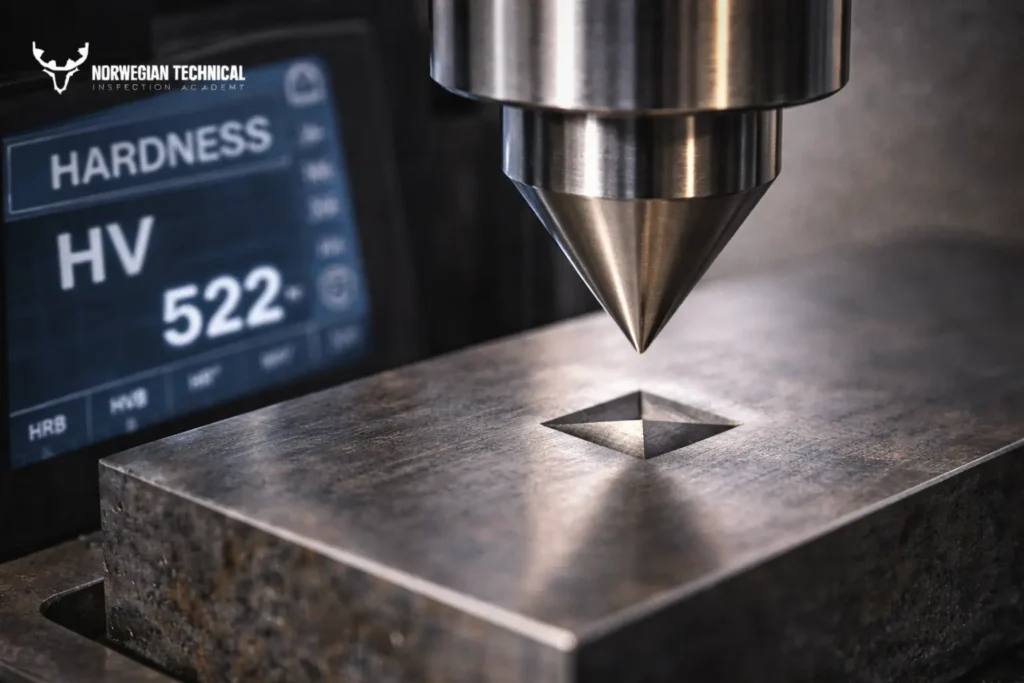
Vickers Hardness (HV)
Vickers testing uses a diamond pyramid indenter:
- Applies a load (can be very small or moderate)
- Leaves a square-shaped indentation
- The diagonals of the indentation are measured under a microscope
- Hardness is calculated from load divided by the area of the pyramidal impression
Vickers is extremely versatile:
- Can be used on very hard or very soft materials
- Suitable for thin sections, surface layers, coating and weld HAZ
- The same scale (HV) works for all materials, which simplifies comparison
3. When to Use Each Method in Real Projects
In practice, the choice is not random; it depends on material, geometry, thickness and the level of accuracy you need. Industrial guidance typically suggests:
Use Brinell when:
- Inspecting large castings and forgings
- You want a representative bulk hardness
- Surface is relatively rough and the part is massive
Use Rockwell when:
- Checking production parts and machined steels
- You need fast readings on a shop floor
- The component is thick enough and can be properly supported
Use Vickers when:
- Measuring hardness in weld HAZ and narrow zones
- Testing thin plates, small parts or surface-treated layers
- You need precise lab-style data and conversion to other scales
Use portable hardness testers mainly for:
- Screening and trend checks on large or installed components
- Situations where you cannot bring the part to a lab machine
Portable methods (e.g. rebound / Leeb) are convenient but usually less accurate than standard bench tests; they are best treated as screening tools, not as your only basis for acceptance.
4. How Hardness Testing Fits into Incoming Inspection and ITPs
In many Inspection and Test Plans (ITPs) for raw materials, hardness appears as one of the inspection activities, often with levels such as Witness (W) or Surveillance (S):
- For plates, forgings and castings, hardness checks confirm that the heat treatment and mechanical condition match the MTC.
- For weld procedures and PQRs, hardness profiles in the weld and HAZ help ensure that the procedure produces acceptable hardness – especially in sour service or other critical applications.
Typical use cases at incoming inspection:
- Verification check if MTC hardness seems borderline or inconsistent
- Spot checks on high-risk materials or suppliers
- Extra testing when there is doubt or history of nonconformities
NTIA’s “Visual & Dimensional Checks: Step-by-Step” shows how hardness naturally complements visual, dimensional and certificate-based checks in a structured incoming inspection flow.
5. How Each Test Works (Simple Procedures)
This section is not a replacement for a full lab procedure, but as an inspector you should understand the basic steps and failure modes.
5.1 Brinell Procedure (HBW)
A typical Brinell test involves:
- Preparing a reasonably smooth, clean surface (free from scale, heavy rust or coatings where possible).
- Selecting an appropriate ball diameter (e.g. 10 mm) and load (e.g. 3000 kgf for steels, smaller for softer materials).
- Applying the load for a standard dwell time (commonly around 10–15 seconds).
- Removing the load and measuring the diameter of the circular indentation in at least two directions.
- Using the average indentation diameter and a standard formula or chart to calculate HBW.
Brinell requires:
- Sufficient material thickness
- Good support under the test area
- Adequate spacing from edges and other indentations
5.2 Rockwell Procedure (HRC, HRB and other scales)
A Rockwell test generally follows these steps:
- Apply a minor load to seat the indenter on the surface.
- Apply the major load for a specified time.
- Remove the major load and measure the depth difference relative to the minor-load position.
- Convert that depth directly into a hardness number on the selected scale (e.g. HRC, HRB).
Key points:
- The correct scale (indenter + load) must be chosen based on material and expected hardness.
- The test surface must be clean, smooth and perpendicular to the indenter.
- The specimen must be rigidly supported to avoid deflection.
Rockwell is quick and highly suitable for production environments, but easier to misuse if support and scale selection are poor.
5.3 Vickers Procedure (HV)
Vickers testing typically involves:
- Preparing a polished or at least smooth surface, especially for small loads.
- Applying a predetermined load through a diamond pyramid indenter for a set dwell time.
- After unloading, measure the two diagonals of the square indentation under a microscope.
- Calculating Vickers hardness (HV) from the load and the average diagonal length.
Vickers is excellent for:
- Microhardness testing in welds and heat-affected zones
- Thin coatings or surface-treated layers
- Small or thin specimens where Brinell or Rockwell are not suitable
Because you can apply very small loads, Vickers is often used in welding procedure qualifications and failure analysis.
6. Practical Hardness Ranges for Common Materials
Exact acceptance ranges come from your project specifications, codes and standards, but it helps to have a mental map of typical values you may see in the field. Guidance documents and manufacturer data generally show approximate ranges such as:
- Low-carbon steels (normalized): roughly 120–180 HBW
- Medium-carbon or alloy steels (heat treated): roughly 200–350 HBW
- Fully hardened tool steels: often > 500 HV or > 50 HRC
- Austenitic stainless steels: typically 150–220 HV
- Weld metal and HAZ in many structural applications: often monitored in a band around 180–260 HV, depending on procedure and service
These are indicative only. The actual acceptable hardness range for a job must always come from:
- Material standards (e.g. EN, ASTM)
- Project specifications
- Welding procedure qualification records (PQRs)
When hardness significantly deviates from expectations, it often triggers further checks (chemical analysis, microstructure, re-heat-treatment) or an NCR.
7. Conversions Between HB, HRC and HV – Use With Care
Many handbooks and online tools provide hardness conversion tables between Brinell, Rockwell and Vickers for steels and other materials. They are based on empirical correlations and can be helpful, but they are not perfect.
Key points:
- Conversions are most reliable within specific ranges and for specific material classes (often carbon and low-alloy steels).
- They become less reliable for very high hardness values and for non-ferrous alloys.
- Conversion should not be used to override a contractual acceptance criterion given in a specific hardness scale.
Good practice:
- Use conversions as a rough comparison or to interpret historical data expressed in another scale.
- For contractual acceptance, test directly in the required scale whenever possible.
- Document clearly when a value is measured and when it is converted, especially in reports and NCRs.
NTIA’s “Vendor Inspection Reporting: IR/NCR/Final Dossier” explains how clarity on such details prevents disputes later.
8. Portable Hardness Testers (Pros and Cons)
Portable hardness testers (for example, rebound / Leeb devices) are popular in field inspection and incoming inspection because they are:
- Small and easy to carry
- Fast to use
- Capable of testing large or in-service components that cannot be cut or moved
However, compared to bench Brinell, Rockwell or Vickers machines, they:
- Are more sensitive to surface condition and mass of the part
- Often require strict conditions (minimum thickness, weight, surface finish) for reliable readings
- Typically provide hardness in one scale and rely heavily on internal conversion tables
Practical approach:
- Treat portable testers as screening tools or for trend monitoring.
- Use them to decide where more detailed testing is needed.
- For final acceptance or critical decisions, confirm with standard lab methods on suitable samples.
Portable hardness values must still be recorded, traceable to location and method, and stored in your inspection records, as described in “Inspection Evidence & Recordkeeping: What Auditors Expect” .
9. Common Mistakes in Hardness Testing (and How to Avoid Them)
Guides on hardness testing and typical lab practice highlight a number of recurring errors that can seriously distort results:
9.1 Poor Support and Vibration
If the part is not firmly supported:
- The surface may deflect under load.
- The indenter goes deeper than it should, giving artificially low hardness.
Always ensure the sample is stable and firmly in contact with the anvil or base.
9.2 Surface Condition Problems
Rough, scaled, heavily corroded or coated surfaces can:
- Cause irregular indentations
- Produce misleading readings
Whenever possible:
- Remove scale, rust or coatings in a small test area.
- Avoid testing over weld spatter or obvious defects.
9.3 Wrong Load or Indenter
Using the wrong load or indenter:
- Can create too small or too large an impression
- May even damage the indenter or the material surface
Select load and indenter according to:
- Material type and thickness
- Expected hardness range
- Relevant standard or internal procedure
9.4 Testing Too Close to Edges or Other Indentations
Hardness standards and guides give minimum distances to edges and between indentations. Violating these rules:
- Can cause edge effects
- Can make the material locally work-hardened, distorting subsequent readings
Plan your indentation locations before testing.
9.5 Misuse of Conversion Tables
Treating converted values as “exact” is a classic mistake:
- A converted “HRC” value from a portable tester can be quite different from a direct HRC bench test.
- Using conversions as acceptance criteria may lead to wrong pass/fail decisions.
Whenever acceptance is critical, test directly on the required scale.
9.6 Over-Reliance on Portable Testers
Portable testers are convenient, but:
- Can be significantly affected by geometry, mass and surface condition
- Often require careful calibration and verification
Use them intelligently:
- Confirm suspicious or borderline readings with lab tests.
- Do not base critical NCRs or acceptances solely on a single portable reading.
NTIA’s “Common Vendor Nonconformities & Fixes” gives a good sense of how such testing errors can cascade into avoidable NCRs and disputes.
10. FAQ – Hardness Testing
Q1. Which hardness test is best for steel?
For general carbon and low-alloy steels in production and incoming inspection, Rockwell (HRC/HRB) and Brinell (HBW) are both widely used. Rockwell is fast and convenient for machined parts; Brinell is excellent for large, rough components like castings and forgings. Vickers is ideal when you need more detailed or localised information, especially in welds.
Q2. Why is Brinell often used for castings and forgings?
Because Brinell uses a relatively large ball and high load, the indentation covers a bigger area and averages out local microstructural variations. That makes it well suited for coarse-grained materials like castings and heavy forgings, where very local tests could be misleading.
Q3. Where is Vickers hardness testing really necessary?
Vickers shines when you need fine spatial resolution and a universal scale: weld HAZ, thin sections, coatings, small parts and lab investigations. Its microhardness versions with low loads are key tools in welding procedure qualifications and failure analysis.
Q4. Can I use portable hardness testers for final acceptance?
Portable testers are best used as screening devices or for trending. For final acceptance, especially when contractual requirements specify a particular hardness range and method, standard bench tests (Brinell, Rockwell or Vickers) on properly prepared surfaces are usually preferred and more defensible.
Q5. How close to a weld can hardness be measured?
When measuring hardness near welds, you need to follow the procedure or standard that defines distances from the weld centreline and between indentations. In many PQR procedures, specific grid patterns and distances are prescribed to map hardness in weld metal, HAZ and base metal without overlap or edge effects.
If You Work with Metals, Hardness Testing Is Your Early-Warning System
Think about hard reality, not just hardness numbers.
If you are:
- Signing off incoming inspection for plates, forgings and castings
- Reviewing MTCs and wondering if the delivered material really matches
- Qualifying welding procedures where HAZ hardness can make or break sour-service approval
- Investigating NCRs where strength, brittleness or wear do not match expectations
…then hardness testing is one of your earliest and cheapest early-warning systems. Done well, it quietly confirms that materials and welds behave as designed. Done badly, it creates false alarms or, worse, false confidence.
That is why NTIA’s Raw Material Inspection training does not treat hardness as a side note. It integrates:
- Certificate reading and traceability
- Hardness and PMI testing
- Practical incoming inspection workflows
- How to document and defend your findings in IRs, NCRs and audits
If this guide feels close to your daily work, that training is the logical next step: so that the next time someone hands you a casting, a weld coupon or a suspicious MTC, you know exactly which hardness test to use, what the number means, and how to turn it into a clear, defensible decision.
Explore NTIA’s Raw Material Inspection Training