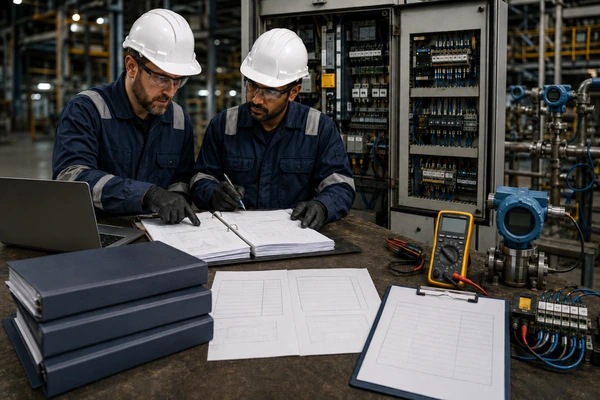
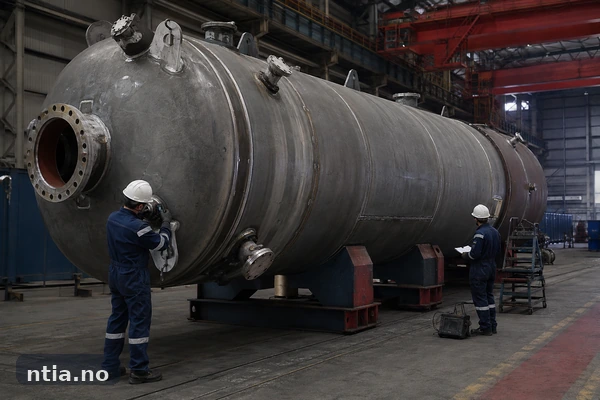
Pressure vessel inspection is the quality control process used to verify pressure vessels, pressurized equipment, materials, welding, NDT, pressure testing and final documentation before the equipment is accepted for use, delivery or operation.
Pressure vessels are used in oil and gas, petrochemical, power generation, marine, manufacturing and process industries. Because they operate under internal or external pressure, inspection is critical for safety, compliance and long-term integrity.
For QA/QC inspectors, vendor inspectors, pressure vessel inspectors and compliance professionals, pressure vessel inspection is not only about checking the physical vessel. It is about confirming that the equipment has been designed, manufactured, tested and documented according to the purchase order, approved drawings, project specifications, applicable codes and regulatory requirements.
If you want structured training on this subject, NTIA provides a Pressure Vessel Inspector Training Course covering pressurized equipment inspection requirements according to PED and ASME standards for inspection, QA and compliance professionals in oil, gas, petrochemical and power industries.
A pressure vessel is a container designed to hold gases, liquids or vapours at a pressure different from the surrounding atmosphere.
Common examples include:
Pressure vessels may operate under high pressure, high temperature, corrosive fluids, cyclic service or hazardous process conditions. Because of these risks, pressure vessel fabrication and inspection require strict control of materials, welding, testing and documentation.
A pressure vessel is not just a tank. It is an engineered item whose safety depends on design, material selection, fabrication quality, inspection records and operating conditions.
Pressure vessel inspection is the verification of a pressure vessel’s materials, fabrication, welding, dimensions, NDT, pressure testing, marking, documentation and compliance status against approved project and code requirements.
It may take place at different stages:
For new fabrication, inspection focuses on whether the vessel is manufactured correctly. For in-service inspection, the focus is more on condition, damage mechanisms, repair, alteration and fitness for continued service.
This article focuses mainly on inspection from the QA/QC and fabrication/vendor inspection point of view.
Pressure vessels store energy. If a vessel fails, the consequences can be severe.
Poor inspection or incomplete documentation may lead to:
Many pressure vessel problems begin during fabrication. A wrong material certificate, missing heat number, unqualified welding procedure or incomplete NDT report may create serious acceptance problems later.
Good pressure vessel inspection helps detect these issues early and confirms that the vessel is safe, traceable and compliant before it is released.
Pressure vessel inspection may involve several codes, standards and regulatory frameworks. The exact requirements depend on project location, client specification, design code and intended service.
| Framework / Standard | Typical Role in Pressure Vessel Work |
| PED 2014/68/EU | European regulatory framework for pressure equipment conformity assessment |
| ASME Section VIII | Common design and fabrication code for pressure vessels |
| ASME Section IX | Welding and brazing procedure and personnel qualification |
| ASME Section V | Nondestructive examination methods |
| EN 13445 | European standard for unfired pressure vessels |
| API 510 | In-service inspection, repair, alteration and rerating of pressure vessels |
Inspectors do not need to be design engineers, but they must understand which code or regulation applies and what documents prove compliance.
One common mistake is treating ASME, PED and API 510 as if they serve the same purpose. They do not. ASME Section VIII is mainly used for design and fabrication. PED is a European regulatory framework for conformity assessment. API 510 is mainly associated with in-service inspection, repair, alteration and rerating.
PED and ASME are often mentioned together, but they are not the same type of requirement.
| Topic | PED | ASME |
| Nature | European directive / regulatory framework | Engineering code and construction standard |
| Main concern | Conformity assessment, essential safety requirements, market access | Design, fabrication, examination, testing and marking rules |
| Region | European Union / European market | Widely used internationally |
| Inspector focus | CE marking route, conformity documents, notified body involvement where applicable | Code compliance, drawings, calculations, materials, welding, testing |
| Common documents | Declaration of conformity, technical file, conformity assessment records | Manufacturer’s data report, drawings, test reports, code documents |
For NTIA’s audience, the practical point is simple: an inspector must know which framework applies to the project and what evidence is required. In some projects, ASME may be used as the design/construction code while PED requirements are also relevant for European conformity.
Pressure vessel inspection normally follows a staged process. The exact scope depends on the ITP, code, purchase order and project specification.
Inspection should start before fabrication begins.
Typical documents include:
The inspector should know what must be witnessed, what must be reviewed and what records are required before the vessel can be accepted.
Without document review, inspection becomes reactive instead of controlled.
Material verification is one of the most important stages of pressure vessel inspection.
Inspectors may check:
Material traceability must be maintained throughout fabrication. If a plate, nozzle or flange loses its identity, the vessel may become difficult or impossible to accept without additional verification.
For pressure-containing parts, missing or inconsistent material documentation is a serious inspection finding.
For a broader explanation of how inspectors verify certificates, markings, heat numbers and traceability before fabrication, see: raw material inspection and traceability.
Before welding, fit-up inspection helps confirm that vessel parts are correctly prepared and aligned.
Typical checks may include:
Dimensional inspection may continue after welding and fabrication. It confirms that the vessel matches the approved drawings and can be installed correctly at site.
Common dimensional checks include overall length, diameter, nozzle projection, flange orientation, support location, manway position and lifting lug arrangement.
Welding is one of the highest-risk areas in pressure vessel fabrication.
Pressure vessel inspectors may review or verify:
The inspector should confirm that welding is performed according to approved procedures and that weld records are traceable to the correct joint and welder.
Welding inspection is not only visual checking. It is also a documentation and traceability activity.
For a detailed explanation of weld inspection stages, NDT methods and report review, see: welding and NDT inspection.
NDT is used to detect surface or internal discontinuities without damaging the vessel.
Common NDT methods may include:
| Method | Typical Use |
| VT / Visual Testing | Weld profile, surface condition, visible defects |
| PT / Penetrant Testing | Surface-breaking defects on non-porous materials |
| MT / Magnetic Particle Testing | Surface and near-surface defects in ferromagnetic materials |
| UT / Ultrasonic Testing | Internal discontinuities and thickness verification |
| RT / Radiographic Testing | Volumetric weld examination |
The inspector should verify that NDT is performed according to the approved procedure, correct weld identification, required coverage, qualified personnel, accepted criteria and complete reporting.
An NDT report should clearly show what was tested, which method was used, what acceptance criteria applied and whether the result was acceptable.
Some pressure vessels require heat treatment, such as post-weld heat treatment, depending on material, thickness, code requirements and service conditions.
Inspection review may include:
Heat treatment records must be complete and traceable. Incomplete PWHT documentation can create serious acceptance problems.
Hydrostatic testing is commonly used to verify the pressure integrity of a completed pressure vessel.
The inspector should check:
The hydrotest is not simply a physical event. It must be supported by correct procedure, safe execution, calibrated instruments and complete documentation.
Pneumatic testing may be used in some cases, but it requires special caution because of the stored energy involved.
After testing and before release, the vessel should be checked for final condition and identification.
Typical checks include:
Nameplate or marking errors can create major documentation and compliance problems even when the physical vessel is otherwise acceptable.
The Inspection and Test Plan defines the required inspection activities, acceptance documents and inspection involvement.
For pressure vessels, an ITP may include:
Common inspection points include:
| Inspection Point | Meaning |
| Hold Point | Work cannot proceed until inspection or approval is completed |
| Witness Point | Client or inspector may attend and witness the activity |
| Review Point | Documents or reports must be reviewed |
| Surveillance | General monitoring of work quality and process compliance |
For vendor inspection, the ITP is the main roadmap. It tells the inspector what to attend, what to review and what evidence must be collected.
A detailed checklist depends on the project and code requirements. However, a practical pressure vessel inspection checklist should normally cover:
| Area | Typical Checks |
| Documents | Drawings, datasheets, ITP, procedures, code requirements |
| Materials | MTCs, heat numbers, material grade, traceability, PMI where required |
| Welding | WPS, PQR, welder qualification, weld map, visual weld inspection |
| NDT | Method, coverage, personnel qualification, reports, acceptance criteria |
| Testing | Hydrotest procedure, pressure, gauges, holding time, leakage, report |
| Dimensions | Shell, nozzles, supports, orientation, flange alignment |
| Marking | Nameplate, serial number, code marking, CE marking where applicable |
| Dossier | Certificates, reports, NCRs, punch closure, release documents |
The checklist should never replace the approved ITP or project specification. It should support the inspector’s work, not define requirements by itself.
Common findings during pressure vessel inspection include:
The inspector’s role is to identify these findings, record them clearly, verify corrective action and confirm closure before acceptance.
A pressure vessel should not be accepted based only on physical inspection. The final documentation must also be complete.
A typical final dossier may include:
Every record should be traceable to the correct vessel tag, serial number, weld number, material item or test activity.
Incomplete documentation can delay shipment, site acceptance or regulatory approval even if the vessel itself is physically complete.
A pressure vessel inspector needs both technical knowledge and inspection discipline.
Important skills include:
The inspector does not need to replace the design engineer or authorized body, but must understand enough to verify compliance against approved requirements.
Pressure vessel inspection training is useful for professionals who inspect, verify, manufacture, test or manage pressurized equipment quality in industrial projects.
This includes:
The training is especially relevant for teams working with pressure vessels, heat exchangers, separators, pressurized systems, fabrication shops and PED/ASME-based project requirements.
Professionals who move into pressure vessel inspection often come from QA/QC, welding inspection, mechanical inspection, NDT, vendor inspection, maintenance, fabrication or compliance backgrounds.
A practical training path should cover:
NTIA’s Pressure Vessel Inspector Training Course is designed for professionals who need structured knowledge of pressurized equipment inspection requirements according to PED and ASME standards.
You can also check the upcoming PED / ASME pressure vessel training dates in the NTIA training calendar.
Pressure vessel inspection is the quality control process used to verify pressure vessel materials, welding, dimensions, NDT, pressure testing, marking and documentation against approved codes, specifications and project requirements.
A pressure vessel inspector checks drawings, material certificates, traceability, fit-up, welding records, NDT reports, heat treatment records, hydrotest results, nameplate data, marking, final condition and final dossier documentation.
PED is a European regulatory framework for pressure equipment conformity assessment. ASME provides engineering codes commonly used for design, fabrication, examination, testing and marking of pressure vessels.
No. API 510 is mainly associated with in-service inspection, repair, alteration and rerating of pressure vessels. Fabrication inspection usually focuses on new construction requirements such as materials, welding, NDT, testing and documentation.
Material traceability proves that pressure-containing parts match the approved material requirements. Without traceability, it may be difficult to confirm that the vessel is safe and compliant.
Hydrostatic testing is a pressure test usually performed with liquid to verify the pressure integrity of a vessel. Inspectors review the procedure, pressure, holding time, gauges, leakage condition and final report.
A final dossier may include approved drawings, datasheets, material certificates, weld maps, WPS/PQR records, welder qualifications, NDT reports, heat treatment records, hydrotest reports, calibration certificates, nameplate records and release documents.
Pressure vessel inspection training is useful for QA/QC inspectors, mechanical inspectors, welding inspectors, NDT personnel, vendor inspectors, compliance professionals and project quality teams working with pressurized equipment.
Pressure vessel inspection is a critical part of industrial QA/QC and technical compliance. A pressure vessel must be verified not only as a physical item, but also as a complete technical package supported by materials, welding records, NDT, testing, marking and documentation.
For inspectors, the key is to understand the applicable requirements, follow the ITP, verify traceability, witness or review the right tests, identify findings clearly and confirm that the final dossier is complete before acceptance.
A strong pressure vessel inspection process helps reduce safety risk, prevent rework, support regulatory compliance and improve project handover.
For professionals who want to build practical competence in this field, NTIA’s Pressure Vessel Inspector Training Course provides structured training in PED and ASME-based pressurized equipment inspection. Upcoming course dates are available in the NTIA Training Calendar.
Support articles:

At NTIA (Norwegian Technical Inspection Academy), we specialize in delivering world-class training programs in vendor inspection, quality surveillance, and technical compliance – specifically tailored for professionals in the oil, gas, and energy industries.
Copyright © 2025 by NTIA. All Rights Reserved.