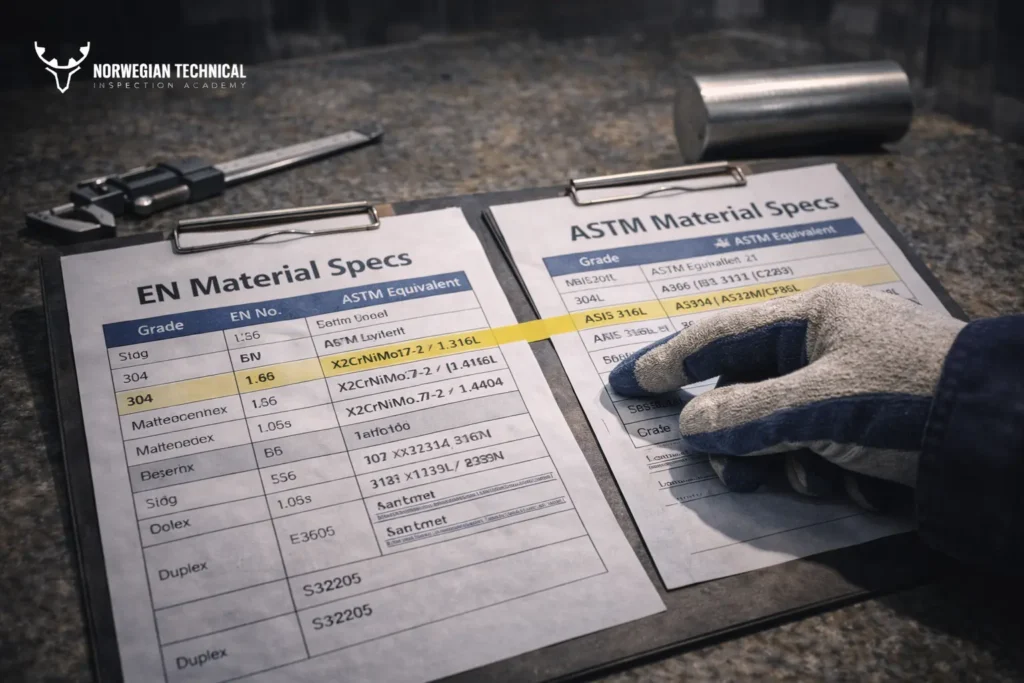
Quick Answer — What “EN vs ASTM Equivalent” Really Means
When people say “P265GH is equivalent to A516 Gr.60” or “S355J2 equals A572 Gr.50”, they usually mean:
- The steels have similar strength levels and typical applications (for example, pressure vessel plate vs structural plate).
- The grades are treated as practical alternatives in procurement, especially on international projects.
- But they are not identical – there are differences in chemistry, toughness, delivery condition and certification.
For inspectors and QA/QC, that means:
Equivalence tables are guidance, not automatic permission to substitute.
You still need to check properties, code context and certificates before accepting any EN ↔ ASTM swap.
This guide gives you the mapping logic and concrete examples you can actually use during MTC review, vendor inspection and NCR handling.
1. How EN and ASTM Material Standards Work in Real Projects
1.1 EN Material Specs: Product-Based Standards
European EN standards are often product-focused. Typical families you see on MTCs include:
- EN 10025 – hot-rolled structural steel (e.g. S235, S275, S355…)
- EN 10028 – flat products for pressure equipment (e.g. P265GH, P355GH, P355NL1/NL2)
- EN 10216 / EN 10217 – seamless and welded tubes for pressure purposes
- EN 10222 – steel forgings for pressure purposes (e.g. 16Mo3, 13CrMo4-5)
An EN grade name (like P265GH) already encodes a lot of information: product type, minimum strength level and typical service (pressure and elevated temperature).
1.2 ASTM/ASME Specs: Material Families & Code Links
In ASTM/ASME, you typically see material specifications grouped by product and service:
- ASTM A36, A572, A992 – structural plate and shapes
- ASTM A516 / ASME SA516 – pressure vessel plates for moderate and low-temperature service
- ASTM A106, ASTM A333, API 5L – pressure pipes
- ASTM A105, ASTM A350, ASTM A182 – forgings for flanges and fittings
Pressure-vessel steels like A516 are integrated into ASME Boiler & Pressure Vessel Code, which defines allowable stresses, design rules and certification routes. That’s why you often see EN grades on EN-coded projects and ASTM/ASME grades on ASME-coded projects, even when the actual service is similar.
1.3 Why One-to-One Equivalence Is Rare (and Risky)
Even when two grades are called “equivalent”, there are usually differences in:
- Chemical composition (C, Mn, micro-alloying elements, residuals)
- Mechanical properties (exact yield/tensile ranges, impact toughness values, temperature ranges)
- Delivery condition / heat treatment (normalized, quenched and tempered, thermomechanically rolled, etc.)
- Inspection and certification conditions (mandatory tests, NDT, certificate type)
The key message for QA/QC:
Two grades can be similar enough to compare – but not similar enough to substitute without engineering approval.
To understand how certificate types and traceability fit into this, you can refer to EN 10204 3.1 vs 3.2: Differences Explained and MTC Interpretation Guide + Checklist (PDF).
2. Before You Trust Any EN–ASTM Equivalence Table: 5 Checks
Whenever you see a cross-reference like “P355GH ≈ A516 Gr.70”, run through these five checks before accepting it.
2.1 Check the Product Form & Standard Scope
First, confirm you’re comparing the same product type and standard scope:
- Plate vs pipe vs forging vs bar
- Pressure vs structural vs high-temperature vs low-temperature
- Which product standard applies (EN 10028 vs EN 10025 vs EN 10216/10217 vs EN 10222, etc.)
For example:
- P265GH is a pressure-vessel plate grade from EN 10028-2.
- A516 Gr.60 is also a pressure-vessel plate from ASTM A516.
That makes them candidates for comparison.
By contrast:
- S355J2 is a structural steel under EN 10025.
- A572 Gr.50 is a high-strength structural steel.
They may be comparable as beams and plates in buildings – but not for pressure-vessel duty.
2.2 Compare Yield & Tensile Strength Ranges
Next, check the minimum yield and tensile strength:
- P265GH and A516 Gr.60 are widely treated as comparable because their strength levels are in a similar range for pressure-vessel use.
- P355GH is commonly presented as the EN counterpart to A516 Gr.70 – again, similar strength and vessel applications, though the detailed ranges differ slightly.
- S355J2 vs A572 Gr.50: both offer roughly 345–355 MPa minimum yield for typical thickness ranges, and both are used as high-strength structural steels.
If the proposed substitution has lower yield or tensile than required, you already have a problem. If it’s significantly higher, you must still check weldability and toughness.
2.3 Check Impact Requirements & Temperature Range
Impact toughness is where many “equivalent” steels diverge:
- Some EN grades (e.g. S355J2, P355NL2) have explicit Charpy impact requirements at low temperature, while some ASTM grades only specify impact toughness when ordered with supplementary requirements.
- For pressure vessels, EN 10028 grades like P355GH or P355NL1/NL2 are typically selected where impact performance at certain minimum temperatures is critical, and you must match that when using A516 or A537 alternatives.
Always verify:
- Test temperature (e.g. –20 °C, –40 °C)
- Required absorbed energy (J)
- Whether the proposed substitute has the same or better impact performance at the project design temperature.
2.4 Check Delivery Condition & Heat Treatment
Delivery condition can change the way a steel behaves:
- P355GH plates are normally supplied normalized, whereas A516 Gr.70 may only be normalized above a certain thickness, depending on order and code.
- For high-temperature alloy steels, EN 10222 forgings like 16Mo3 or 13CrMo4-5 are aligned with ASTM A182 F1/F11/F12/F22 for pressure purposes – but you must still check how they are ordered and heat-treated for the intended service.
A mismatch in delivery condition (normalized vs as-rolled vs quenched and tempered) can affect toughness, creep resistance and weldability, even if basic composition looks similar.
2.5 Check Certification, Code & Project Specification
Finally, step back and look at the bigger picture:
- Does the design code (ASME vs EN vs local regulations) accept that grade?
- Does the project specification allow substitutions, and under which approvals?
- What certificate type is required (EN 10204 3.1 vs 3.2, or ASME code-stamped material)?
In practice:
- Use EN 10204 3.1 vs 3.2: Differences Explained to check whether the provided certificate type is correct.
- Use MTC Interpretation Guide + Checklist (PDF) as a step-by-step to confirm all required tests and references are present before you even think about accepting an “equivalent” material.
3. Common EN ↔ ASTM Mappings by Category (With Examples)
Below are practical mappings you’ll encounter often. Treat them as starting points – not as automatic approvals.
3.1 Structural Steels (EN 10025 vs ASTM A36/A572/A992)
Typical EN structural grades:
- S235JR / S275JR / S355JR / S355J2 / S355NL under EN 10025
Common ASTM comparisons:
- S235 ↔ A36 – both mild structural steels with similar yield strength for basic construction, though composition and detailed properties differ.
- S355JR/S355J2(+N) ↔ A572 Gr.50 / A992 – often used as approximate equivalents for high-strength structural applications (buildings, bridges, frames).
In practice, when a vendor proposes A572 Gr.50 instead of S355J2:
- Confirm both are used as structural steel for a similar thickness range.
- Compare yield and tensile values for the relevant thickness.
- Check impact requirements (S355J2 often has defined Charpy values at –20 °C; make sure A572 meets project needs).
- Ensure the project’s design code and spec accept the switch.
If your project has strict EN-based design and CE-marking requirements, you may need S355J2 or S355J2+N specifically, even if A572 Gr.50 looks close on paper.
3.2 Pressure Vessel Plates (EN 10028 vs ASTM A516/A537)
These are some of the most used EN–ASTM mappings in pressure equipment work.
P265GH ↔ A516 Gr.60 (pressure-vessel plate)
- EN 10028-2 P265GH is a non-alloy steel for pressure vessels at elevated temperatures.
- ASTM/ASME A516 Gr.60 is a carbon steel for moderate and lower-temperature pressure-vessel service.
- They are widely used as functional counterparts for vessels and boilers.
P355GH ↔ A516 Gr.70 (higher-strength vessel plate)
- EN 10028-2 P355GH and ASME SA516 Gr.70 are often treated as functionally equivalent for higher-strength pressure-vessel plates.
- Both have similar tensile strength and typical applications, but composition and impact requirements still need to be checked case by case.
You may also see P295GH, P355NH/NL1/NL2 compared against A516 Gr.65/70 or A537 Cl.1, particularly where low-temperature performance is critical.
Practical QA/QC implications:
When a vendor offers A516 instead of P265GH or vice versa:
- Verify the design code and allowable stress approach.
- Match yield/tensile bands and thickness ranges.
- Check impact toughness requirements and test temperatures in both specs.
- Confirm delivery condition (normalized vs as-rolled) and any mandatory NDT.
3.3 Pressure Pipes & Tubes (EN 10216/10217 vs ASTM A106/A333/API 5L)
For pipes and tubes, mapping is more service-based than grade-name-based.
Examples of concept-level comparisons:
- EN 10216-3 P355N/P355NL2 vs API 5L X52 or ASTM A106-type materials for high-pressure pipes. These are all intended for demanding services, but their exact composition, toughness and code context differ.
Cross-reference sheets often show families of EN and ASTM pipe grades next to each other to guide selection, but they always include disclaimers about non-identical properties.
For inspectors:
- Treat EN–ASTM pipe equivalence tables as a starting point, not a design decision.
- Check design code (e.g. ASME B31.x vs EN 13480), allowable stress tables and project spec before accepting any substitution.
- For critical services (e.g. sour, cryogenic), verify impact requirements and any supplementary clauses.
3.4 Forgings, Flanges & Fittings (EN 10222 vs ASTM A105/A182/A350)
Forging-grade mappings are very common in flange and fitting procurement.
Typical comparisons include:
- EN 10222-2 16Mo3 (1.5415) ↔ ASTM A182 F1
- Both are low-alloy 0.5% Mo steels for elevated temperature pressure applications.
- EN 10222-2 13CrMo4-5 (1.7335) ↔ ASTM A182 F12/F22
- For stainless and duplex: A182 F304/F304L/F316/F316L vs EN 1.4301/1.4401/1.4404, and duplex F51 (UNS S31803/S32205) vs EN 1.4462.
Here again:
- The overall alloy family and service temperature are aligned, but composition and mechanical properties still differ slightly.
- Treat them as practical equivalents that require verification, not as identical twins.
4. How to Use EN–ASTM Mappings in Vendor Inspection & MTC Review
4.1 Reading MTCs and Cross-References
A good MTC (Mill Test Certificate) already contains clues about equivalence:
- Material standard and grade (e.g. EN 10028-2 P355GH, ASTM A516 Gr.70)
- Product form and dimensions
- Heat number, chemical analysis, mechanical tests, impact tests, NDT overview
- Sometimes, cross-referenced grades or customer specifications
When you review a certificate:
- Verify that the standard and grade match the PO and drawing.
- If the vendor proposes an alternative, check whether the certificate clearly shows the actual grade supplied.
- Use MTC Interpretation Guide + Checklist (PDF) as a baseline to ensure all critical fields are present and correctly filled before making a decision.
4.2 Handling Vendor Substitution Proposals
Scenario: the PO and datasheet specify P355GH, but the vendor offers A516 Gr.70 “as equivalent”.
Your process should include:
- Documented proposal – the vendor formally requests substitution.
- Technical comparison – side-by-side review of chemical composition, mechanical and impact properties, delivery condition and any additional requirements.
- Design and code check – confirm with design engineers that the proposed substitution is acceptable under the governing code and project specification.
- Certificate and traceability check – ensure certificates clearly reference the actual delivered grade and applicable standard.
- Formal approval or NCR/concession – record the decision via deviation, concession or NCR, so it is traceable later.
The structure and documentation for such decisions are aligned with Vendor Inspection Reporting: IR/NCR/Final Dossier and the patterns described in Common Vendor Nonconformities & Fixes.
4.3 When to Require PMI & Additional Testing
Sometimes EN–ASTM mapping is not enough to be comfortable.
Typical triggers for PMI (Positive Material Identification) or extra tests:
- Mixed heats or unclear marking on components
- Vendor history of material mix-ups
- Critical service (e.g. sour, hydrogen, high-temperature creep)
- Substitution between closely related alloy families
In those cases:
- Use PMI to confirm alloy family and key elements (Cr, Mo, Ni, etc.).
- Request additional impact tests or hardness tests at the relevant temperature where needed.
For scoping and documenting these checks, see PMI Testing: What, When & How to Document.
4.4 Sampling & Additional Verification
If a batch contains a newly accepted “equivalent” grade, or there’s a real risk of mix-up, you may need additional sampling:
- Decide sampling basis (by heat, by thickness, by component type).
- Define what will be tested: mechanical tests, impacts, hardness, specific corrosion tests if needed.
- Apply risk-based logic and sampling principles similar to those described in Receiving Inspection Sampling Plans (AQL).
Documenting your sampling and test rationale in your IR and NCRs makes later audits much easier.
4.5 Recording Equivalence Decisions in IRs and NCRs
Once an equivalence decision is made, make it visible and traceable:
- In the inspection report, state clearly:
- which grade was specified,
- which grade was delivered,
- under which deviation/concession it was accepted.
- In the NCR or deviation form, summarise the comparison and approvals obtained.
For structured examples of wording and how this fits the bigger picture, see Vendor Inspection Reporting: IR/NCR/Final Dossier and Common Vendor Nonconformities & Fixes.
5. Workflow: What to Do When You See an Unfamiliar Grade
Here is a simple, inspector-friendly workflow you can follow whenever you see an EN or ASTM grade you don’t recognise:
- Identify the standard and product form
- Is it EN 10028 (plate), EN 10216 (tube), EN 10222 (forging), ASTM A516 (plate), A182 (forging)…?
- This immediately tells you whether you’re in structural, pressure-vessel, pipe or forging territory.
- Check basic properties
- Look up minimum yield and tensile strength, plus any impact requirements at the design temperature.
- Compare these with the required grade in the PO/datasheet.
- Review the MTC
- Compare with the required grade
- If someone claims it is equivalent to S355J2 or A516 Gr.70, verify that strength, toughness and delivery condition are aligned – not just “similar-sounding names”.
- Decide the next step
- Accept as-is (if all requirements are fully met).
- Request additional data/tests (e.g. more impact tests, PMI).
- Escalate to a formal deviation, concession or NCR if there is a gap.
- Record your decision
- Note the reasoning and references in your IR and, if applicable, in NCRs or deviation forms.
Remember that material equivalence always sits alongside physical checks on the actual items. For that side of the work, Visual & Dimensional Checks: Step-by-Step remains your practical reference.
6. FAQ — P265GH vs A516, S355 vs A572 & Other Common Questions
Q1. Is P265GH equivalent to A516 Gr.60 or Gr.70?
P265GH (EN 10028-2) is commonly treated as comparable to A516 Gr.60 for pressure-vessel applications: similar strength level and intended service. It is not equivalent to A516 Gr.70; for that, P355GH is usually the closer EN match.
Q2. Is P355GH equivalent to A516 Gr.70?
P355GH and A516 Gr.70 are widely used as functional counterparts for higher-strength pressure-vessel plates. Both have similar tensile strength and typical applications, but they differ in details of chemistry, impact requirements and heat-treatment options. Treat them as practical equivalents, and check the project spec and code before accepting any substitution.
Q3. Which ASTM grade is closest to S355J2?
For structural purposes, S355J2 is most frequently compared with ASTM A572 Grade 50 or sometimes A992. They sit in the same “high-strength structural steel” category and have broadly similar strength levels. However, they differ in chemical composition, toughness and design-code context (Eurocodes vs AISC), so design approval is still required for substitution.
Q4. Can I accept an ASTM substitution for an EN-specified project without design approval?
In most projects, no. Even if two grades are shown as “equivalent” in a comparison table, design and code responsibilities sit with engineering. QA/QC and inspectors should:
- highlight the proposed substitution,
- provide the property comparison, and
- ensure that design, code and client requirements are considered before acceptance.
The decision usually needs to be documented as a deviation or concession, not just noted informally.
Q5. Where should EN–ASTM equivalence be documented: MTC, IR or NCR?
Ideally:
- The MTC clearly states the actual standard and grade supplied (EN or ASTM) and all required test results.
- The inspection report (IR) explains any differences between specified and delivered grades, referencing the MTC.
- If there is a deviation from the specified grade, an NCR or formal concession records the justification and approvals.
Used correctly, EN–ASTM mappings are powerful tools: they let you understand what you are really looking at on an MTC, ask better questions in vendor meetings and write stronger IRs and NCRs. Used lazily, they can hide real gaps in strength, toughness or code compliance. As an inspector, you are there to make sure they are used the right way.