Quick Answer: Common Vendor Nonconformities in One Screen
- In ISO 9001 terms, a nonconformity is simply a failure to meet a requirement from a standard, spec, PO, drawing, or internal procedure.
- In vendor inspection, that includes product issues (dimensions, material, tests), process issues (ITP not followed, unqualified welders), and system issues (poor document control, weak calibration, training gaps).
- The same patterns repeat across projects:
- Documentation & ITP gaps
- Material mix-ups and weak MTC/PMI control
- Weld & NDT defects
- Dimensional and assembly errors
- Failed hydrostatic / seat leak / functional tests
- Wrong nameplates, poor packing & preservation
- ISO 9001 Clause 10.2 requires you to react, contain, investigate root causes, implement corrective actions, and verify effectiveness so problems don’t keep coming back.
- The most effective vendor QA/QC teams combine:
- Clear NCRs,
- Structured IR / MRB workflow,
- Properly designed ITPs & checklists, and
- Trend analysis of NCRs by vendor, product, and cause.
What Is a Vendor Nonconformity?
ISO 9001:2015 defines a nonconformity as the non-fulfilment of a requirement. That requirement may come from: the customer’s PO or spec, a referenced code/standard, regulatory rules, or your own procedures and work instructions.
In vendor inspection, a nonconformity is any situation where:
- the product doesn’t match drawings, datasheets, codes, or test requirements,
- the process doesn’t follow the approved ITP/QCP or procedures, or
- the quality system fails to control documents, calibration, training, or traceability.
If you’re new to the overall workflow (PO → ITP → shop surveillance → FAT → dossier), it helps to first read [What Is Vendor Inspection? Roles & Responsibilities] for the big picture of roles, RACI, and acceptance logic.
Product, Process & System Nonconformities in Vendor Inspection
In practice you’ll see nonconformities at three levels:
- Product (output) nonconformities
- wrong material grade
- out-of-tolerance dimensions
- failed hydrostatic / seat leak / functional tests
- coating and packing that don’t meet spec
- Process nonconformities
- ITP witness/hold points skipped
- NDT done outside approved procedure
- unqualified welders or inspectors
- preheat, PWHT, or environmental conditions not controlled
- System / QMS nonconformities
- repeated calibration issues
- weak document control and revision management
- lack of NCR trending and management review
ISO 9001 distinguishes between nonconforming outputs (Clause 8.7) and nonconformities in the management system (Clause 10.2), but both must be handled in vendor QA/QC.
Minor vs Major vs Critical — A Practical Classification
The standard doesn’t impose a universal definition, but most QA/QC and audit programs treat them roughly as:
- Minor nonconformity
- isolated, low-risk deviation
- limited impact on function or compliance
- example: one missing inspector signature on a low-risk in-process check
- Major nonconformity
- systemic or repeated issue, or a significant deviation from requirements
- could meaningfully affect product conformity, safety, or compliance
- example: several ITP points skipped across multiple orders; welders not qualified for the joints they are making
- Critical nonconformity
- immediate and serious threat to safety, integrity, or regulatory compliance
- requires urgent action (stop work, quarantine, escalation)
- example: pressure-retaining welds with gross lack of fusion, valves shipped for high-pressure service with no mandatory tests
Your classification drives who must be informed, how fast you react, and how deep the corrective action must go.
ISO 9001 Clause 10.2 in Vendor Inspection — From NCR to Real Fix
Clause 10.2 in Plain Language
ISO 9001 Clause 10.2 requires organizations to do more than just fix a bad part. Whenever a nonconformity occurs, you must: (en-10204-3-1-vs-3-2)
- React
- control and correct the nonconformity
- deal with any consequences (scrap, rework, concessions, recalls)
- Investigate
- determine the root cause(s)
- check whether similar nonconformities exist or could occur elsewhere
- Correct
- implement corrective actions appropriate to the effect of the nonconformity
- Verify
- check that actions are effective
- update risks, opportunities, and QMS documents where needed
In vendor inspection, this translates into structured NCRs, vendor corrective action plans, and follow-up visits or audits.
Typical Vendor NCR Workflow (IR → NCR → MRB → Trend)
Most EPCs and owners use a similar flow for vendor nonconformities:
- Inspection Report (IR)
- inspector notes the issue during a visit or FAT
- report includes facts: measurements, photos, clause references
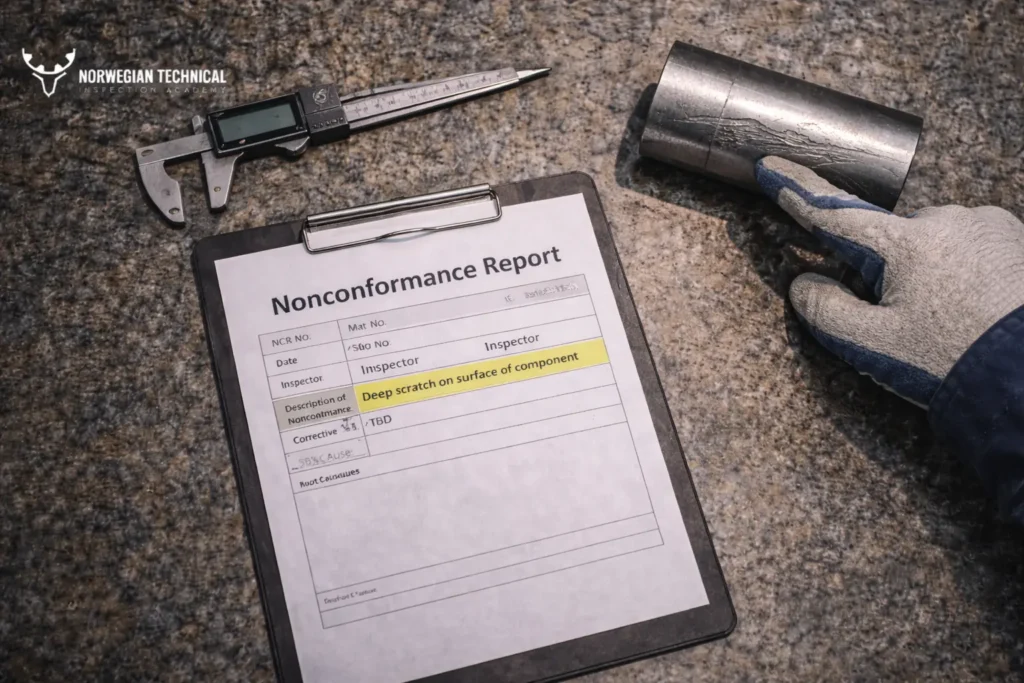
- Nonconformance Report (NCR)
- raised for significant issues or repeated failures
- typically captures:
- clear description & requirement reference
- risk rating (minor/major/critical)
- immediate containment
- proposed disposition: rework, repair, reject, use-as-is/concession
- root cause & corrective action, with owner and due dates
- MRB / Concession Decision
- Material Review Board or equivalent decides the final disposition
- concessions (“use-as-is” or “repair and accept”) require buyer/owner approval
- Closure & Trending
- effectiveness of actions is verified
- NCRs are trended by vendor, product, and category to find systemic issues
For detailed IR/NCR structure, examples, and dossier tips, see [Vendor Inspection Reporting: IR/NCR/Final Dossier].
Common Vendor Nonconformities by Category (With Examples & Fixes)
Below are the nonconformities vendor inspectors see most often, plus how to fix and prevent them. The structure is the same for each:
- How it typically shows up
- Example NCR wording
- Why it matters
- Immediate fixes
- How to prevent it
Documentation & QMS Nonconformities
Typical Issues
- ITP/QCP not followed (hold/witness points skipped, checks not documented)
- missing or outdated procedures (welding, NDT, coating, pressure testing)
- expired or missing calibration certificates
- incomplete vendor dossier (IRs, MTCs, test reports, NCR log, as-built drawings)
Example NCR Wording
“ITP Item 3.2 (hydrostatic test – client witness) was performed on 12 valves without client notification and without inspection records. This is a nonconformity against ITP No. VI-023 Rev.1 and PO technical attachment TA-07.”
Why It Matters
- You can’t trust results that are not properly documented.
- Skipped ITP points may hide deeper issues.
- Missing calibration or procedures undermines your ability to defend acceptance decisions.
Immediate Fixes
- Hold shipment until documentation is reconstructed or tests are repeated with proper witnessing and calibrated instruments.
- Define the scope: which tags, lots, and POs are affected?
- Decide on disposition: full retest, partial retest, or exceptional acceptance with documented limitations.
How to Prevent It
- Design practical, risk-based ITPs and communicate them clearly to the vendor.
- Use a structured ITP/QCP builder and RACI approach so each step has a clear owner; [Build an ITP & QCP for Vendor Surveillance] goes into this in depth.
- Strengthen document control: only current revisions on the shop floor, plus clear links between procedures, ITPs, and POs.
- Use targeted vendor audits on document control and QMS implementation, as discussed in [Vendor Audit vs Vendor Inspection: Key Differences].
Raw Materials & Material Identification Nonconformities
Typical Issues
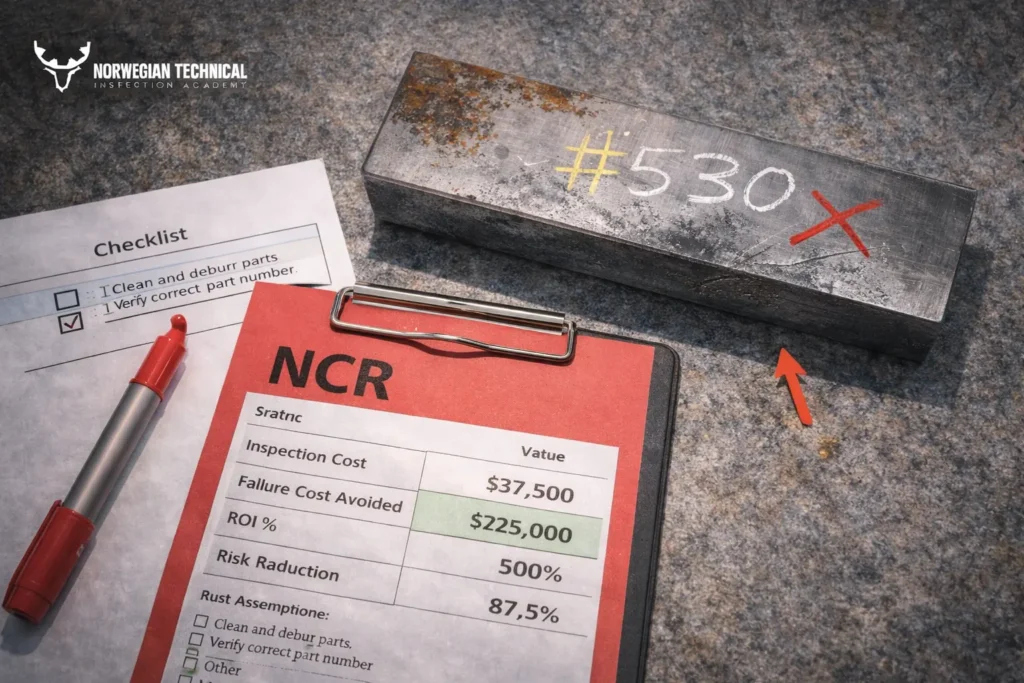
- wrong material grade vs PO/spec (e.g. ASTM A105 instead of A350 LF2 for low-temperature service)
- mixed heats or lost traceability; tags no longer match MTCs
- incomplete or inconsistent MTCs (missing mechanical/chemical data, wrong standards)
- PMI not performed where required, or results not traceable to specific items
Example NCR Wording
“MTC No. 24-017 for forging batch F-122 lists material grade ASTM A105, whereas PO 450123 and datasheet DS-VLV-004 specify ASTM A350 LF2. This is a nonconformity against project material specification M-101.”
Why It Matters
- Material mix-ups directly affect strength, toughness, and corrosion resistance.
- Incorrect MTCs and missing PMI weaken traceability and legal defensibility.
Immediate Fixes
- Segregate all material and components potentially affected by the suspect heat or grade.
- Perform PMI and/or additional tests on a risk-based sample or 100% of affected items.
- Replace, downgrade, or scrap nonconforming items; update the full MTC package.
How to Prevent It
Welding & Fabrication Nonconformities
Typical Issues
- weld defects found by VT/MT/PT/RT/UT (lack of fusion, undercut, porosity, slag inclusions)
- WPS not qualified to the correct code, or essential variables changed without re-qualification
- welders not qualified for the process/position/material combination
- preheat/interpass temperatures not recorded; PWHT cycles missing or not per procedure
Example NCR Wording
“UT of shell-to-nozzle welds on Vessel V-301 revealed areas of lack of fusion exceeding ASME VIII Div.1 acceptance criteria. Welds were made by Welder ID 217, who is not qualified for position 5G on SA-516 Gr.70 under WPS W-07.”
Why It Matters
- Weld nonconformities compromise pressure integrity, fatigue life, and code compliance.
- Improper welding controls are a major source of costly repair, delay, and re-NDT.
Immediate Fixes
- Mark and isolate affected welds; define repair procedures referencing relevant code clauses.
- Re-weld or repair as per qualified WPS, then repeat NDT on repaired areas and adjacent zones.
- Expand sampling if similar joints or welders were used elsewhere.
How to Prevent It
- Implement a welding quality system aligned with recognized fabrication standards and welding coordination principles. (visual & dimensional inspection guide)
- Control WPS/PQR revisions and welder qualifications; monitor welder performance with NDT trending.
- Ensure ITPs explicitly call out special-process controls (welding, heat treatment, NDT) and their acceptance criteria.
Machining, Dimensional & Assembly Nonconformities
Typical Issues
- out-of-tolerance dimensions (wall thickness below minimum, flange OD/BCD off, excessive runout)
- assembly mistakes: wrong gasket type, missing bolts, reversed components, misaligned supports
- incorrect surface finish or flange facing (e.g. not to ASME B16.5 profile or roughness requirements)
Example NCR Wording
“Random dimensional check on Valve Tag FV-117 revealed raised face height of 9.0 mm against specified 2.0–3.2 mm per ASME B16.5 for Class 600, 4” RF flange. This is a nonconformity against drawing DR-V-013 Rev.2 and ASME B16.5.”
Why It Matters
- Dimensional and assembly errors cause installation problems, leak paths, and mechanical overstress.
- They often surface late — during commissioning — when correction is most expensive.
Immediate Fixes
- Isolate the batch and re-measure critical dimensions; identify the full scope of impact.
- Re-machine or repair where possible; re-assemble correctly and repeat functional checks.
- In severe cases, scrap and re-manufacture.
How to Prevent It
- Use structured visual/dimensional workflows such as [Visual & Dimensional Checks: Step-by-Step] (W3.2).
- For valves, apply the structured checklist approach in [Valve Inspection Checklist (PDF): Visual, Dimensional, Testing] (W1.2).
- Build clear dimensional checkpoints, sampling levels and instruments into your ITPs.
- Ensure all measuring tools are calibrated and suitable for the tolerances you are checking.
Surface Preparation, Coating & Painting Nonconformities
Typical Issues
- inadequate surface cleaning (remaining rust, mill scale, oil, salts)
- incorrect blast profile (too smooth or too rough)
- DFT readings below minimum or far above maximum range
- wrong coating system or color coding versus project spec
Example NCR Wording
“DFT measurements on steel lot ST-04 showed 40–55 μm on intermediate coat, whereas project spec PS-COAT-02 requires 80–120 μm. This is a nonconformity against PS-COAT-02 Section 5.3.”
Why It Matters
- Under-coated steel corrodes early; over-thick coatings may crack or delaminate.
- Re-coating is labour-intensive and often causes schedule slippage.
Immediate Fixes
- Decide whether local touch-up is acceptable or full re-blast/re-coat is required.
- Control environmental conditions (temperature, humidity, dew point) during repair.
- Re-measure DFT; perform adhesion or holiday tests where specified.
How to Prevent It
- Qualify coating procedures and applicators; control batch, mixing, and environmental conditions.
- Integrate surface prep and DFT checks into the ITP with clear acceptance ranges.
- Capture DFT data in structured logs that can be reviewed by QA/QC and client.
Testing & Functional Nonconformities
Typical Issues
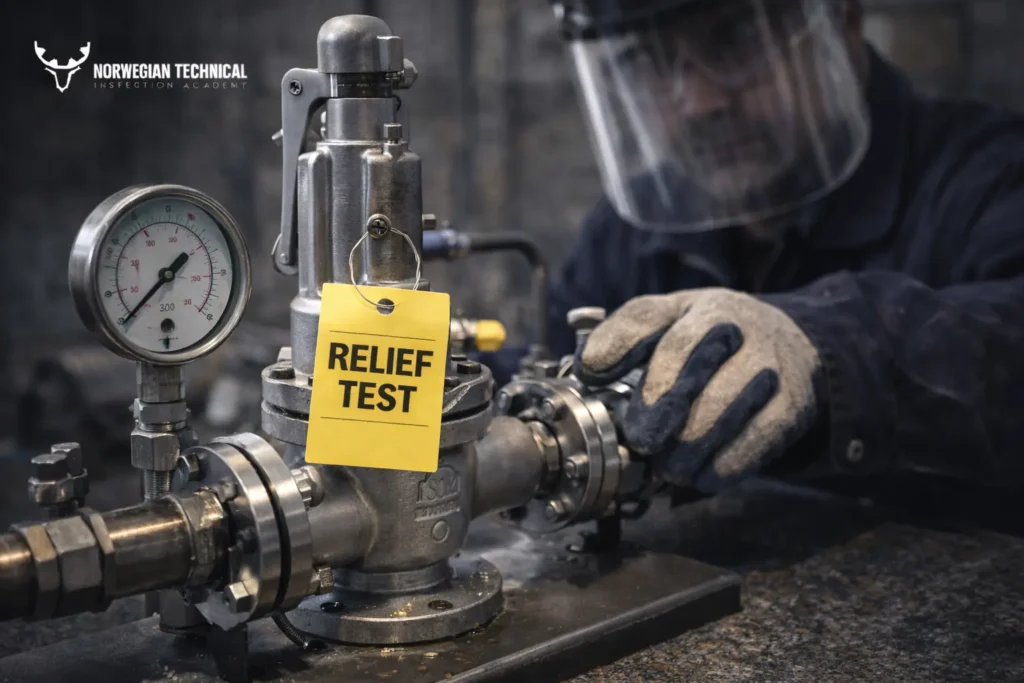
- Hydrostatic test problems
- test pressure below required factor (e.g. < 1.5 × design)
- hold time too short
- uncalibrated pressure gauges/recorders
- visible shell leakage or unacceptable pressure decay
- Seat leak and tightness failures
- leakage beyond the limit for the specified leakage class
- wrong test medium, pressure or direction
- incomplete or missing seat leak records
- Functional test deviations
- actuator fail-safe position incorrect
- stroke time outside spec
- torque higher than actuator capability, or valve not reaching full travel
Example NCR Wording
“Seat leak test on Valve XV-210 (DN150, Class 600) recorded continuous bubbles at downstream flange when tested at 100% rated pressure in water. The project spec and governing standard require zero visible leakage for soft-seated valves in this service. Valve is nonconforming.”
Why It Matters
- Test failures reveal direct safety, reliability, and environmental risks.
- Weak test setups create disputes and force repeat FATs.
Immediate Fixes
- Verify test setup: connections, test medium, gauges, venting, and procedures.
- Repair (e.g. re-lap seats, replace soft parts, adjust actuators) and repeat the full test under controlled conditions.
- Extend checks to similar tags in the same batch.
How to Prevent It
Align your test procedures and acceptance with Hydrostatic vs Seat Leak Tests: Procedures & Acceptance and API 598 vs ISO 5208: Valve Testing Acceptance.
- Make hydrostatic, seat leak, and functional tests clear stages in ITPs with defined witness/hold points.
- Ensure test bay technicians are trained on the standards, acceptance criteria, and correct use of calibrated instruments.
Marking, Nameplates, Packing & Preservation Nonconformities
Typical Issues
- incorrect nameplate data (tag, rating, service, material, design code)
- missing mandatory markings (e.g. CE mark, serial numbers, design pressure/temperature)
- mismatch between nameplate and drawings/datasheets/MTCs
- poor packing and preservation (no flange protectors, no VCI, wrong lifting lugs, inadequate bracing)
Example NCR Wording
“Nameplate for Pump P-104 shows service ‘Condensate’ and design pressure 10 barg, whereas datasheet DS-P-104 specifies service ‘Produced Water’ and design pressure 25 barg. Additional nameplates show inconsistent tag numbers within the same batch.”
Why It Matters
- Mislabelled equipment increases risk of mis-installation and wrong service use.
- Poor packing leads to damage in transit and corrosion during storage.
Immediate Fixes
- Replace or correct nameplates and tagging; verify all data against the latest approved docs.
- Re-pack equipment per project packing/preservation specs.
- Inspect items for damage; issue NCRs for any transport damage discovered.
How to Prevent It
- Use standardized, QA-controlled nameplate templates.
- Include a dedicated final “marking & packing check” as a step in the ITP.
- Train warehouse and logistics teams on preservation requirements and lifting instructions.
- Consider bundling your checklists and mini-forms in a central toolkit like Master Inspection Templates Pack (ZIP): ITP, Checklists, Forms
Systemic / Repeating Nonconformities — When It’s a QMS Problem
Some nonconformities are not one-off mistakes, but signs of deeper issues:
- the same documentation or calibration problems show up across multiple POs,
- weld defects keep repeating on similar joints,
- the same valve failure modes appear after FAT, installation, and early operation.
At this point, the problem is no longer only “one bad part” — it is a system nonconformity inside the vendor’s QMS.
Practical actions:
- escalate from NCR level to CAPA level; involve vendor management
- request a structured corrective action plan with clear owners and deadlines
- plan targeted vendor audits on the weak processes (welding management, incoming inspection, calibration, document control)
- use technical analysis to understand whether design, operation, or manufacturing is driving repeated failures
Using NCR Trends to Improve Vendor Performance
NCR Logs & Supplier Metrics
A single NCR tells you what happened once. An NCR log tells you:
- which vendors have stable quality, and which ones drift,
- which product families (valves, vessels, structures) are highest-risk,
- and which types of defects (docs, materials, tests) dominate your risk profile.
Common KPIs include:
- NCRs per 100 POs or per 1 M EUR/USD of spend,
- percentage of NCRs by category (docs, materials, welding, tests, etc.),
- recurrence rate (how often the same root cause appears again).
Combined with receiving data and sampling policies from [Receiving Inspection Sampling Plans (AQL)] , this helps you justify stronger or lighter surveillance on specific vendors and products.
From NCRs to Vendor CAPA & Approval Decisions
Mature QA/QC programs use NCR trends to drive:
- vendor-level CAPA plans (corrective and preventive actions),
- approval status changes (approved, conditional, probation, disqualified),
- and changes in inspection level (more/less site visits, higher/lower sampling).
Typical elements of a good vendor CAPA:
- precise problem statement and risk description
- honest, evidence-based root cause analysis (not “operator error” for everything)
- actions that modify processes, training, tooling, or design, not just one item
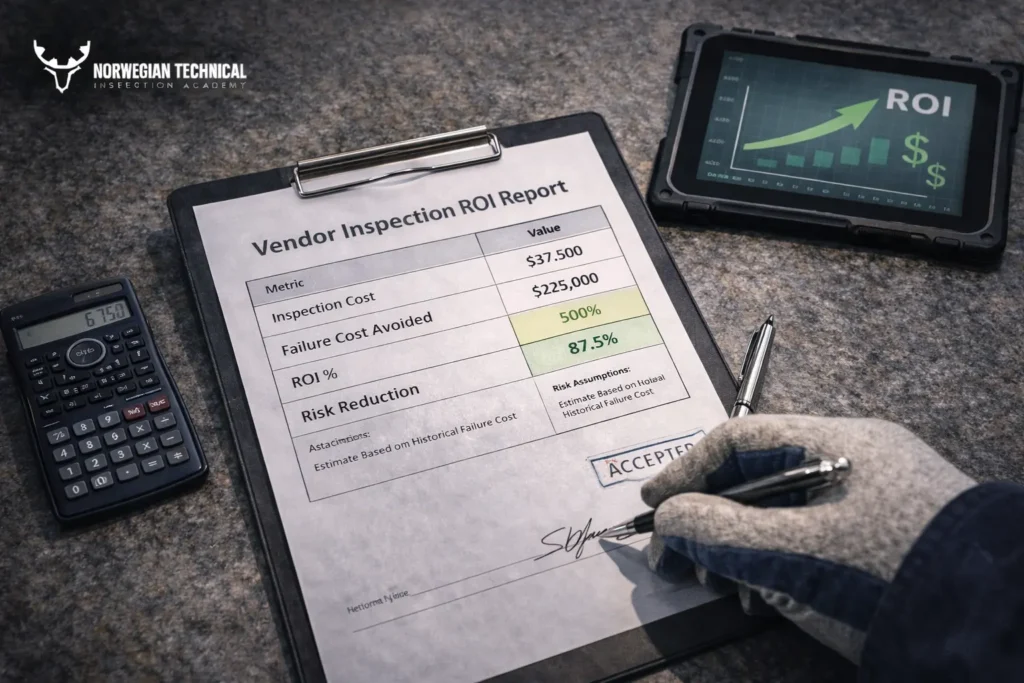
- effectiveness checks (e.g. 6–12 months with reduced NCR frequency)
The outputs of this process later feed directly into management and procurement communication; when you need to justify tougher controls or vendor changes, having clear NCR and CAPA history makes those decisions defensible.
Need this implemented in a live project?
If you want independent presence at the vendor (planning, hold/witness coverage, and acceptance-grade reporting),
NWE can support with third-party inspection and quality surveillance.
FAQ: Vendor Nonconformities in Practice
What are the most common vendor nonconformities?
Across many oil, gas, and energy projects, the same patterns appear:
- missing/incorrect documents and ITP signatures
- material identification and MTC/PMI issues
- weld defects and NDT findings beyond acceptance
- dimensional and assembly errors
- test and functional failures
- wrong nameplates, poor packing, and preservation gaps
Most can be traced back to weaknesses in ITP design, training, document control, or supplier management.
How many NCRs are “too many” from one vendor?
There is no universal limit, but you should be concerned when:
- NCR frequency is increasing instead of decreasing,
- the same causes keep reappearing,
- or fundamental issues (documents, calibration, ITP discipline) are not improving.
Many organizations define thresholds in their supplier evaluation procedure, linking NCR rates to approval status and surveillance level.
When do I need a full NCR instead of just a punch list note?
Raise a full NCR when:
- safety, function, or regulatory compliance may be affected,
- you need a formal decision (e.g. repair vs replacement vs concession),
- the issue is systemic or has occurred before,
- or the client’s procedures require NCRs for specified defect types.
Punch lists are fine for minor, low-risk items that can be rectified quickly without ambiguity.
Who should approve “use-as-is” or concession decisions?
Concessions should be approved by the buyer/owner (or their appointed representative), with input from engineering, QA/QC, and sometimes HSE or integrity teams. Vendors must not self-approve concessions; decisions and technical justifications need to be documented in the NCR/MRB records.
Can a vendor stay “approved” if they have many minor nonconformities?
Yes — but frequent minor nonconformities often indicate poor discipline or weak systems. If minor issues keep repeating, treat them as a systemic QMS problem, request a formal CAPA, and consider adjusting approval status or surveillance level until the trend improves.