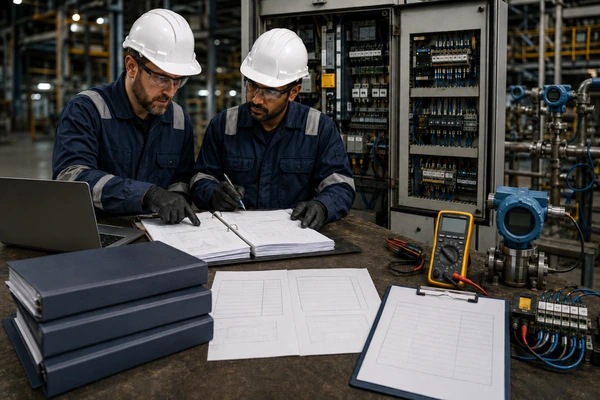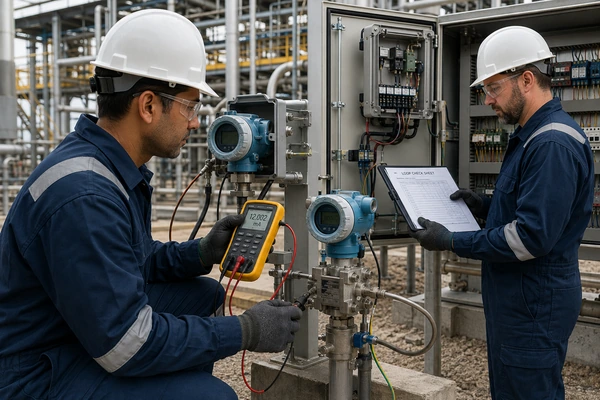
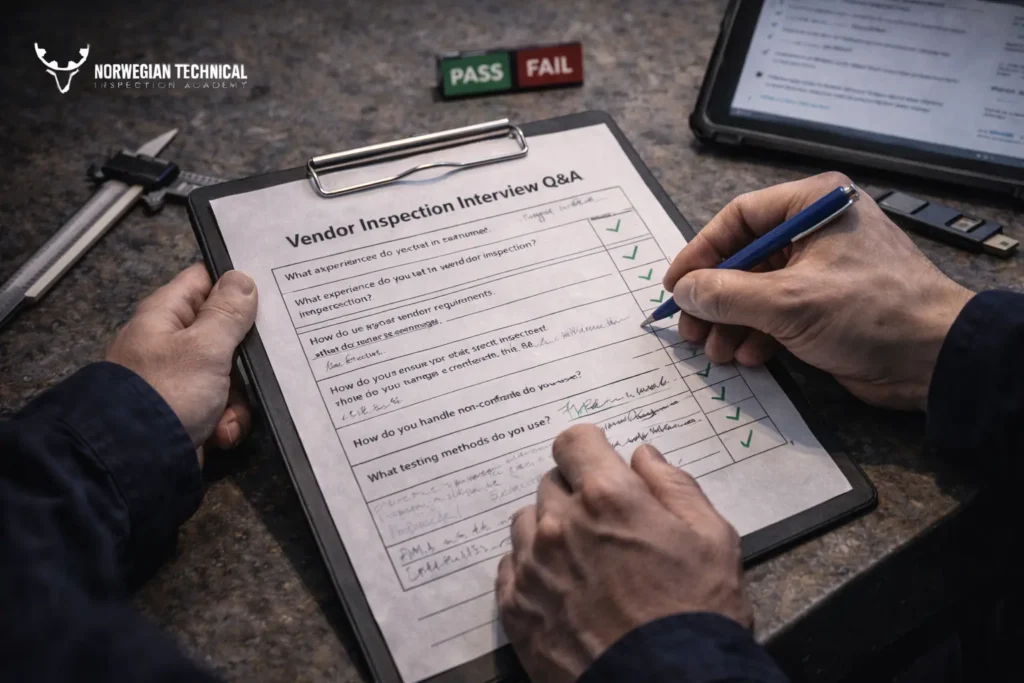
Vendor inspection roles are changing fast.
In 2025, hiring managers don’t just want someone who can “tick boxes” on an ITP. They want inspectors and supplier quality engineers who understand:
This guide gives you 30 vendor inspection interview questions with example answers you can use:
Along the way, we’ll connect to practical tools like:
Use the questions as they are, or adapt them for your own projects and industries.
Q1. How do you explain “vendor inspection” to a non-technical stakeholder in your company?
A strong answer shows the candidate can translate technical work into business impact:
“I explain vendor inspection as the way we make sure suppliers deliver what we paid for — safely, on time and in full compliance with the contract.
We visit or monitor their manufacturing, review documents and tests, and check final products before shipment.
The goal is to prevent quality and schedule problems from reaching our site, where they are much more expensive to fix.”
They might briefly refer to concepts from What Is Vendor Inspection? Roles & Responsibilities, but in plain language, not code words.
Q2. What are the key differences between vendor inspection and in-house production inspection?
Look for understanding of context:
“In in-house inspection we control processes we own. We can change internal procedures and workflows.
In vendor inspection, we work with independent companies. Everything is defined by the PO, specifications and codes.
So we focus more on:
Q3. In your view, what are the top three objectives of vendor inspection on a capital project?
Good answers mention:
For example:
“First, prevent nonconforming equipment from going to site — especially safety-critical items.
Second, protect the project schedule by catching issues early in the vendor’s shop, not at site.
Third, secure complete documentation and traceability so that later audits, repairs and operation are supported.”
Q4. Which typical vendor inspection deliverables do you expect at the end of a project?
Look for a structured list:
“I expect:
Q5. How do you prioritise which purchase orders or packages should receive more vendor surveillance than others?
You want to hear risk-based thinking:
“I use a risk-based approach:
Q6. How do you build or review an Inspection & Test Plan (ITP) for a new vendor package?
A solid answer connects the ITP to requirements:
“I start from the PO, datasheet, applicable codes and client specs.
Then I:
“Using a standard structure like the NTIA Vendor Inspection ITP Template (Excel) really helps keep things consistent across suppliers.”
Q7. What’s the difference between an ITP and a QCP, and how do they work together in vendor inspection?
The candidate should not confuse the two:
“The ITP is the inspection and test view — it lists the checks, tests, witness and hold points, and which documents prove compliance.
The QCP (Quality Control Plan) is broader: it covers the vendor’s internal control of processes, people, procedures and equipment.
In practice, we use the QCP to understand how the vendor intends to control quality, and we overlay our ITP to decide where we need to present or review evidence.
Articles like ITP & QCP in Vendor Inspection – 6-Step Builder + Templates describe this interface very well.”
Q8. Can you walk us through how you plan your shop visits over the manufacturing schedule?
Look for practical planning:
“I align my visits with milestones where:
Q9. How do you handle situations where the vendor is not ready at a planned witness or hold point?
You want a mix of firmness and practicality:
“First, I verify whether the scope change is genuine or just poor planning.
If they’re not ready:
Q10. How do you balance inspection coverage with limited man-days and budget?
Good candidates talk about optimisation, not perfection:
“You can’t be everywhere all the time, so I use:
Q11. Which international codes and standards do you most commonly use in vendor inspection, and how do you stay current?
Look for relevant families (API, ASME, ISO, EN, etc.) plus a method:
“In my last roles I’ve worked mostly with API 598 and ISO 5208 for valve testing, ASME VIII for pressure vessels, ASME B31.3 for piping, and various EN/ASTM material standards.
I stay current by:
Q12. How do you verify that material certificates and MTCs are correct and traceable to the product?
You want to hear a systematic checklist, not “I just look at it”:
“I check:
I also look at consistency across multiple certificates and deliveries. Repeated mistakes on certificates are an early warning sign about the supplier’s internal quality system.”
They might mention tools like the MTC Interpretation Guide + Checklist at NTIA (by name, even if you don’t link it here).
Q13. What is the difference between a vendor audit and a vendor inspection, and when would you use each?
A precise answer:
“A vendor audit is a systematic evaluation of the supplier’s quality system, processes and organisation. It’s typically done at qualification stage or periodically, and looks at how they work in general.
A vendor inspection is project or PO specific. It focuses on whether a particular order is being manufactured and tested according to contract.
I use audits to assess whether a supplier should be on the AVL and to understand their system maturity. I use inspections to make sure each delivery actually complies with what we ordered.”
They can mention Vendor Audit vs Vendor Inspection: Key Differences as a concise reference.
Q14. Describe how you check that the final documentation and data book from a vendor is complete before final acceptance.
Good answers show a checklist mindset:
“I start from the contractual document index and the ITP. For each required document — certificates, test reports, drawings, manuals — I verify:
I also check that all punch list items and NCRs are closed and referenced in the dossier. Only then do I recommend final acceptance.”
This aligns well with practices from Vendor Inspection Reporting: IR, NCR & Final Dossier Guide.
Q15. Can you give an example where documentation or traceability issues made you stop or delay a shipment? How did you handle it?
You want a realistic scenario with clear reasoning:
“On a valve package, the physical nameplates and body castings didn’t match the pressure class stated on the datasheets.
The MTCs were correct, but traceability between body, trim and certificates wasn’t proven.
I stopped the shipment, raised an NCR and requested:
Q16. Walk us through your typical process from detecting a nonconformity at a vendor to issuing and closing an NCR.
You want to hear steps and structure:
“First, I confirm the requirement and the deviation — spec, drawing, code.
Second, I classify the severity (critical, major, minor) and whether immediate containment is needed.
Third, I discuss it with the vendor on site to avoid misunderstandings, then issue an IR or NCR with clear description, evidence and references.
Fourth, I follow up on their corrective action plan, asking for root cause analysis and proposed corrections.
Finally, I verify effectiveness — by re-inspection or data review — before closing the NCR and updating our records.”
Q17. How do you distinguish between a minor deviation that can be accepted and a major nonconformity that requires full NCR and possible rework?
Good candidates think in risk and impact, not personal preference:
“I evaluate:
A cosmetic paint defect on non-critical surfaces may be a minor deviation with a concession. A dimension out of tolerance on a sealing surface is major and must be treated as a nonconformity, even if fixing it affects schedule.”
Q18. Tell us about a recurring vendor nonconformity you faced. How did you drive a real corrective action instead of just fixing the symptom?
You want a story that reflects the spirit of Common Vendor Nonconformities & Fixes:
“We had repeated documentation issues from a fabricator: missing EN 10204 certificates and wrong welding procedure numbers.
Instead of just rejecting and asking for re-send each time, we raised a systemic NCR and requested a root cause analysis.
Their investigation showed poor training of document control staff and no internal checklists.
They implemented:
Within two projects, documentation-related NCRs from that vendor dropped to almost zero.”
Q19. How do you make sure lessons learned from vendor NCRs are actually used in future POs and ITPs?
Look for a feedback loop:
“After closing NCRs, I summarise key lessons in a short report or database entry:
For repeating patterns, I work with QA and engineering to:
That way we don’t just ‘put out fires’; we change the system that allowed the problem.”
Q20. How do you report vendor quality issues in a way that is useful for procurement and management decisions, not just QA/QC?
Here the candidate should connect to vendor performance and scorecards, like in the article SQS KPIs That Matter (Vendor Scorecards):
“I translate quality events into simple metrics:
I summarise this per supplier per year. Procurement can then:
Q21. What has changed in vendor inspection in recent years with the rise of digital QMS and remote/virtual inspections?
Modern answers reflect current trends:
“We now see:
This improves transparency and reduces travel, but it also requires clear protocols for evidence, data integrity and cybersecurity. Inspectors need to be comfortable verifying things on screen as well as on the shop floor.”
Market analyses show strong growth in AI and digital quality inspection tools in 2024–2025, driven by manufacturers seeking to cut defect rates and recall costs.
Q22. Have you ever conducted or participated in a remote vendor inspection or audit? What worked well, and what didn’t?
Look for concrete experience:
“Yes. During travel restrictions we conducted several remote inspections.
What worked well:
What didn’t:
We solved some of this by combining live sessions with high-quality photos and short video clips uploaded to the portal.”
Q23. How would you evaluate and use AI-based inspection data when making acceptance decisions?
This tests critical thinking about new tools:
“I see AI-based inspection as another source of evidence, not a black box that replaces judgment.
I would ask:
If the system is validated and integrated into the QMS, I can use its output to support acceptance decisions, but I still cross-check critical items and investigate patterns it highlights.”
Studies show AI vision systems can now detect small surface defects with very high accuracy, but they require robust data governance to be reliable in production.
Q24. In your view, what are the biggest opportunities and risks of relying on digital tools and AI in vendor inspection?
Good answers balance optimism and caution:
“Opportunities:
Risks:
The key is to treat digital tools and AI as support for qualified inspectors and engineers, not substitutes for them.”
Q25. Tell us about a time you had a serious disagreement with a vendor about an inspection result. How did you handle it?
You want emotional control and clarity:
“On a pump package, the vendor argued that a dimensional deviation was ‘within tolerance’ based on their internal drawing, which was obsolete.
I stayed calm, showed the latest client-approved drawing and spec, and explained the risk.
We escalated the issue to a short technical meeting with engineering and the vendor’s QA manager.
The outcome was re-machining and updating drawing control at the vendor. Communication stayed professional throughout.”
Q26. Describe a situation where you had to defend a quality decision that impacted project schedule or cost. What was the outcome?
Look for courage and pragmatism:
“I once refused to release a batch of valves with incomplete seat leak testing.
Project management initially pushed to ship and ‘test later on site’ to save time.
I explained the risk in cost and reputation if the valves failed in service.
We agreed to a compressed test programme at the vendor with client presence.
It delayed shipment by three days, but prevented a major site issue and the client explicitly appreciated the decision in their close-out report.”
Q27. Give an example of how you helped a weaker vendor improve their quality performance over time.
Here you want supplier development thinking:
“A small fabricator had frequent NCRs for weld consumables and WPS use.
Instead of just rejecting their work each time, we:
Over a year, their weld-related NCRs dropped significantly, and they became a reliable supplier for standard items.”
Q28. How do you handle pressure when multiple vendors, sites and inspectors need your attention at the same time?
Listen for prioritisation, not heroics:
“I:
I’m transparent about capacity limits so stakeholders understand trade-offs instead of being surprised by delays.”
Q29. Tell us about a time you made a mistake in vendor inspection. How did you detect it, and what did you do next?
You want honesty and learning:
“Early in my career I missed a small mismatch between drawing revision and a test report on a pressure vessel.
We discovered it during the final dossier review.
I informed my supervisor, we checked whether any acceptance criteria were affected — fortunately they weren’t — and we corrected the documentation.
As a lesson learned, I added a simple cross-check step for drawing revisions in my inspection reports and shared it with the team.”
Q30. Where do you see the role of vendor inspection and supplier quality heading in the next 3–5 years? How are you preparing for that?
Modern, forward-looking answers might include:
“I see vendor inspection becoming:
I’m preparing by:
Use these questions to:
Mentioning frameworks from NTIA articles (ITPs, IR/NCR structure, scorecards) in your own words can demonstrate that you think systematically, not just by habit.
You can turn this list into a structured interview guide:
Combine this with practical exercises, such as:
This gives you an evidence-based view of whether the candidate can operate effectively in your vendor ecosystem.
Good answers in an interview are only the beginning. To turn them into real performance on projects, teams need clear processes and templates.
NTIA’s vendor inspection toolkit can help you operationalise what you’ve seen in this Q&A:
Used together, these tools help vendor inspectors, supplier quality engineers and procurement teams move from ad-hoc interviews and “tribal knowledge” to a shared, disciplined approach to supplier quality surveillance.

At NTIA (Norwegian Technical Inspection Academy), we specialize in delivering world-class training programs in vendor inspection, quality surveillance, and technical compliance – specifically tailored for professionals in the oil, gas, and energy industries.
Copyright © 2025 by NTIA. All Rights Reserved.