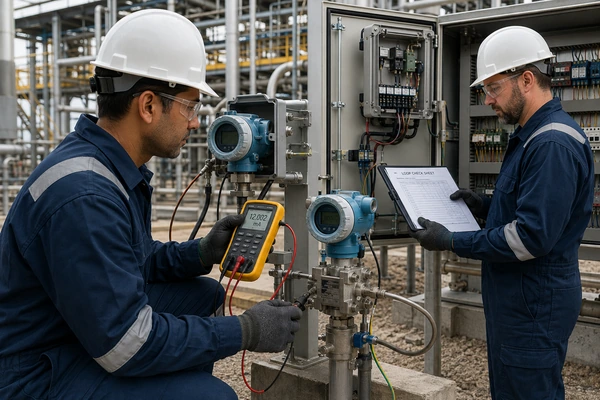
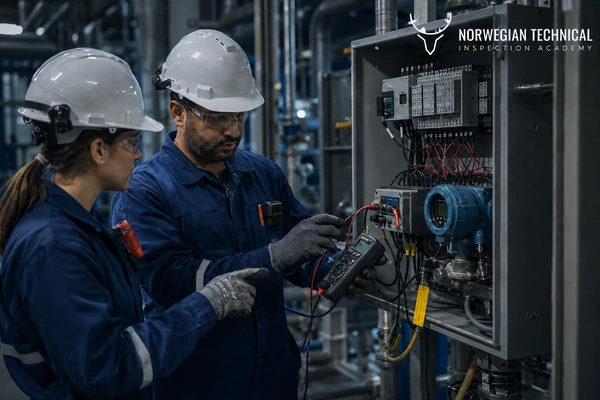
E&I inspection is the quality control process used to verify electrical and instrumentation systems before, during and after installation, testing, commissioning and handover. It covers electrical panels, cables, junction boxes, field instruments, calibration, loop checks, FAT/SAT, inspection records and final documentation.
In industrial projects, E&I inspection helps confirm that electrical and instrumentation work is installed, tested and documented according to approved drawings, project specifications, applicable standards, safety requirements and the inspection and test plan.
For QA/QC teams, E&I inspectors, site inspectors, vendor inspectors and commissioning personnel, E&I inspection is not only about checking cables or instruments. It is about confirming that the full electrical and instrumentation system is traceable, safe, functional, testable and ready for handover.
If you want structured training on this subject, NTIA provides an Electrical & Instrumentation Inspection Training Course covering E&I inspection principles, testing methods, quality control, documentation and compliance requirements.
E&I stands for Electrical and Instrumentation.
In industrial projects, the electrical scope usually covers power distribution, electrical panels, cables, earthing, lighting, motors, protection systems and electrical safety. The instrumentation scope usually covers field instruments, transmitters, control valves, gauges, junction boxes, control loops, calibration, signal verification and control system interfaces.
Although electrical and instrumentation are often grouped together, they are not the same discipline. Electrical systems mainly deal with power, protection and safe energization. Instrumentation systems deal with measurement, monitoring, control signals and process response.
A competent E&I inspector must understand both sides well enough to verify installation quality, test records and project compliance.
E&I inspection is the verification of electrical and instrumentation materials, installation, testing, calibration, loop checking, functional performance and documentation against approved project requirements.
It may take place during:
The goal is to make sure that the E&I scope is not only physically installed, but also correctly tested, documented and ready for safe operation.
E&I systems are critical to the safety, control and reliability of industrial facilities. A small error in wiring, termination, calibration, earthing or loop configuration can create major operational problems.
Poor E&I quality can lead to:
In oil and gas, energy, petrochemical, marine, manufacturing and process industries, E&I inspection helps prevent these issues before the system reaches operation.
Good E&I inspection also reduces rework. Finding a wrong cable tag, incorrect termination or missing calibration certificate during inspection is much cheaper than discovering it during start-up.
Electrical and instrumentation inspections are connected, but their focus areas are different.
| Area | Electrical Inspection | Instrumentation Inspection |
| Main focus | Power, protection and electrical safety | Measurement, control and signal accuracy |
| Typical items | Cables, panels, motors, breakers, earthing, lighting | Transmitters, gauges, control valves, junction boxes, loops |
| Common tests | Insulation resistance, continuity, earthing checks, panel inspection | Calibration, loop checks, function tests, signal verification |
| Key documents | Single-line diagrams, cable schedules, panel drawings, test reports | Instrument index, datasheets, loop diagrams, calibration records |
| Main risk | Unsafe power distribution or energization | Incorrect measurement, control or process response |
A strong E&I inspection program does not treat these areas separately in isolation. It checks how electrical supply, instrument signals, control systems and field installation work together.
E&I inspection can include many activities depending on the project scope, equipment type and inspection stage. The following are the most common inspection areas.
Before installation or testing, inspectors should verify that materials and documents are correct and approved.
This may include:
The inspector should confirm that the installed or supplied items match the approved project requirements. This is especially important for tagged instruments, cables, control panels, hazardous area equipment and safety-related devices.
Cables are one of the most common sources of E&I installation problems.
Cable inspection may include checking:
For instrumentation cables, shielding and grounding details are especially important because poor termination can create signal noise or unstable readings.
Panels and junction boxes must be inspected both physically and against approved drawings.
Typical checks include:
For vendor-supplied panels, inspection may happen during FAT. For site-installed panels and junction boxes, inspection usually continues during installation and pre-commissioning.
Earthing and grounding are critical for personnel safety, equipment protection and signal integrity.
Inspection may include checking:
Poor grounding can create both safety hazards and instrumentation problems. In some cases, it may also affect control system reliability.
Insulation resistance testing verifies the condition of cable insulation and electrical circuits before energization. Continuity testing confirms that conductors and cable cores are correctly connected from one end to the other.
Inspectors usually check:
The inspector does not only look at the number in the report. The report must clearly identify what was tested, when it was tested, with which equipment and against which acceptance requirement.
Continuity checks are especially important before loop checking, because a loop cannot be properly verified if the basic wiring path is incorrect.
Field instruments must be installed according to datasheets, hook-up drawings and project specifications.
Typical inspection points include:
For pressure, temperature, flow and level instruments, the installation detail can directly affect measurement accuracy. A correctly calibrated instrument may still perform poorly if installed incorrectly.
Calibration confirms that an instrument measures or responds within an acceptable range.
Inspectors usually review:
Calibration review is not just a paperwork activity. It confirms that the instrument is technically ready to be included in a loop and later in a functional test.
A loop check verifies the full signal path from the field instrument to the control system and, where applicable, back to the final control element.
A typical loop may include:
During a loop check, inspectors may verify:
Loop check records are important handover documents. Missing or incomplete loop check records can delay commissioning.
E&I inspection may include both FAT and SAT.
FAT, or Factory Acceptance Test, is performed at the vendor or manufacturer’s facility before equipment is shipped. It is commonly used for control panels, PLC panels, electrical panels, analyzers, packaged systems and other vendor-supplied E&I equipment.
SAT, or Site Acceptance Test, is performed after delivery and installation at site to confirm that the equipment still meets requirements in its actual installation environment.
Typical FAT/SAT checks may include:
For inspectors, FAT and SAT are not just formal events. They are key opportunities to identify nonconformities before commissioning.
E&I FAT activities may also connect with other equipment packages, especially where electrical, instrumentation and control checks are part of a larger mechanical package. For example, rotating equipment packages may require E&I verification for controls, alarms, motors, instruments and protection systems. See also: rotating equipment inspection and FAT.
In oil and gas, petrochemical, energy and process facilities, E&I inspection often involves equipment installed in hazardous areas.
Inspectors may need to verify:
Terms such as ATEX, IECEx and CompEx may appear in this context. The inspector should understand the purpose of hazardous area requirements, even if the project has a separate Ex inspector or specialist.
Incorrect hazardous area installation can create serious safety risks. For this reason, Ex-related E&I checks must be treated carefully and according to project requirements and applicable regulations.
An Inspection and Test Plan, or ITP, defines what must be inspected, when it must be inspected, which documents are required and who must be involved.
For E&I work, an ITP may include:
Common inspection points include:
| Inspection Point | Meaning |
| Hold Point | Work cannot proceed without required inspection or approval |
| Witness Point | Client or inspector may witness the activity |
| Review Point | Documents or records must be reviewed |
| Surveillance | General monitoring of work quality and compliance |
A good E&I inspector must understand the ITP before attending inspection. Without the ITP, it is easy to miss required records, witness points or acceptance criteria.
The exact checklist depends on the project, but a basic E&I inspection checklist may include the following.
| Area | Typical Checks |
| Documents | Approved drawings, instrument index, cable schedule, loop diagrams, ITP, calibration records |
| Electrical items | Cable type, cable tags, routing, glands, terminations, insulation resistance, continuity, earthing |
| Panels and junction boxes | Nameplate, wiring, terminals, ferrules, segregation, enclosure rating, cleanliness |
| Instrumentation items | Tag numbers, installation, hook-up, process connection, calibration, ranges and units |
| Loop checks | Signal path, control system response, alarm setpoints, loop sheets, punch items |
| Handover | Test records, NCR closure, punch status, as-built drawings, final dossier |
The checklist should always be used together with approved drawings, project specifications, test procedures and the ITP.
E&I inspection often identifies issues that may look small but can create major commissioning problems.
Common findings include:
The value of E&I inspection is not only finding these issues. It is recording them properly, following up corrective actions and confirming closure before the system is accepted.
Documentation is a major part of E&I inspection. A system may be physically complete but still not ready for handover if the records are missing or incomplete.
A typical E&I final dossier may include:
Inspectors should check that every record is traceable to the correct tag, cable, panel, loop or system. Good traceability makes future maintenance, troubleshooting and audits much easier.
An E&I inspector does not need to be a design engineer, but must understand enough technical detail to verify quality and compliance.
Important skills include:
Technical knowledge is important, but inspection discipline is just as important. The inspector must be methodical, document-driven and able to compare site conditions against approved requirements.
E&I inspection training is useful for professionals who need to inspect, verify or manage electrical and instrumentation quality in industrial projects.
This includes:
The training is especially relevant for teams working in oil and gas, petrochemical, power generation, marine, manufacturing, fabrication and process industries.
People who move into E&I inspection often come from electrical, instrumentation, commissioning, maintenance or QA/QC backgrounds.
A practical training path should cover:
NTIA’s Electrical & Instrumentation Inspection Training Course is designed for professionals who need structured knowledge of E&I inspection, testing, quality control, safety and compliance in industrial projects.
You can also check the upcoming E&I inspection training dates in the NTIA training calendar.
E&I inspection is the quality control process used to verify electrical and instrumentation systems, including cables, panels, instruments, calibration, loop checks, testing records and final documentation.
An E&I inspector checks electrical and instrumentation materials, installation quality, cable termination, panel wiring, instrument installation, calibration records, loop checks, FAT/SAT results, test reports and final handover documents.
Electrical inspection focuses on power systems, cables, panels, protection, earthing and electrical safety. Instrumentation inspection focuses on field instruments, signals, calibration, loop checks, control system response and measurement accuracy.
A loop check verifies the full signal path from the field instrument to the control system and, where applicable, to the final control element. It confirms tag number, wiring, signal response, range, unit, alarm and functional behavior.
Calibration confirms that an instrument measures or responds within the required tolerance. Without valid calibration, the instrument reading may be unreliable, even if the installation looks correct.
Common documents include approved drawings, instrument index, cable schedule, loop diagrams, datasheets, calibration certificates, test reports, FAT/SAT records, punch lists, ITPs and final dossier documents.
No. E&I inspection may start during material receiving or vendor FAT and continue through installation, testing, pre-commissioning, commissioning support and final handover.
E&I inspection training is useful for QA/QC inspectors, electrical engineers, instrumentation technicians, commissioning personnel, maintenance engineers, vendor inspectors and project quality teams working in industrial projects.
E&I inspection is a critical part of industrial quality control. It connects electrical installation, instrumentation accuracy, testing, calibration, loop verification, documentation and final handover into one inspection process.
For inspectors, the goal is not only to confirm that equipment is installed. The goal is to verify that every cable, panel, instrument, loop and record meets the approved project requirements and is ready for safe operation.
A strong E&I inspection process helps reduce commissioning delays, prevent operational problems, improve safety and support reliable project handover.
For professionals who want to build practical competence in this field, NTIA’s Electrical & Instrumentation Inspection Training Course provides structured training in E&I inspection, testing, quality control and compliance. Upcoming course dates are available in the NTIA Training Calendar.

At NTIA (Norwegian Technical Inspection Academy), we specialize in delivering world-class training programs in vendor inspection, quality surveillance, and technical compliance – specifically tailored for professionals in the oil, gas, and energy industries.
Copyright © 2025 by NTIA. All Rights Reserved.