A coating inspection report should allow another competent reviewer to reconstruct what was inspected, where and when it happened, which requirement applied, what evidence was obtained and whether the work was accepted, rejected or left open. The final coating dossier should then connect those individual records into one controlled handover set.
The objective is to preserve the decision trail from specification and inspection point to result, repair, retest and release. This guide complements the wider coating inspection process.
The report records an inspection event; the dossier proves that the required coating activities and open issues have been controlled across the defined scope. Neither should rely on the reviewer guessing what a number, photograph or signature relates to.
A defensible evidence chain answers seven questions:
ASTM D3276-21 describes its painting-inspection guide as a reference and states that inspection requirements should be addressed in the specification, with items selected for the particular job. The project therefore defines the controlling records, values, roles and approvals.
| DOCUMENT CONTROL: This article provides an evidence model, not a universal mandatory dossier index. The contract, project coating specification, approved procedures, ITP, manufacturer’s instructions, sector rules and client document-control requirements govern the actual deliverables. |
Using one form for every purpose often hides gaps. A daily report can summarize work and inspections, but it may not contain the reading map required for a DFT decision. An NCR can control a failed requirement, but it does not replace the repair and retest records.
| Record type | Main purpose | Typical trigger | Minimum decision it should support |
|---|---|---|---|
| Daily coating inspection report | Reconstruct work, conditions, inspections and status for a shift or day | Each active inspection period | What happened, where, under which conditions, with which open actions? |
| Dedicated test record | Preserve method-specific readings, locations, equipment and result | Specified test or measurement | Does the tested scope meet the applicable criterion? |
| Inspection request or notification | Control readiness and attendance at an ITP point | Planned hold, witness, review or surveillance activity | Was the activity ready, attended and released to proceed? |
| Finding or observation | Record a condition requiring clarification or action | Evidence is incomplete or significance is not yet established | What was observed, and what evaluation is required? |
| Nonconformity report (NCR) | Control failure to fulfil a specified requirement | Objective evidence of nonconformity under the project process | What requirement failed, what disposition was approved and how was closure verified? |
| Punch item | Control defined incomplete or outstanding work | Project punch process | What remains, who owns it and what evidence closes it? |
| Repair and retest record | Prove correction of a traceable location | Approved repair or rework | Was the correct area repaired through the required stages and successfully retested? |
| Final coating dossier | Assemble the controlled evidence set for the defined handover scope | Completion or staged turnover | Is the required record set complete, current, traceable and ready for review? |
| Release or handover document | Record the authorized release decision | Completion of required review and outstanding-item control | Who released what scope, under which conditions or reservations? |
Information repeated across records should agree. If the daily report identifies Tank T-201, Area A3 and topcoat batch B-17, the test sheet, repair map and dossier index should use compatible identifiers.
For the broader distinction between inspection reports, NCRs and dossier close-out in vendor surveillance, see NTIA’s vendor inspection reporting guide. Coating records still need the additional layer, area, batch, environmental and test-location detail discussed here.
Before work starts, agree the requirement hierarchy, asset breakdown, report set, numbering system, review route and dossier index.
Record the project-approved sources that determine the inspection:
If documents conflict, record the issue and obtain controlled clarification. Cite the revision actually used.
The location reference should allow another person to find the inspected area. It may combine:
“Pipe rack” or “tank exterior” is rarely enough. Use a marked-up drawing, isometric, grid map or repair sketch where needed.
The ITP defines planned inspection involvement; the record proves what occurred. Map each relevant ITP step to its expected output before execution.
NTIA’s vendor ITP guide explains the wider relationship between inspection points, acceptance documents and records. For coating work, the mapping should also identify the system, layer and location detail needed for later dossier review.
A daily report should connect work areas, materials, conditions, inspections, results and open actions without becoming an unstructured diary.
Record the report number and revision, project, contractor or applicator, date, shift and reporting period. Identify the work package, item or area, coating system, activity and coat. Separate simultaneous areas or systems clearly.
Identify the inspector and relevant parties. Record major activities, access or readiness limits, stopped or deferred work and end-of-period status.
Attendance does not equal acceptance. Record any notification, non-attendance or authorized waiver without treating absence as approval.
As required, capture product and component, batch or lot, colour, shelf-life status, mixing details, thinner authorization, induction or pot-life information, application method and product-data-sheet revision. A reviewer should be able to connect the material to the correct system, area and time.
For each inspection entry, identify stage, location, requirement, method or checklist, result and status. Reference dedicated test sheets rather than compressing readings into a daily summary. Replace “surface prep OK” with the inspected scope, requirement, result, record reference and disposition.
Record events that affect the work or evidence, including weather changes, access limits, equipment failure, contamination, damaged coating, exceeded intervals, missing documents and rejected areas. Give each follow-up an owner, next step and status, and carry open actions forward until closed.
Environmental and surface-preparation records need a defined location, time and coating stage. Values without context cannot show which work they governed.
Capture the required environmental parameters, time, location, instrument ID, activity and result against the applicable criterion. Record significant changes and actions. Use project and product limits rather than universal values.
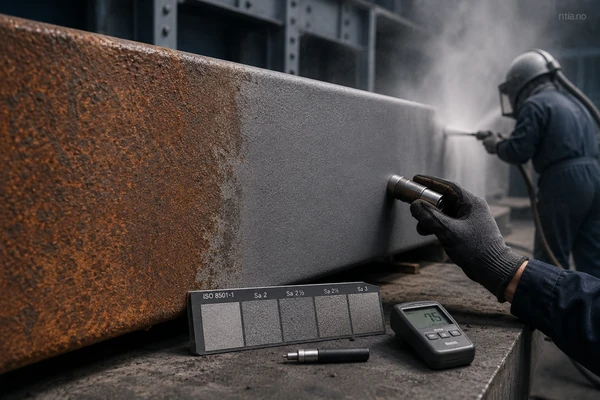
For surface preparation, identify the substrate and area, initial condition, preparation method, visual-cleanliness requirement and result, surface-profile method and result where required, and contamination checks such as dust or soluble salts when specified. ISO 8502-3:2017 covers assessment of dust on prepared steel surfaces, while ISO 8502-6:2006 describes extraction of soluble contaminants using an adhesive patch. These method references do not supply a universal acceptance value.
If coating does not begin promptly after surface acceptance, record any required continued control, protection or reinspection. Link any loss of condition and repeat inspection to the original area.
A test sheet should preserve the evidence behind the acceptance decision; the final value alone is rarely sufficient.
Include, as applicable:
Wet-film thickness (WFT) is normally process-control evidence during application; dry-film thickness (DFT) is assessed after the relevant cure stage. Keep them distinct and connect them to the correct coat or total system.
ISO 19840:2012 specifies a procedure for verifying DFT against nominal DFT on rough steel surfaces. It does not mean every project uses the same sampling plan, acceptance rule or instrument workflow. Record the method and criterion required for the actual job.
For holiday testing, identify the method, equipment, coating and thickness basis, test area, required settings, detected locations and retest status. There is no universal voltage for every system.
For adhesion or other destructive testing, record the approved locations, cure condition, preparation, equipment, results, failure observations and repair of the test areas. Separate the test result from any causal conclusion. If the test cannot be interpreted because the location or failure mode is unclear, show the limitation.
| TEST BOUNDARY: This guide describes what the record should preserve. It does not replace the approved test procedure, equipment instructions, safety controls, sampling plan or project acceptance criteria. |
A repair record should begin with the exact finding location and end with evidence that answers the original acceptance question. “Repaired” is an activity status, not proof of acceptance.
Use a controlled chain:
If the repair boundary expands, update the map and records. If one original finding creates several repair locations, give each a unique sub-reference so none can close by association with a different area.
Keep correction and corrective action distinct. Repairing a low-DFT area corrects the physical condition. A separate investigation and action may be needed if repeated low DFT indicates a systemic cause. The coating dossier should show the required repair closure; it should not present an unverified root cause as fact.
Photographs are supporting evidence, not self-explanatory proof. Pair an overview with a close image and add a scale, marker or orientation reference when useful.
Each image should be traceable through:
Preserve original files where required and control annotated copies without obscuring the condition.
Identify the device actually used and link its unique ID to the required calibration, verification or status record covering the use date. Certificates cannot support a result if the test sheet does not identify the instrument.
The matrix below is an original review tool for connecting each evidence family to the release decision. Adapt it to the project’s terminology and required documents; do not treat it as a prescribed standard form.
| Evidence family | Requirement reference | Asset, area and stage | Essential traceability | Result and status | Linked exception or closure | Release question |
|---|---|---|---|---|---|---|
| Material records | Coating schedule, approved product data and procedure | System, coat, work area and application window | Product, component, batch, shelf-life/status and issue record | Correct material confirmed or exception open | Material deviation, concession or NCR | Can every applied system be traced to accepted material? |
| Environmental log | Specification, procedure and product limits | Location, time window and activity | Instrument ID, reading time, parameters and work governed | Within criterion, stopped, repeated or pending | Weather delay, repeat check or affected area | Are the conditions connected to the work they controlled? |
| Surface-preparation record | Preparation requirement and approved method | Item, area and pre-coat stage | Initial condition, method, visual result, profile and contamination checks | Accepted, rejected or re-prepared | Finding, repeat preparation and reinspection | Is the surface release visible before it became hidden? |
| Application and WFT record | Application procedure and coating-system requirement | Area, layer, batch and application period | Method, batch, timing and WFT locations where required | Process-control result and action | Adjustment, affected area or repeat pass | Can application evidence be tied to the correct layer and material? |
| DFT or other test record | Test procedure and project criterion | Reading map, layer or completed system | Method, equipment, individual readings and calculation basis | Conforming, nonconforming or pending | NCR, repair map and retest | Does the record support the stated acceptance decision? |
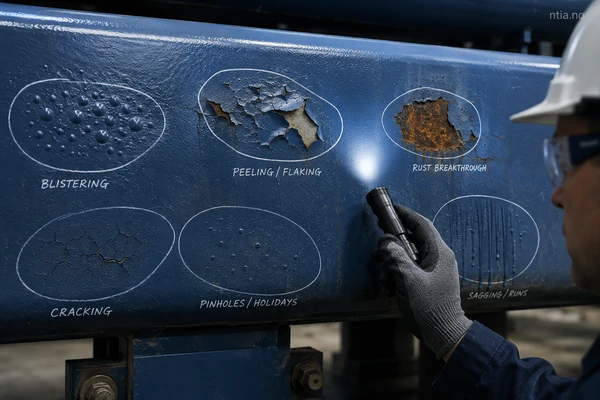
| Visual and defect record | Finish, continuity and workmanship requirement | Exact defect or inspection location | Symptom, extent, photos, date and stage | Accepted, rejected or evaluation pending | Finding, punch item, NCR or approved disposition | Are observations separated from assumed causes? |
| Repair and retest record | Approved disposition and repair procedure | Original location plus repair boundary | Removal, preparation, materials, layers, inspection stages and retest | Repaired and accepted, or still open | Original finding and formal closure | Does every repair answer the original failed requirement? |
| Dossier index and release record | Contract turnover and document-control requirement | Handover system, area, package or asset | Document number, title, revision, status and approval | Complete, conditional or rejected | Open-item register and reservation | Is the release scope clear, current and authorized? |
Use the matrix during execution, not only at handover. It exposes orphan records early: a DFT sheet without a location map, a repair without a finding, a photo without a report, or a calibration certificate without an instrument reference.
For professionals who need structured development in coating inspection techniques and QA documentation, NTIA’s Industrial Coating and Painting Inspector Training Course provides a relevant learning path. Review the live course page for the current syllabus and delivery details.
Start with an approved index reflecting the contract and turnover structure. It may group governing documents, material records, inspection records, tests, deviations, repairs, final status and release documents.
Each index line should identify document number, title, revision, date, status and applicable asset or package. Show multi-area scope and record the authorized basis for any “not applicable” status.
Control superseded records. Retain the approved revision or identify why earlier versions remain. Remove uncontrolled drafts and duplicate scans from the handover set.
A useful adaptable filename pattern is:
`[Project]-[Package]-[Asset/Area]-[RecordType]-[Sequence]-[Revision]-[Date]`
Example scenario:
`NTP-CP03-T201-A3-DFT-004-R1-20260726.pdf`
This is illustrative. Follow client rules and keep the controlled index authoritative for title, revision and status.
For instrument exports, spreadsheets or digital systems, define the controlled record and supporting-data retention. Verify that exports retain units, timestamps, device IDs and locations.
A complete index can still hide orphan evidence and uncovered assets. Audit in both directions.
Trace representative assets, systems, layers and stages through the specification or ITP to reports, readings, repairs and acceptance. This reveals missing evidence for completed work.
Select reports, photographs, repairs and certificates. Confirm that each identifies the subject, requirement, method, status and related records. This exposes documents that cannot support a decision.
Before release, also check:
Do not use a final release document to hide incomplete records. If the contract allows conditional handover, state the open items and authority clearly.
ISO 9001:2015 allows organizations flexibility in how they document a quality management system. It does not prescribe a universal coating report form or final dossier index. Project and sector requirements still determine what evidence must be retained.
ISO 19011:2018 gives guidance on auditing management systems. It can inform disciplined audit thinking, but it is not a coating inspection report-format standard. Citing it as the source of mandatory report fields would be misleading.
ISO 12944-7:2017 addresses execution and supervision of paint work on steel structures, while ISO 12944-8:2017 covers development of specifications for corrosion protection using protective paint systems. They support the wider project framework but do not replace the project’s controlled reporting plan.
Some sectors define a more specific technical file. IMO Resolution MSC.215(82), for example, requires a Coating Technical File for dedicated seawater ballast tanks in ships and double-side skin spaces of bulk carriers within its stated scope. It includes coating work records, a coating log, inspection reports and maintenance or repair information. That is a useful bounded example of traceable coating documentation, not a universal requirement for every industrial asset.
No universal format applies to every project. The contract, coating specification, procedure, ITP, test methods, client document-control rules and applicable sector requirements define the required forms and approvals.
A daily report reconstructs work, conditions, inspections and open actions for a reporting period. A test report preserves the method-specific locations, equipment, readings, criterion and result needed for a particular acceptance decision.
That depends on the contract and authorized release process. The open NCR should never disappear from the record set. If conditional handover is permitted, the scope, reservation, owner, target action and authority should be explicit.
Link the original finding and location to the approved disposition, repair boundary, preparation, materials and batches, environmental conditions, application stages, reinspection, retest and final closure.
Usually not by themselves. Photographs support the record, but they need location and context and should connect to the applicable requirement, inspection or test result and acceptance status.
Follow the project’s document-control arrangement. The certificate may be included once in the dossier or referenced through an instrument register, but each test record should identify the actual device so its valid status can be verified.
No. ISO 19011 provides guidance on auditing management systems. It does not define a mandatory coating-report template.
Use a controlled dossier index and perform a two-way audit: trace selected assets and requirements to their evidence, then trace selected records back to the exact asset, stage, requirement and status.
Treat reporting as part of inspection, not an administrative task left until handover. Define the record architecture before work starts, preserve traceability while evidence is created, close repairs against the original requirement and audit the dossier in both directions.
Use NTIA’s coating inspection guide for the complete inspection lifecycle. For structured learning in coating inspection techniques and QA documentation, review the Industrial Coating and Painting Inspector Training Course.

At NTIA (Norwegian Technical Inspection Academy), we specialize in delivering world-class training programs in vendor inspection, quality surveillance, and technical compliance – specifically tailored for professionals in the oil, gas, and energy industries.
Copyright © 2025 by NTIA. All Rights Reserved.