
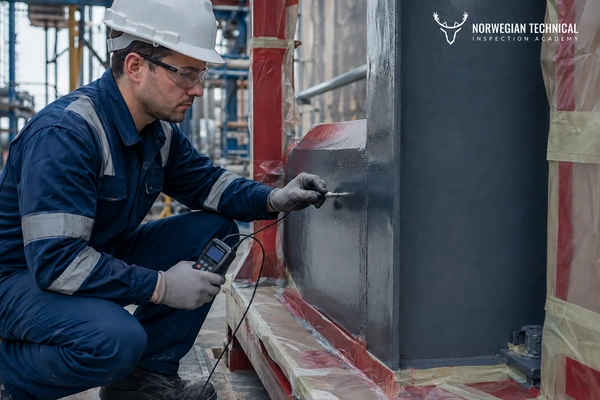
Coating inspection is the quality control process used to verify surface preparation, environmental conditions, coating application, film thickness, curing, testing, defects and final documentation before an industrial coating system is accepted.
In industrial projects, coating and painting are not only about appearance. Protective coating systems are used to prevent corrosion, protect steel structures, extend service life and reduce maintenance costs. A coating system may fail early if the surface is not prepared correctly, if environmental conditions are not controlled, if the wrong coating thickness is applied, or if inspection records are incomplete.
For QA/QC inspectors, coating inspectors, painting inspectors, site supervisors and project quality teams, coating inspection is about confirming that the coating work meets the approved specification, inspection and test plan, manufacturer’s data sheet, project requirements and acceptance criteria.
If you want structured training on this subject, NTIA provides an Industrial Coating and Painting Inspector Training Course covering surface preparation, coating types, application, inspection, quality control, coating defects, failure analysis and QA documentation.
Industrial coating inspection is the verification of surface preparation, coating application and coating quality against approved project specifications and inspection requirements.
It may include checking:
The goal is to confirm that the coating system has been applied correctly and can provide the required protection in service.
A coating inspector does not only look at the final painted surface. Many important inspection points happen before and during application. Once the coating is applied, some preparation problems may become hidden and difficult to correct.
Protective coatings are often the first line of defense against corrosion. In oil and gas, marine, offshore, energy, petrochemical, infrastructure and industrial facilities, poor coating quality can create serious long-term problems.
Poor coating inspection may lead to:
Many coating failures are not caused by the coating material itself. They are often caused by poor surface preparation, incorrect application, unsuitable environmental conditions or incomplete inspection control.
Good coating inspection helps identify these problems before the coating system is accepted.
Coating inspection and painting supervision are related, but they are not the same.
| Area | Coating Inspection | Painting Supervision |
| Main purpose | Verify quality and compliance | Manage painting activities and workforce |
| Focus | Specification, testing, records, acceptance | Productivity, resources, execution |
| Typical output | Inspection report, test records, NCRs, acceptance status | Daily progress, manpower, work planning |
| Main question | Does the work meet requirements? | Is the work being executed efficiently? |
A painting supervisor may manage the application team. A coating inspector verifies whether the work complies with the specification and can be accepted.
In some projects, one person may support both functions, but the inspection role must remain objective and document-driven.
Coating inspection is usually divided into three main stages:
Each stage has different inspection points.
Surface preparation is one of the most important parts of coating quality. Even a high-performance coating can fail if applied over a poorly prepared surface.
Before coating starts, the inspector may verify:
Surface preparation must match the project specification. Requirements may refer to standards such as ISO 8501, ISO 8502, ISO 8503, SSPC/NACE or equivalent project-defined criteria.
The inspector should not rely only on visual appearance. Surface profile, cleanliness and contamination checks may all be required before coating is released.
Environmental conditions can strongly affect coating application and curing.
Before and during application, inspectors may check:
A common coating risk is applying paint when the steel surface is too close to the dew point. This can cause condensation, poor adhesion and early coating failure.
Environmental readings should be recorded at required intervals and included in the inspection report.
Before application, the inspector should verify that the correct coating materials are being used.
Typical checks include:
Using the wrong coating product, expired material or incorrect mixing ratio can compromise the entire coating system.
Material traceability is also important. Batch numbers should be recorded so that any future issue can be traced back to the applied product.
During coating application, the inspector checks whether the coating is applied correctly and consistently.
Typical inspection points include:
Wet Film Thickness, or WFT, is checked during application to help ensure that the required Dry Film Thickness, or DFT, can be achieved after curing.
WFT is not usually the final acceptance measurement, but it is a useful process control tool during application.
Dry Film Thickness, or DFT, is one of the most important coating inspection measurements.
DFT inspection verifies whether the cured coating thickness meets the specified range.
If the coating is too thin, it may not provide enough corrosion protection. If it is too thick, it may crack, cure improperly or fail to perform as intended.
During DFT inspection, the inspector should verify:
DFT readings should be documented clearly and linked to the inspected area, structure, spool, equipment item or coating system.
Coating inspection requirements are usually defined by project specifications, coating procedures and client requirements. However, several standards and industry references are commonly used in industrial coating work.
| Standard / Reference | Common Use in Coating Inspection |
| ISO 8501 | Visual assessment of surface cleanliness and rust grades |
| ISO 8502 | Tests for surface contaminants such as salts and dust |
| ISO 8503 | Surface profile and roughness assessment after blasting |
| ISO 12944 | Corrosion protection of steel structures by protective paint systems |
| SSPC / NACE / AMPP | Surface preparation, coating application and inspection references |
| Manufacturer’s Data Sheet | Product-specific mixing, application, recoat and curing requirements |
| Project Coating Specification | Main acceptance document for the specific project |
Inspectors should always follow the project specification first. Standards and references help define methods and acceptance requirements, but the applicable project documents decide what must be inspected and recorded.
Certification routes such as AMPP/NACE, FROSIO, ICorr or BGAS may also appear in coating inspection contexts. These are useful competency frameworks, but they should not be confused with the project’s actual coating acceptance criteria.
The exact tests depend on the project specification and coating system. However, common coating inspection tests include:
| Test / Check | Purpose | Typical Stage |
| Surface cleanliness | Confirms removal of rust, mill scale and contaminants | Before coating |
| Surface profile | Measures anchor pattern after blasting | Before coating |
| Salt contamination test | Checks soluble salts on the surface | Before coating |
| Dust test | Checks dust contamination after blasting | Before coating |
| Environmental readings | Verifies suitable application conditions | Before and during coating |
| WFT measurement | Controls wet coating thickness during application | During coating |
| DFT measurement | Confirms dry coating thickness after curing | After coating |
| Holiday test | Detects pinholes or discontinuities | After coating |
| Adhesion test | Checks bonding of coating to substrate | After curing / qualification |
| Visual inspection | Identifies defects, missed areas and workmanship issues | All stages |
This table gives inspectors a quick overview of what should normally be controlled before, during and after coating application.
Holiday testing is used to detect discontinuities, pinholes or missed areas in a coating system.
A holiday is a small defect where the coating does not fully cover the surface. In corrosive environments, holidays can become starting points for underfilm corrosion.
Holiday testing is especially important for linings, immersed service, buried pipelines, tanks and critical protective coating systems.
The inspector should verify:
Holiday testing should be performed according to the project specification and coating system requirements.
Adhesion testing evaluates how well the coating is bonded to the substrate or to previous coating layers.
Adhesion may be checked using methods such as pull-off testing or cross-cut testing, depending on the specification and coating type.
The inspector should verify:
Adhesion testing is not always required for every coated surface, but when specified, it provides important evidence of coating system quality.
Coating inspectors should be able to recognize common coating defects and understand their possible causes.
| Defect | Possible Cause |
| Pinholes | Air entrapment, poor application, porous surface |
| Holidays | Missed areas, poor coverage, damage after coating |
| Runs and sags | Excessive film thickness or poor application technique |
| Blistering | Moisture, contamination, osmotic pressure or poor adhesion |
| Peeling | Poor surface preparation or adhesion failure |
| Cracking | Excessive thickness, wrong curing or coating stress |
| Orange peel | Poor spray technique or incorrect viscosity |
| Dry spray | Poor spray distance, wind or fast solvent evaporation |
| Poor adhesion | Contamination, low surface profile, wrong recoat interval |
| Underfilm corrosion | Holidays, damage, contamination or coating breakdown |
Defect identification should be linked to corrective action. The inspector should record the location, extent, likely cause, repair method and retest requirement where applicable.
An Inspection and Test Plan, or ITP, defines the inspection activities, acceptance documents and inspection involvement for coating work.
A coating ITP may include:
Common inspection points include:
| Inspection Point | Meaning |
| Hold Point | Work cannot proceed until inspection or approval is completed |
| Witness Point | Client or inspector may attend the activity |
| Review Point | Documents or reports must be reviewed |
| Surveillance | General monitoring of work quality and process control |
For coating work, hold points are often used before coating starts, especially after surface preparation. This is because once coating is applied, surface defects or contamination may be hidden.
A practical coating inspection checklist should cover the full process, not only final DFT readings.
| Stage | Typical Checks |
| Before coating | Specification, material, surface cleanliness, profile, salt, dust, environmental conditions |
| During coating | Mixing, pot life, WFT, stripe coat, application method, recoat interval |
| After coating | DFT, visual condition, holidays, adhesion where required, curing, repairs |
| Documentation | Batch records, inspection reports, test results, NCRs, repair records, final dossier |
The checklist should always be used together with the approved project specification, coating procedure and ITP.
Coating inspection is not complete until the records are complete.
A typical coating final dossier may include:
Every record should be traceable to the correct structure, equipment item, spool, area or coating system.
Incomplete records can delay handover, even when the coated surface appears acceptable.
A coating inspector needs both technical knowledge and careful observation.
Important skills include:
The inspector does not need to formulate coatings, but must understand enough to verify whether the coating system has been applied according to approved requirements.
Coating inspection training is useful for professionals who inspect, supervise, verify or manage coating and painting quality in industrial projects.
This includes:
The training is especially relevant for teams working with steel structures, tanks, pipelines, pressure equipment, offshore structures, marine assets, fabricated components and industrial maintenance projects.
Professionals who move into coating inspection often come from QA/QC, painting supervision, fabrication, site inspection, corrosion control, maintenance or project quality backgrounds.
A practical training path should cover:
NTIA’s Industrial Coating and Painting Inspector Training Course is designed for professionals who need structured knowledge of industrial coating inspection, painting quality control, coating defects, application requirements and documentation.
You can also check the upcoming coating and painting inspection training dates in the NTIA training calendar.
Coating inspection is the quality control process used to verify surface preparation, coating application, film thickness, curing, defects, testing and documentation against project specifications and acceptance requirements.
A coating inspector checks surface cleanliness, surface profile, environmental conditions, coating material, mixing, WFT, DFT, holiday testing, adhesion where required, defects, repair work and final inspection records.
WFT means Wet Film Thickness and is measured during coating application. DFT means Dry Film Thickness and is measured after the coating has dried or cured. DFT is usually the main thickness measurement used for final acceptance.
Surface preparation is critical because coating adhesion and long-term performance depend on a clean, correctly profiled surface. Poor surface preparation is one of the most common causes of coating failure.
Holiday testing is used to detect pinholes, missed areas or discontinuities in a coating system. It is especially important for linings, buried service, immersed service and critical corrosion protection systems.
Common coating defects include pinholes, holidays, runs, sags, blistering, peeling, cracking, orange peel, dry spray, poor adhesion and underfilm corrosion.
Common references include ISO 8501, ISO 8502, ISO 8503, ISO 12944, SSPC/NACE/AMPP documents, coating manufacturer’s data sheets and project coating specifications.
A coating final dossier may include coating specifications, material data sheets, batch records, surface preparation reports, environmental logs, DFT reports, holiday test reports, adhesion test records, repair reports, NCRs and final inspection reports.
Coating inspection training is useful for coating inspectors, painting inspectors, QA/QC personnel, site supervisors, corrosion control personnel, fabrication teams and project quality professionals working with industrial coating systems.
Coating inspection is a critical part of industrial QA/QC and corrosion protection. A coating system must be inspected before, during and after application to confirm that surface preparation, environmental conditions, coating thickness, testing, repairs and documentation meet the approved requirements.
For inspectors, the key is to understand the coating specification, follow the ITP, verify surface preparation before coating, monitor application conditions, check WFT and DFT, identify defects clearly and confirm that all required records are complete before acceptance.
A strong coating inspection process helps reduce premature coating failure, prevent corrosion, minimize rework and support reliable project handover.
For professionals who want to build practical competence in this field, NTIA’s Industrial Coating and Painting Inspector Training Course provides structured training in coating inspection, painting quality control, defects, testing and QA/QC documentation. Upcoming course dates are available in the NTIA Training Calendar.

Instructor · Welding & Industrial Inspection
Hamidreza Saadat brings more than 25 years of experience in welding, industrial inspection and asset integrity to technical training for inspection professionals.

At NTIA (Norwegian Technical Inspection Academy), we specialize in delivering world-class training programs in vendor inspection, quality surveillance, and technical compliance – specifically tailored for professionals in the oil, gas, and energy industries.
Copyright © 2025 by NTIA. All Rights Reserved.
Sign in, or create your account in a minute.