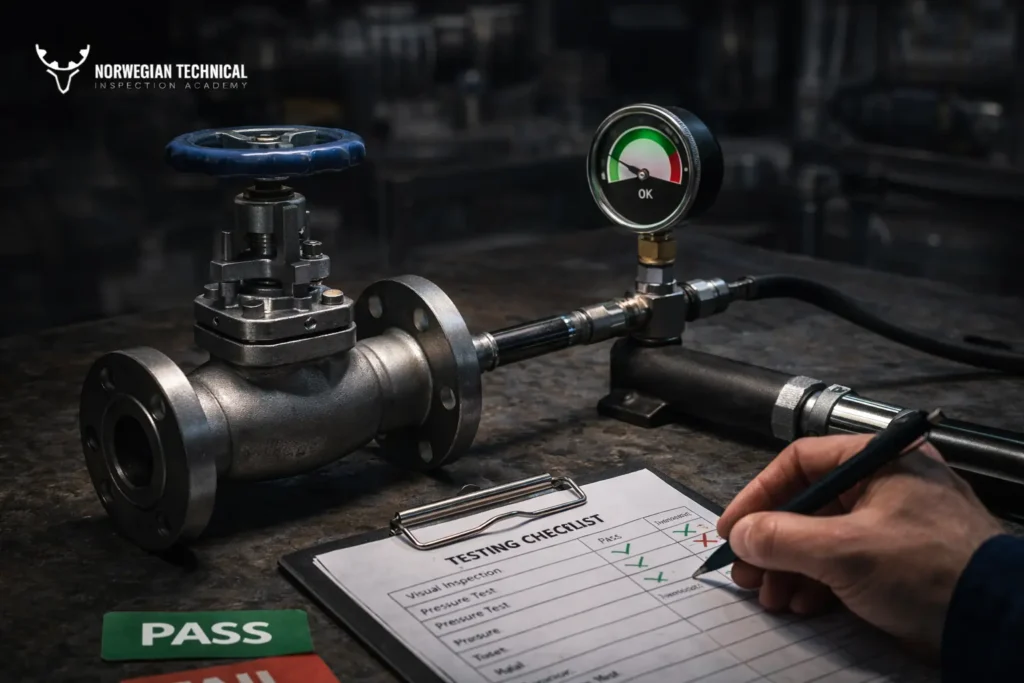
In a lot of projects, all valves are treated the same from an inspection point of view: one generic checklist, one generic test, and a final “OK as per spec” in the report.
But control valves and safety valves (PSVs/PRVs) are not just different designs – they have different functions, standards, failure modes and acceptance criteria. If you inspect and test them the same way, you either over-test the wrong things or miss what actually matters.
This guide focuses on practical inspection and testing differences between control valves and safety valves, so that:
- you know what to look at for each type
- you understand which standards sit behind the tests
- you can write inspection reports and NCRs that are technically defensible
If you want the broader baseline first, start with Valve Inspection Checklist (PDF): Visual, Dimensional & Testing, then use this article to split your approach by valve function.
Function and Role: Control Valves vs Safety Valves
Before going into tests, it helps to be clear about what each valve is supposed to do.
Control valves
Control valves are modulating devices. They continuously adjust opening to control a process variable (flow, pressure, level, temperature) as part of a control loop.
Key points:
- sized using flow equations from standards such as ISA 75.01 / IEC 60534-2-1, based on Cv/Kv and process conditions
- expected to work across a range of operating conditions
- allowed leakage is defined by a leakage class (ANSI/FCI 70-2 / IEC 60534-4), not “zero leak”
- failure typically affects process control quality (instability, poor setpoint control, off-spec product)
Safety / relief valves (PSVs/PRVs)
Pressure safety valves and relief valves are protective devices. They are designed to open at a specific set pressure and relieve enough flow to prevent the protected equipment from exceeding its design limits.
Key points:
- sized using standards like API 520 and ISO 4126, considering worst-case relieving scenarios
- normally closed; open automatically when set pressure is reached
- behaviour on opening:
- safety valve: pop action, rapid full opening (typical for steam/gas)
- relief valve: modulating opening in proportion to overpressure (often on liquids)
- seat tightness in normal operation is defined by API RP 527 (Seat Tightness of Pressure Relief Valves)
- failure affects safety and code compliance (overpressure, vessel failure, regulatory breach)
Because the function is different, what you check and how you test has to be different.
Standards Landscape for Inspection and Testing
You do not need to quote every clause in your report, but you should know which standards sit behind the tests.
Control valves – key references
- IEC 60534-2-1 / ISA 75.01 – sizing and flow capacity (Cv/Kv)
- ANSI/FCI 70-2 / IEC 60534-4 – seat leakage classes and test methods (Class I–VI)
- API 598 / ASME B16.34 – generic valve pressure tests (shell and closure tests) commonly applied to control valve bodies
- ISA-75 / manufacturer standards – performance and dynamic tests (deadband, hysteresis, step response)
Safety / relief valves – key references
- API 520 – sizing and selection
- API 521 – pressure-relieving systems
- API 526 – standard safety valve dimensions and orifice designations
- API RP 527 – seat tightness test for pressure relief valves
- ISO 4126 – safety devices against excessive pressure (global framework for safety valves and bursting discs)
When you write “tested in accordance with…”, these are the standards you are implicitly referring to. For shop-floor acceptance language and documentation phrasing, align your reporting with Vendor Inspection Reporting: IR, NCR & Final Dossier.
Inspection Focus for Control Valves
For control valves, inspection is about ensuring the valve can control as specified and shut off to the required leakage class, not about acting as a primary safety device.
Design and documentation
Before touching the hardware, confirm that:
- the valve data sheet matches the supplied valve:
- type (globe, ball, butterfly, etc.)
- size and rating
- flow characteristic (linear, equal percentage, etc.)
- required leakage class (e.g. Class IV or VI)
- failure action (fail-open, fail-closed, fail-in-place)
- sizing calculations (Cv/Kv) are available for critical services where control quality matters
If the leakage class, trim or fail position on nameplate or actuator label does not match the datasheet, you already have a potential nonconformity. When you verify markings, traceability and nameplate content, use the same workflow as Valve Nameplates, MTRs & Material Identification.
Mechanical and materials inspection
Core checks include:
- body and bonnet:
- rating and body material markings match the datasheet and piping class
- no cast defects, cracks, excessive corrosion or mechanical damage
- trim:
- plug, seat, cage and stem materials match the datasheet and MTCs
- seating surfaces clean, undamaged and with appropriate finish for leakage class
- packing and gaskets:
- material compatible with process fluid, temperature and pressure
- proper installation (no extrusion, over-compression or missing rings)
- end connections:
- flanged faces within flatness and roughness requirements
- weld ends prepared as specified
This ties directly into the general inspection sequence in Valve Inspection Checklist.
Actuator and positioner
Control valve performance depends heavily on the actuator–valve–positioner combination.
Key inspection points:
- actuator type and size:
- pneumatic, electric or hydraulic sized with enough force/torque to achieve shutoff and fail position under worst differential pressure
- travel limits:
- positioner zero and span correctly set so 0–100% signal matches full mechanical stroke
- fail action:
- valve moves to specified position on loss of signal and/or supply (air, power)
- positioner performance (where tested):
- hysteresis and deadband within acceptable limits
- no sticking, overshoot or hunting during step tests
If the actuator cannot close the valve against the specified differential pressure, leakage class becomes meaningless.
Seat leakage and shutoff test
The seat leakage class defines how much leak is allowed in the closed position:
- leakage classes I–VI are defined in ANSI/FCI 70-2 and IEC 60534-4
- typical patterns:
- metal-seated control valve: Class IV
- high-performance metal: Class V
- soft-seated control valve: Class VI (very tight)
Inspection focus:
- confirm which leakage class applies (from datasheet / spec)
- verify test medium (air or water), differential pressure and test method match the standard
- check measured leakage (flow, bubble rate or other method) against the class limits
- ensure test is done with the correct actuator and fail position, not by handwheel only
For the broader “body vs seat” logic and acceptance framing, see Hydrostatic vs Seat Leak Tests: Procedures & Acceptance and the comparison guide API 598 vs ISO 5208: Valve Testing Acceptance.
Functional and dynamic tests
For critical control loops, dynamic behaviour matters:
- stroke tests:
- full open/close stroke under signal
- no noticeable stiction or jerky movement
- step response tests (if specified):
- evaluate dead time, rise time and overshoot for standard signal steps
- fail-safe tests:
- simulate loss of instrument signal and/or supply, confirm valve moves to specified safe position
Your report should distinguish between static (seat leak, shell test) and dynamic issues (hysteresis, slow response). For reporting structure and “defensible language”, use Write a Valve Inspection Report (With Sample Template).
Inspection Focus for Safety Valves (PSVs / PRVs)
For safety and relief valves, inspection is about protective function: do they open at the right pressure, pass the right capacity, and reseat correctly?
Design and documentation
Before any bench work:
- check nameplate:
- set pressure, temperature, orifice designation, capacity, code stamp, service, manufacturer
- compare against sizing calculations and relieving scenarios (API 520 / ISO 4126)
- confirm application (steam, gas, liquid) and type (safety, relief, safety-relief) is correct
If nameplate data does not match the design case, the valve may be fundamentally wrong even if all tests “pass”. For consistency in nameplate and traceability checks across valve types, follow Valve Nameplates, MTRs & Material Identification.
Mechanical condition
Before and after testing (for overhaul or new valves), examine:
- nozzle and disc:
- surface condition (erosion, corrosion, pitting, foreign material)
- guides and spindle:
- free movement, no bending, scoring or contamination
- spring:
- physical condition (no cracks, severe corrosion or wear)
- correct spring identified for set pressure range
- blowdown ring (where fitted):
- position set as per manufacturer’s recommendation; seals in place
Poor mechanical condition can lead to chattering, failure to open, or failure to reseat.
Set pressure and pop test
The set pressure defines when the valve starts to perform its protective job.
Typical test (bench or in-situ):
- slowly increase pressure at the inlet until the valve pops or lifts
- record cold set pressure and compare against required set (usually within a specified tolerance, e.g. ±3% depending on code and service)
- observe the nature of the lift: sharp pop vs sluggish lift, chatter, instability
You also check blowdown – how much pressure drop is required for the valve to reseat:
- blowdown typically expressed as a percentage of set pressure (e.g. reseat at 7–10% below set, depending on service and standard)
An inspector’s report should explicitly mention:
- required set pressure and tolerance
- measured pop pressure
- observed blowdown behaviour
Seat tightness (API 527)
Unlike control valves, safety valves spend almost all their life fully closed. Seat tightness directly affects emissions, losses and, in some cases, ability to build up to set pressure.
API RP 527 defines:
- test media (air, steam or water depending on service)
- test pressures and hold periods
- leakage measurement methods and acceptable leakage limits for each size and type
Inspection focus:
- ensure proper test setup (orientation, media, pressure measurement)
- confirm leakage below the standard’s allowable limit for that valve size and type
- note whether seat leakage is measured at set pressure or at a lower proving pressure, as defined by the standard and project spec
Seat tightness here is not described as a “Class IV or VI” but as compliance with API 527 acceptance criteria.
Testing Differences: Control Valves vs Safety Valves
Putting it side by side, you can see why one generic test procedure does not work for both.
Control valves – typical testing scope
- Shell pressure test
- often per API 598 / ASME B16.34 for body integrity
- Seat leakage test
- per ANSI/FCI 70-2 or IEC 60534-4 to the specified leakage class
- Functional and dynamic tests
- stroke tests, response to control signal, fail-safe tests
The focus is on controllability and shutoff performance.
Safety valves – typical testing scope
- Set pressure (pop) test
- confirm valve opens at the correct set pressure within allowed tolerance
- Seat tightness test
- per API 527, with acceptance criteria based on leak rate or bubble count
- Functional checks
- lift characteristics, chatter, reseat behaviour, blowdown
The focus is on correct actuation at set pressure and adequate tightness in normal conditions.
For an inspector, the key difference is this:
- a control valve may pass its FCI leakage class test and still be completely wrong as a safety device
- a safety valve may have perfect pop and seat results but be useless as a control element
They are inspected and tested for different reasons, against different standards.
Common Nonconformities and How to Judge Them
Understanding typical nonconformities helps you decide when to accept, when to repair and when to refuse a valve.
For a practical “what fails in real projects” baseline, see Common Vendor Nonconformities & How To Fix Them and connect your findings to your documentation pack using IR/NCR/Final Dossier.
Control valve nonconformities
Common issues include:
- Leakage class not achieved
- measured leakage exceeds limits for specified class (e.g. valve ordered as Class VI but only achieves Class IV)
- Wrong trim or materials
- plug, seat or cage material not matching datasheet or MTCs; high risk in corrosive or erosive service
- Actuator undersized or incorrectly set
- valve cannot fully close under differential pressure; fail position not achieved on loss of signal
- Poor dynamic behaviour
- excessive hysteresis or stiction; control loop cannot maintain stable operation
Safety valve nonconformities
Typical PSV/PRV issues:
- Set pressure out of tolerance
- pop pressure too high or too low relative to code limits
- Seat leakage beyond API 527 limits
- valve cannot maintain required tightness; may cause losses or inability to build up to set pressure
- Incorrect sizing or orifice
- nameplate orifice does not match design calculations; inadequate capacity
- Poor installation conditions
- excessive inlet pressure drop, wrong orientation, block valves where prohibited, or inadequate discharge piping
Document your reasoning clearly in the inspection report and tie it back to applicable standards and project requirements.
Quick Comparison Guide: Control vs Safety Valve Inspection
Use the questions below as a mental checklist when you stand in front of a valve:
For a control valve, ask:
- Is the valve sized and specified correctly for the control duty (Cv, characteristic, noise limits)?
- Does the actuator/positioner combination deliver the required stroke, fail action and leakage class?
- Has the valve passed shell and seat tests to the specified FCI class?
- Does the dynamic response (stroke, hysteresis, fail tests) fit the control loop requirements?
For a safety valve, ask:
- Is the valve sized and selected correctly for the relieving scenario (API 520 / ISO 4126)?
- Does the nameplate correctly show set pressure, temperature, orifice and capacity?
- Does the valve pop and reseat within the allowed set pressure tolerance and blowdown?
- Does it meet seat tightness criteria per API 527?
- Is it installed correctly (inlet conditions, discharge piping, block valves) so it can actually deliver capacity?
If your inspection report answers these questions clearly, you are not just ticking boxes – you are documenting whether the valve can do the job it was purchased for.
From “Any Valve” to Risk-Based Inspection: NTIA’s Role
Treating all valves the same is convenient on paper, but risky in the field.
A control valve that cannot meet its leakage class or respond properly will quietly damage process stability and product quality. A safety valve that does not open or close where it should can compromise people, equipment and regulatory compliance.
Distinguishing between control and safety valves in data sheets, ITPs, checklists, tests and reports is a key step toward risk-based inspection.
Within NTIA’s valve training, these ideas are translated into practical tools and procedures. If you want a structured learning path, start here: Industrial Valve Inspection & Testing Training.
For safe execution of pressure tests in the shop (especially pneumatic), align your practice with Valve Pressure Testing Safety, then document outcomes using the same format described in Write a Valve Inspection Report.