Quick Answer
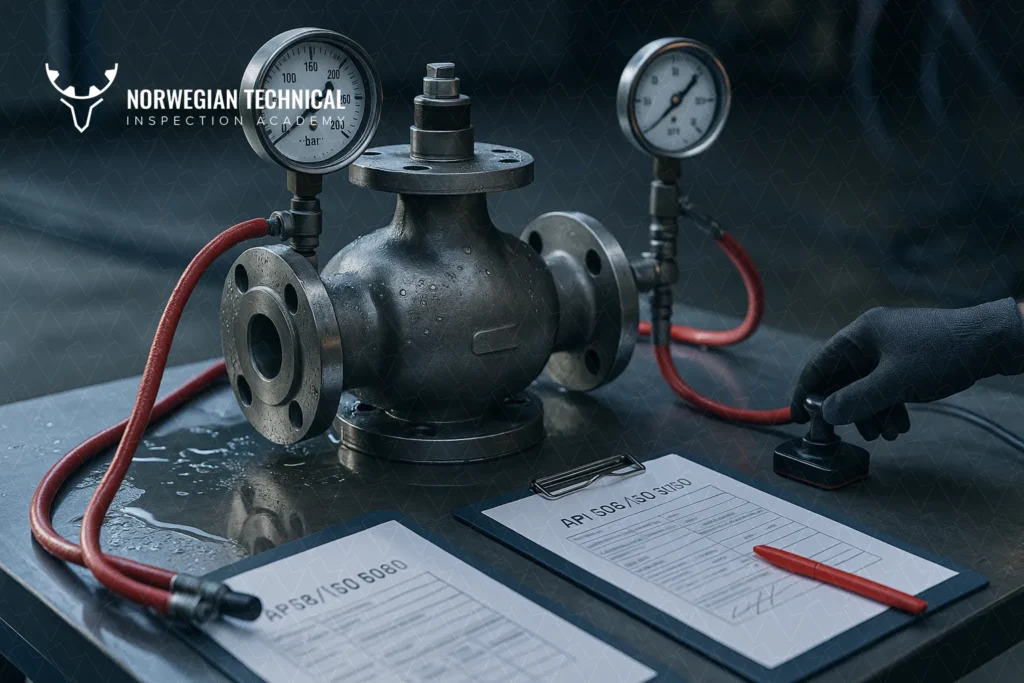
- Hydrostatic (Shell) Test = Body Strength → checks the valve pressure boundary at ~1.5× rated pressure, no visible leakage allowed.
- Seat Leak Test = Tight Shut-off → checks the sealing performance of disc/plug/ball against seat using water or air.
- Both are mandatory in API 598, ISO 5208, and EN 12266.
- Sequence: Hydro first, then Seat Leak.
- See Comparison Table ↓ for side-by-side differences.
Hydrostatic vs Seat Leak Test — Comparison
| Aspect |
Hydrostatic Test |
Seat Leak Test |
| Purpose |
Verify pressure boundary integrity (body, bonnet, casing). |
Verify closure tightness between disc/ball/plug and seat. |
| Medium |
Water (with inhibitor if required). |
Water or air/gas (nitrogen, dry air). |
| Test Pressure |
1.5× rated pressure (per API 598 / ISO 5208). |
Typically at 1.0× rated pressure. |
| Duration |
2–10 min (depending on size/class). |
15 sec – 5 min (depending on size/class). |
| Acceptance |
No visible leakage permitted. |
API 598 → limited leakage for metallic seats, zero for resilient seats; ISO 5208 → leakage rate classes A–D. |
| Failure Modes |
Cracks, porosity, rupture, gauge drift. |
Seat wear, scratches, bubble leakage, misalignment. |
👉 Together, they provide complementary assurance: one proves strength, the other proves tightness.
Introduction — Why Pressure & Leak Testing Matters
Valves are critical safety and process control components in pipelines, refineries, power plants, and industrial facilities. Before shipment or installation, valves must pass pressure and leak testing to verify that:
- The body and pressure-containing parts can safely withstand design loads.
- The seating surfaces can effectively seal against process fluids.
- The valve complies with purchase order requirements and international standards.
Two mandatory tests are applied:
- Hydrostatic Test (Shell Test) → confirms structural integrity of the valve body.
- Seat Leak Test → ensures sealing performance of the closure element.
These are required by API 598, ISO 5208, and EN 12266. Failure to comply leads to safety risks, costly shutdowns, and rejection at FAT (Factory Acceptance Test).
👉 For visual, dimensional, and test checklists, see Valve Inspection Checklist (PDF).
Hydrostatic (Shell) Test
Definition & Purpose
The hydrostatic test (or shell test) ensures the valve body, bonnet, and pressure-retaining parts can withstand internal pressure without leakage or permanent deformation.
- Medium: clean water (sometimes with corrosion inhibitor).
- Pressure: typically 1.5× Cold Working Pressure (CWP).
- Objective: expose weaknesses in castings, welds, and body design.
Equipment & Setup
- Hydro pump capable of exceeding test pressure.
- Calibrated gauges (±1% accuracy).
- Clamping bench or fixtures to hold the valve.
- Vents & drains to eliminate air.
- Water reservoir for filling and circulation.
Procedure (Step-by-Step)
- Preparation
- Visual check for cracks, defects, loose parts.
- Fit blind flanges or plugs.
- Fill with clean water, ensuring all air is vented.
- Pressurization
- Increase pressure gradually up to required value.
- Stabilize for 30–60 sec.
- Hold & Inspect
- Maintain test pressure for 2–10 min depending on valve size/class.
- Observe body, bonnet, joints.
- Acceptance
- No visible leakage through body/bonnet.
- Sweat at gaskets may be tolerated if defined in project specs.
Acceptance Criteria (Standards)
- API 598: Shell test at 1.5× rated pressure, no visible leakage.
- ISO 5208 / EN 12266: Duration and pressure based on DN and PN rating.
- ASME B16.34: Verifies design by 1.5× test pressure.
Reporting
- Document test in IR (Inspection Report): valve ID, class, size, pressure, duration, results.
- Failures → raise NCR (Non-Conformance Report) and retest after corrective action.
👉 External reference: API 598 overview
Seat Leak Test
Definition & Purpose
The seat leak test checks sealing between the closure element (disc, plug, ball, gate) and seat surfaces.
- Water seat test: practical, easy detection.
- Air/gas seat test: highly sensitive, detects micro-leaks.
Types of Seat Tests
- Water Seat Test
- Medium: clean water.
- Observation: drips or wetting.
- Common for general valves.
- Air (or Gas) Seat Test
- Medium: air, nitrogen, or dry gas.
- Observation: bubbles in water bath or pressure decay.
- Safer detection of very small leaks, used for gas service valves.
Procedure (Step-by-Step)
- Preparation
- Mount valve, isolate one side.
- Connect to the test pump or the gas line.
- Pressurization
- Apply at rated pressure (~1.0× CWP).
- Test each seat separately if bi-directional.
- Leak Detection
- Water → visual drips.
- Gas → bubble test or pressure drop.
- Hold Period
- 15 sec – 5 min depending on DN and standard.
Acceptance Criteria
- API 598:
- Resilient seats = zero leakage.
- Metal seats = limited drops/min per inch size.
- ISO 5208 / EN 12266:
- Defines Leakage Classes A–D.
- Class A = bubble-tight, B–D = allowable leakage.
- ANSI/FCI 70-2 (for control valves):
- Classes II–VI, ranging from small permissible leakage to bubble-tight.
👉 External references: ISO 5208 official page | FCI 70-2 standard
Common Failures & Documentation
Even when performed according to API 598 and ISO 5208, valve tests may expose weaknesses that require corrective actions. Understanding typical failures helps inspectors document properly and manufacturers improve quality.
Common Hydrostatic Failures
- Body seepage or sweating → indicates casting porosity or poor welding.
- Sudden rupture → major defect in material or manufacturing.
- Pressure drop without visible leak → often caused by trapped air or faulty gauges.
- Gasket leakage → improper assembly or wrong gasket material.
Common Seat Leak Failures
- Dripping past the closed seat (water test).
- Continuous bubble formation (air/gas test).
- Seat surface damage → scratches, erosion, or foreign particles.
- Soft seat wear → excessive leakage after repeated cycling.
Documentation & Reporting
Valve testing is incomplete without proper records:
- Inspection Report (IR)
- Records valve ID, size, class, test medium, pressure, duration, and result.
- Signed by the inspector and the manufacturer’s QA/QC representative.
- Non-Conformance Report (NCR)
- Issued if acceptance criteria are not met.
- Describes failure mode, root cause, and corrective action plan.
- Final Dossier / Test Certificates
- Compiled as part of the valve documentation package.
- Includes IRs, NCRs, calibration certificates, and conformity statements.
- Essential for traceability and client acceptance.
👉 Learn how these records integrate into inspection workflows in our Valve Inspection Checklist (PDF).
Related Content
For a practical, step-by-step overview of valve inspection—including visual, dimensional, and functional testing—see our detailed resource:
👉 Valve Inspection Checklist (PDF)
This guide complements the current article by showing where hydrostatic and seat leak tests fit in the overall valve inspection workflow.
Enroll in the Valve Inspection Course
Mastering hydrostatic and seat leak testing isn’t just about following procedures—it’s about ensuring safety, compliance, and client approval.
🎯 By joining NTIA’s Valve Inspection Training Course, you will:
- Learn step-by-step hydrostatic and seat leak procedures with case studies.
- Practice with real-world IR, NCR, and Final Dossier documentation.
- Gain access to templates (Word, Excel, PDF) used by EPC contractors.
- Receive a certificate trusted by international engineering companies.
👉 Enroll in NTIA’s Valve Inspection Course
FAQ – Hydrostatic vs Seat Leak Tests
Q1. What is the difference between hydrostatic and seat leak tests?
Hydrostatic checks body integrity at 1.5× rated pressure. Seat leak checks closure sealing, some leakage allowed depending on standard.
Q2. Why is air preferred in some seat leak tests?
Because it’s more sensitive: even micro-leakage produces bubbles or pressure decay.
Q3. Typical test durations?
Hydrostatic: 2–10 min. Seat leak: 15 sec–5 min.
Q4. Which standards apply?
API 598, ISO 5208, EN 12266, and ANSI/FCI 70-2 for control valves.
Q5. Can a valve pass hydro but fail seat leak?
Yes. Body may be intact, but seats can leak due to wear, scratches, or misalignment.
Q6. How are valve test results documented?
Via Inspection Reports, NCRs, and Final Dossiers for client handover.