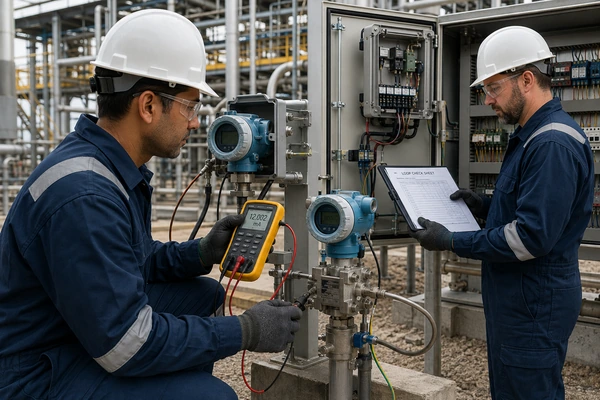
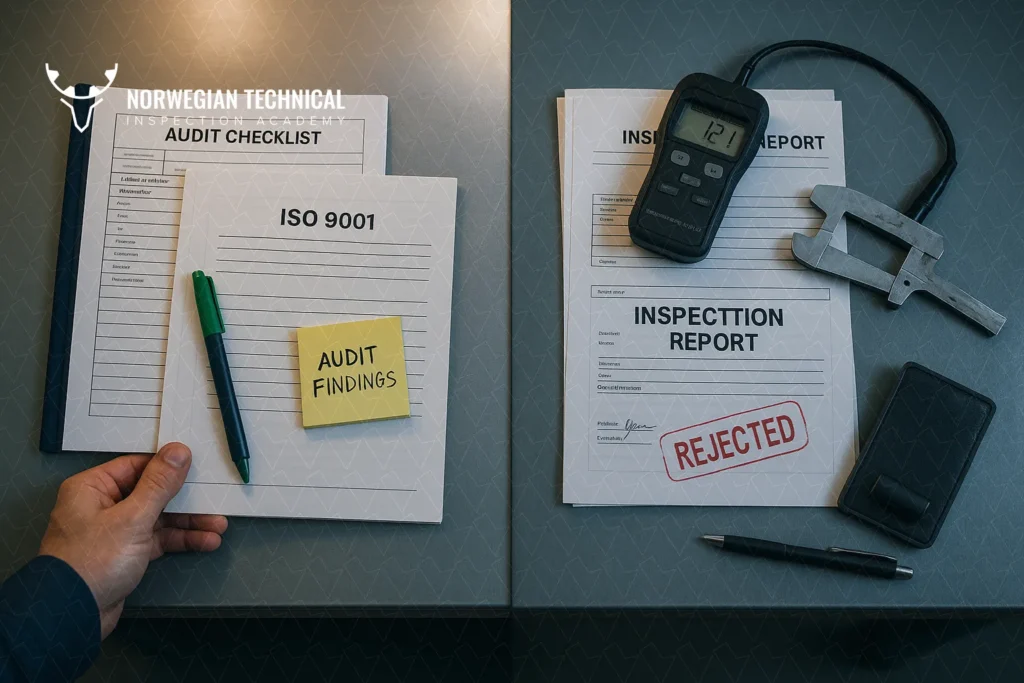
A vendor audit evaluates a supplier’s management systems and processes (ISO 19011, ISO 9001), while a vendor inspection verifies the actual conformity of products and equipment (API, ASME, EN).
👉 In short: Audit validates capability. Inspection validates the product.
In vendor quality assurance, audit and inspection are two terms often used interchangeably — but they are not the same. While both serve the ultimate goal of ensuring that purchased materials and equipment conform to requirements, their scope, timing, and deliverables are fundamentally different.
Confusing audit with inspection can cause serious issues:
For QA/QC engineers, procurement teams, and project managers, understanding the distinction is more than a semantic detail. It defines:
👉 This article clarifies vendor audit vs. inspection, compares their key elements in a structured table, and illustrates when to use each in real projects.
A vendor audit is a structured assessment of a supplier’s management systems, processes, or compliance with contractual and regulatory requirements. Unlike inspection, it does not primarily focus on checking individual pieces of equipment — instead, it evaluates whether the vendor has the capability and controls to consistently deliver conforming products.
ISO 19011 defines auditing as a “systematic, independent, and documented process for obtaining evidence and evaluating it objectively to determine the extent to which audit criteria are fulfilled.” In vendor QA/QC, this means evaluating whether a supplier’s quality management system (QMS) and production processes align with the standards required by the buyer.
📖 External Reference: ISO 19011 — Guidelines for auditing management systems
A system audit checks the vendor’s overall QMS framework, typically against ISO 9001 or equivalent. It verifies documentation, organizational structure, and the way quality is managed across departments.
A process audit dives deeper into specific manufacturing or service processes (e.g., welding, coating, machining). It ensures that procedures are documented, followed, and capable of producing consistent outputs.
A compliance audit checks alignment with contractual and regulatory requirements — for example, compliance with API/ASME codes, safety regulations, or environmental laws.
👉 In short, vendor audits focus on the management and process capability, not the physical conformity of a single item.
A vendor inspection is the QA/QC activity carried out at a supplier’s facility to confirm that specific materials, components, or equipment meet the purchase order, drawings, and referenced standards. Unlike an audit, which is system-focused, inspection is product-focused.
Vendor inspection is the process of verifying and documenting that the delivered item conforms to technical requirements. It is based on the Inspection & Test Plan (ITP) or Quality Control Plan (QCP) agreed between the buyer and the vendor.
Performed during manufacturing, covering raw material checks, welding inspections, dimensional control, coating checks, etc. The goal is to detect nonconformities before they accumulate.
Critical activities where the buyer’s inspector must be present — e.g., hydrostatic test, pressure test, or final assembly checks. Work cannot proceed beyond a hold point without approval.
Conducted at the vendor’s facility to demonstrate that the assembled equipment meets functional and performance requirements before shipment. This often involves running equipment under simulated operating conditions.
👉 In short, vendor inspection ensures the item you buy is exactly what was specified, reducing the risk of costly rejections or failures on site.
Although both activities are part of vendor QA/QC, their focus, timing, and outputs differ significantly.
| Aspect | Vendor Audit 📝 | Vendor Inspection 🔍 |
| Primary Objective | Evaluate management systems, processes, and compliance capability | Verify conformity of actual materials, equipment, and tests |
| Scope | QMS, procedures, documentation, and organizational capability | Purchase order, drawings, standards, test plans |
| Standards/Guides | ISO 19011, ISO 9001, contractual audit criteria | API, ASME, EN, ASTM, project specifications |
| Timing | Before or during contract execution (pre-award, periodic) | During manufacturing, testing, and final release |
| Performed By | Auditors (often QA/QC managers or external auditors) | Inspectors (in-house or third-party) |
| Deliverables | Audit report, corrective action requests (CARs) | Inspection reports (IRs), nonconformance reports (NCRs), and final dossier |
| Focus | Capability to produce a conforming product | Actual conformity of the product being delivered |
| Frequency | Periodic or scheduled (annual, project-specific) | Continuous or milestone-based (per ITP/QCP) |
Vendor audits and inspections should not be seen as alternatives, but as complementary tools:
👉 Together, they form a complete vendor oversight strategy — one checks the system, the other the product.
Understanding when to perform a vendor audit vs. inspection helps organizations allocate resources effectively and avoid gaps in quality control.
A major EPC contractor awarded a contract for pressure vessels to a vendor with ISO 9001 certification.
👉 The lesson: Audit validates the capability, inspection validates the product. Both are necessary in high-stakes projects.
Vendor audits and inspections are not isolated activities — they connect directly with other elements of vendor QA/QC.
If you’re new to vendor oversight, start with our What Is Vendor Inspection? guide. It explains the fundamentals of vendor inspection, roles and responsibilities, and how inspections fit into the procurement cycle.
Inspections don’t stop at the shop floor — they generate critical documentation. Our article on Vendor Inspection Reporting: IR, NCR & Final Dossier details how findings are recorded, how nonconformities are managed, and how the final dossier ensures contractual close-out.
👉 By combining audits, inspections, and proper reporting, companies establish a closed-loop quality system:
Understanding the difference between vendor audit and vendor inspection is not just theory — it is a skillset demanded by EPC contractors, clients, and international projects. Engineers and managers who can apply both tools correctly gain a competitive advantage in QA/QC roles.
👉 Master IR, NCR, and Final Dossier reporting — and learn how audits and inspections complement each other in real projects.
📌 Every participant receives:
Join NTIA’s Vendor Inspection Training Course
Not necessarily. Audits are often performed during vendor qualification or when systemic issues arise. Inspections, however, are required for most equipment deliveries as per the ITP.
No. An audit cannot prove product conformity, and an inspection cannot prove system capability. They are complementary, not interchangeable.
Audits confirm capability, inspections confirm product conformity, and reporting provides evidence to the client. Together they form a closed quality loop.

At NTIA (Norwegian Technical Inspection Academy), we specialize in delivering world-class training programs in vendor inspection, quality surveillance, and technical compliance – specifically tailored for professionals in the oil, gas, and energy industries.
Copyright © 2025 by NTIA. All Rights Reserved.