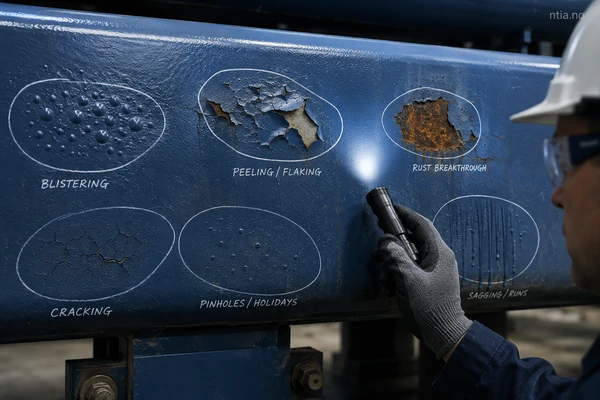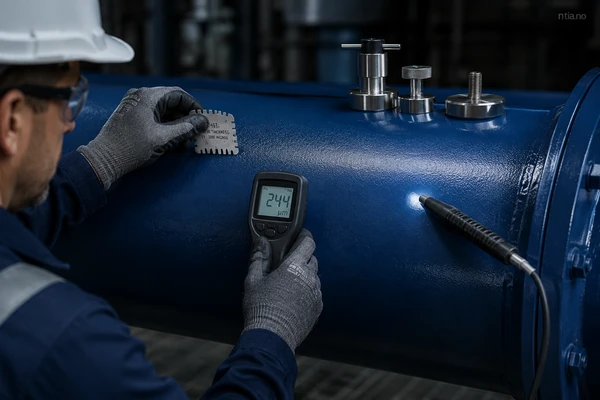
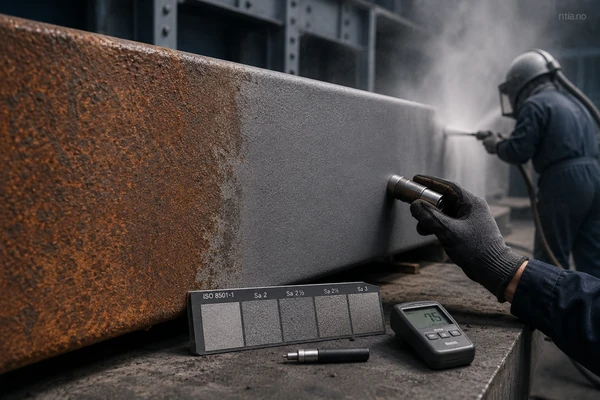
A surface-preparation designation such as Sa 2½ or SSPC-SP 10/NACE No. 2 describes a defined surface condition within a particular standard. It does not, by itself, prove that the surface is ready for coating. A defensible release decision may also require checks for surface profile, dust, soluble salts, welds and edges, environmental conditions, and the project’s timing or reinspection rules.
This guide explains how ISO, AMPP and legacy SSPC/NACE terminology fits together and, more importantly, how an inspector should translate a designation into verifiable acceptance evidence. For the complete before-during-after workflow, use NTIA’s coating inspection guide.
A designation defines one part of the required end condition. Coating release usually depends on several acceptance layers, each supported by its own reference, test method or project rule.
For example, a visually acceptable blast-cleaned surface may still have the wrong roughness, excessive dust, water-soluble contamination, untreated sharp edges or condensation risk. None of those conditions is resolved simply because the surface resembles a visual reference photograph.
| Acceptance layer | Main question | Typical controlling reference |
|---|---|---|
| Visual cleanliness | Does the prepared surface meet the specified visual preparation grade? | ISO 8501-1 or the specified AMPP/SSPC standard |
| Surface profile | Does the roughness meet the coating system and project requirement? | Specified ISO 8503 or other approved measurement method |
| Surface contaminants | Are dust and water-soluble contaminants within specified limits? | Specified ISO 8502 methods or project-approved alternatives |
| Substrate workmanship | Are welds, edges and surface imperfections prepared as required? | ISO 8501-3 and/or project workmanship requirements |
| Release conditions | Are environment, timing, traceability and hold-point conditions satisfied? | Project specification, ITP and coating manufacturer documentation |
| INSPECTOR RULE Treat the designation as one controlled requirement—not as a complete certificate of surface readiness. |
AMPP, the Association for Materials Protection and Performance, now operates the combined standards programme. According to the official AMPP programme announcement, the NACE and SSPC standards programmes were merged into the AMPP Standards Program on 2 June 2021.
That organizational change did not make every familiar designation disappear. Project specifications, client documents, coating procedures and standard titles may still use SSPC, NACE or joint SSPC/NACE identifiers. Inspectors therefore need to recognize the legacy names while identifying AMPP as the current standards organization.
A useful writing convention is:
AMPP’s SC 05 Surface Preparation inventory continues to display many SSPC and joint SSPC/NACE designations, which is why inspectors encounter both current and legacy naming in active work.
ISO 8501-1 is a visual-assessment standard for steel substrates. Its scope includes initial rust grades and preparation grades for surfaces prepared by methods such as abrasive blast-cleaning and hand or power-tool cleaning.
The initial condition matters. The same preparation method can produce different appearances depending on mill scale, corrosion, pitting and previous coatings. Inspection should therefore use the applicable standard reference and the correct initial-condition context—not a generic online photograph or an image saved from another project.
Within ISO terminology, Sa designations are associated with abrasive blast-cleaning. St designations are associated with hand and power-tool cleaning. The grade identifies a defined visual result within that framework; it is not a numerical profile measurement and does not quantify invisible contamination.
When the specification requires Sa 2½, the inspector should confirm at least:
| COPYRIGHT AND SCOPE Use the official standard and its approved visual references for acceptance. An article can explain the framework, but it should not reproduce the standard’s protected photographs or act as a substitute for the applicable edition. |
AMPP’s surface-preparation documents define different cleaning methods and end conditions. Their numbers are identifiers, not a simple scale in which a higher number always means a cleaner surface.
The AMPP surface-preparation overview groups familiar references such as solvent cleaning, hand and power-tool cleaning, abrasive blast-cleaning, power-tool cleaning to bare metal and commercial-grade power-tool cleaning. For field use, the exact standard—not the article summary—controls the acceptance decision.
| Designation family | Examples commonly encountered | Inspector focus |
|---|---|---|
| Pre-cleaning / contaminant removal | SSPC-SP 1 | Confirm the specified contaminant-removal step and how completion is verified before mechanical preparation. |
| Hand and power-tool cleaning | SSPC-SP 2 and SSPC-SP 3 | Verify the stated method and required end condition; do not assume bare metal is required. |
| Abrasive blast-cleaning | SSPC-SP 5/NACE No. 1, SP 6/NACE No. 3, SP 7/NACE No. 4, SP 10/NACE No. 2 and SP 14/NACE No. 8 | Use the exact referenced standard and its acceptance method; do not rank by number alone. |
| Power-tool preparation with profile requirements | SSPC-SP 11 and SSPC-SP 15 | Confirm both cleanliness and the specified profile requirement, plus any allowance stated in the applicable standard. |
If a project document says only “prepare to SSPC standard” without a designation, edition or acceptance basis, the requirement is incomplete. The inspector should raise a controlled clarification rather than select a standard from habit.
Sa 2½ and SSPC-SP 10/NACE No. 2 are often paired in coating specifications because both are used for a high degree of abrasive blast cleaning. That practical relationship does not make them exact equivalents.
The two systems are written and assessed within different standards. Their terminology, visual references and acceptance details are not identical. Secondary comparison guides also warn that the criteria should not be treated as interchangeable; however, the contractually applicable standard remains the controlling source.
| Question | ISO 8501-1 Sa 2½ | SSPC-SP 10/NACE No. 2 | Inspector action |
|---|---|---|---|
| What is it? | A visual preparation grade within the ISO 8501-1 framework. | A joint legacy SSPC/NACE blast-cleaning designation maintained within the AMPP standards programme. | Record the exact designation stated in the project documents. |
| How is it assessed? | Against the applicable ISO visual-assessment framework and references. | Against the requirements and assessment basis of the referenced joint standard. | Use the specified reference; do not convert by memory. |
| Can one replace the other? | Only if the project documents explicitly define the accepted relationship. | Only if the project documents explicitly define the accepted relationship. | Request clarification when the specification says “or equivalent” without defining equivalence. |
| Does it prove full readiness? | No. | No. | Verify complementary acceptance layers separately. |
The practical non-equivalence issue is also discussed in this manufacturer comparison of ISO and SSPC/NACE preparation standards. Use such pages to understand common industry questions, not to replace the official standard or the project specification.
A visual preparation grade answers a visual cleanliness question. It does not automatically answer the separate questions below.
Surface profile is the roughness created or retained by preparation. The ISO 8503-1 framework covers ISO surface-profile comparators for blast-cleaned steel, while ISO 8503-5 addresses a replica-tape field method. The project must state the accepted method and range; the inspector should not infer either from Sa 2½ or SP 10.
ISO 8502-3 describes a method for assessing dust remaining on cleaned steel surfaces and provides pictorial ratings. The project specification must still define the accepted rating, size class, frequency and evidence.
ISO 8502-6 covers extraction of water-soluble contaminants using adhesive cells, commonly associated with the Bresle method. ISO 8502-9 addresses conductometric assessment of water-soluble salts. Extraction, analysis and acceptance are separate controls; the article should not supply a universal salt limit because the applicable value is project- and coating-system-specific.
ISO 8501-3 addresses preparation grades for welds, cut edges and other areas with surface imperfections. A surface may satisfy a visual cleanliness grade while still having sharp edges, weld spatter or irregularities that require correction.
The prepared surface can deteriorate after acceptance. Condensation, flash rust, airborne dust, handling contamination or excessive delay can invalidate the earlier result. The coating procedure, product documentation and project specification should define the environmental limits, maximum exposure time and reinspection rule.
Before the work begins, convert each surface-preparation requirement into a check with a method, acceptance basis and evidence output. Do not begin with a generic checklist and try to fit the specification into it later.
This requirement-to-evidence approach is consistent with the broader vendor-inspection principle of converting contractual requirements into shop-floor activities and deliverables, as outlined in NWE’s vendor inspection scope and visit-plan guide.
The matrix below is the working bridge between a specification and the inspector’s record. It does not supply project values; it shows what must be defined and evidenced.
| Check area | Specification should identify | Inspector verifies | Minimum traceable record |
|---|---|---|---|
| Visual cleanliness | Standard, designation, applicable edition, substrate/initial condition and area. | Surface condition using the specified visual method and reference. | Area/item ID, requirement, result, reference used, date/time, inspector and photographs where required. |
| Surface profile | Method, required range, locations and frequency. | Correct comparator/instrument, condition check or calibration status, and representative readings. | Readings, units, locations, instrument ID, calibration status and pass/fail basis. |
| Dust | Method, accepted rating/size class, locations and frequency. | Test execution and result against the project criterion. | Location, result, acceptance criterion, test evidence and disposition. |
| Water-soluble contaminants | Extraction and analysis method, unit, limit, blank/control rule, locations and frequency. | Correct kit/instrument, sampling area, result and calculation or instrument output as required. | Location, method, result/unit, limit, instrument/kit ID and acceptance status. |
| Welds and edges | Preparation grade or project workmanship requirement. | Sharp edges, weld spatter, irregularities, pits and corrected areas. | Location-tagged photographs, punch/NCR reference and close-out evidence. |
| Release to coat | Prerequisites, hold/witness point, authority, exposure-time and recheck rule. | All checks closed before the irreversible coating step. | Signed ITP/release entry, open items, environmental record and reinspection status. |
If your role requires stronger competence in reading surface-preparation requirements, checking coating work and producing QA/QC records, review NTIA’s Industrial Coating and Painting Inspector Training Course. The live course scope includes surface preparation, inspection and quality control.
A useful record states what was required, where it was checked, how it was verified, what result was obtained and whether the result was accepted. “Surface OK” is not a defensible record.
| Weak wording | Stronger wording direction |
|---|---|
| Surface blasted and accepted. | Identify the item/area, specified designation and edition, visual reference used, result, inspector and date/time. |
| Profile OK. | Record method, readings and units, locations, instrument ID, calibration/check status, project range and acceptance. |
| Dust-free. | Record the specified dust-test method, location, rating/size class, project criterion and result. |
| Salt test passed. | Record extraction/analysis method, sample location, result and unit, specified limit, instrument/kit ID and acceptance. |
| Edges repaired. | Identify locations, required preparation basis, correction completed, close-out evidence and acceptance status. |
The exact sentence format will vary by company form or digital system. The evidence fields should not. If an NCR is required, describe the observed condition and the violated requirement separately; do not present an assumed cause as a verified fact.
| Error | Why it creates risk | Required action |
|---|---|---|
| Treating Sa 2½ and SP 10 as exact equivalents | Acceptance may be judged against the wrong framework. | Use the specified standard or obtain a controlled clarification. |
| Using a cleanliness grade as a profile requirement | Visual appearance does not quantify roughness. | Verify profile with the specified method and project range. |
| Using universal dust, salt or profile values | Acceptance depends on the project and coating system. | Use approved project/PDS criteria only. |
| Using the newest edition found online | The contract may invoke another edition. | Confirm the applicable controlled edition and document any conflict. |
| Accepting the whole area from one convenient location | Representative conditions and local defects may be missed. | Follow the specified frequency and location plan; expand checks when required. |
| Coating after the surface has changed | Earlier acceptance may no longer represent current conditions. | Apply the project reinspection rule before release. |
| Recording only pass/fail | The result cannot be audited or defended later. | Record requirement, method, result, location and traceable evidence. |
No. They are commonly paired because they describe broadly similar abrasive blast-cleaning objectives, but they belong to different standards and use different assessment frameworks. Treat them as exact substitutes only when the project documents explicitly define that relationship.
AMPP is the current organization operating the combined standards programme. SSPC and NACE are legacy organizations, but their familiar designations remain in standard titles and project specifications.
ISO 8501-1 addresses visual rust and preparation grades. Surface profile requires a separate specified method, often from the ISO 8503 family or another project-approved reference.
It may. Visual cleanliness does not quantify dust or water-soluble contamination. Perform those tests when the project specification, coating procedure or approved product requirements call for them.
ISO 8501-3 addresses preparation grades for welds, cut edges and other surface imperfections. Project workmanship requirements may add or modify the acceptance basis.
Record the exact requirement, applicable reference and edition, item or area, method, result, complementary tests, instrument or reference details, date/time, inspector and release status.
Not automatically. The applicable contractual or project edition controls unless an approved change adopts another edition.
Ask the responsible technical authority to define the accepted alternative and its acceptance basis. Do not create an equivalence table or choose a substitute from memory.
Before releasing a prepared surface, verify the exact standard and edition, then close every complementary requirement named by the project. A designation is useful only when it is connected to a controlled method, acceptance criterion and traceable record.
For the full inspection lifecycle, return to the coating inspection guide. For structured learning in surface preparation, coating inspection, testing and QA/QC documentation, see the Industrial Coating and Painting Inspector Training Course.

At NTIA (Norwegian Technical Inspection Academy), we specialize in delivering world-class training programs in vendor inspection, quality surveillance, and technical compliance – specifically tailored for professionals in the oil, gas, and energy industries.
Copyright © 2025 by NTIA. All Rights Reserved.