
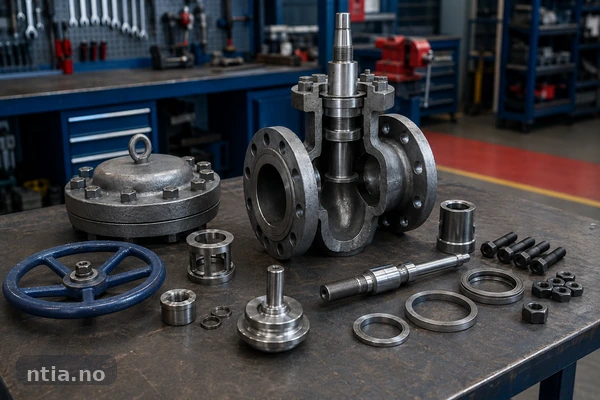
Valve inspection gets much easier when you can translate a datasheet, a nameplate, and a test record into the same mental model. This guide explains the core valve components and the terminology inspectors see most often—so you can spot material mix-ups, sealing risks, and documentation gaps before they become NCRs.
If you want the full inspection lifecycle and FAT workflow first, start here:
What Is Industrial Valve Inspection & Testing?
For a checklist-driven baseline that maps these parts to FAT checks, use:
Valve Inspection Checklist (PDF): Visual, Dimensional & Testing
Terminology is not “nice to know.” It affects:
When a vendor says “trim is per spec,” an inspector must be able to ask:
Which trim parts, what material, what hardness/overlay, and what evidence supports it?
A useful standards-first context (how design/testing/documentation fit together) is here:
Valve Codes & Standards Map: API, ASME, ISO and EN
The body is the main pressure-containing housing. It connects to the pipeline/process through:
Inspector focus:
The bonnet closes the body and provides access for internal assembly. Bonnet design varies widely and affects sealing and maintenance.
Inspector focus:
Depending on valve type, you may see:
Interface errors are one of the fastest paths to rejection. Always tie dimensions to the datasheet/drawings and record measured values.
A practical inspection workflow for dimensions and evidence is covered in:
What Is Industrial Valve Inspection & Testing?
The closure member is the moving part that stops or permits flow. Naming depends on valve type:
Inspector focus:
For an inspection-focused overview of how these valve types differ, use:
Types of Industrial Valves (Inspection-Focused Guide)
A seat is the sealing surface that contacts the closure member. Seats may be:
Why inspectors care:
Seat leakage is often driven by microscopic defects, contamination, misalignment, or incorrect seat material.
A seat ring is a replaceable seat component installed in the body (common in many designs). It may be welded, threaded, or retained depending on design.
Inspector focus:
Inspectors should treat seating surfaces as “precision interfaces”:
If you need the test intent separation—shell integrity vs seat leakage—start here:
Hydrostatic Vs Seat Leak Tests For Valves
And for acceptance language (API vs ISO), use:
API 598 Vs ISO 5208: Valve Testing Acceptance Guide
Trim typically refers to the internal components that are exposed to the flow and/or form the sealing interface. It commonly includes:
Because “trim” definitions vary by vendor and standard, the safest inspection habit is:
Trim is where you see:
When trim is critical (corrosive service, high temperature, sour service, erosive media), treat trim evidence as a release gate, not a nice-to-have.
A failure-mode view that connects trim issues to real service failures is here:
Valve Failure Modes & Root Causes — Complete Guide
The stem transmits motion from handwheel/actuator to the closure member. In many gate and globe valves, stems are critical alignment components.
Inspector focus:
A shaft performs the same role but is typically a rotating element.
Inspector focus:
The yoke supports the stem mechanism. The yoke nut is a load-bearing interface that can wear.
Inspector focus:
Seat leakage is not the only leakage that matters. Many in-service leaks are external (to atmosphere) and originate at:
Packing is the sealing material around the stem/shaft. Common packing types include braided packings (e.g., graphite-based) and other engineered sets depending on service.
Inspector focus:
The gland compresses packing. Poor alignment or damage can cause uneven compression and leakage.
The gasket seals the body-to-bonnet joint. For critical service, gasket type and evidence may matter.
Manual valves may use:
Inspector focus:
Actuated valves add additional inspection needs:
Functional checks become more important when actuation is part of the safety case.
A nameplate is not a decoration. It’s the first compliance claim. Inspectors should verify nameplate data matches:
If you’re working across multiple standard families and want to avoid mixed compliance claims, use:
Valve Codes & Standards Map: API, ASME, ISO and EN
Terminology must match across:
If your reporting structure doesn’t force consistency, you will get contradictions. A practical reporting template reference is here:
Write A Valve Inspection Report (With Sample Template)
Internal flow passage diameter. Often relevant for performance and piggability (pipeline context).
The end-to-end length between connection faces. Critical for fit-up.
Weld end geometry (bevel angle, land) or flange face type (RF/RTJ).
Defines allowable leakage under a specified test method and acceptance basis.
Pressure boundary integrity test (often hydrostatic).
Sealing performance test across the seat(s).
Mechanical limits that control open/close position, especially on quarter-turn valves.
The final evidence package for acceptance and handover.
For the full lifecycle and evidence model that ties these terms to FAT steps, see:
What Is Industrial Valve Inspection & Testing?
No. Definitions vary. Always request an explicit list of trim parts and tie each to material and evidence requirements.
Sealing is sensitive to alignment, cleanliness, surface finish, and test setup. Minor defects can cause measurable leakage.
“Trim” ambiguity, unclear seat material, unclear sealing method, and inconsistent nameplate/record terminology.
If your goal is to inspect valves with confidence—linking components, valve types, tests, acceptance, safety, and documentation into a repeatable FAT workflow—start here:
Industrial Valve Inspection and Testing Training Course
And for a checklist-driven inspection baseline, use:
Valve Inspection Checklist (PDF): Visual, Dimensional & Testing

At NTIA (Norwegian Technical Inspection Academy), we specialize in delivering world-class training programs in vendor inspection, quality surveillance, and technical compliance – specifically tailored for professionals in the oil, gas, and energy industries.
Copyright © 2025 by NTIA. All Rights Reserved.